
Dry stone wallers need to be pragmatists, building around or over problem areas, or incorporating boulders too big to move.
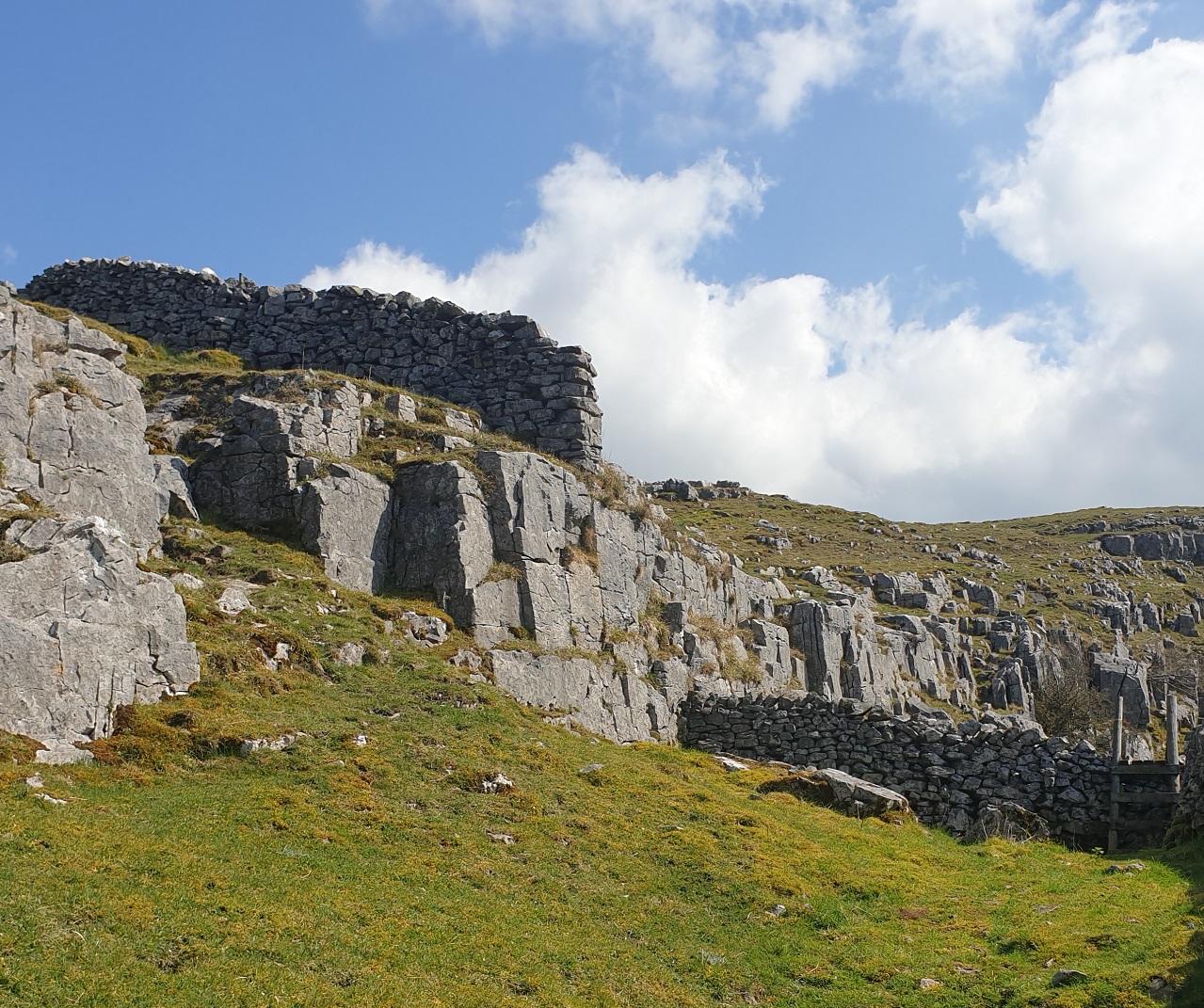
At Bents, near Newbiggin-on-Lune on the edge of the Westmorland Dales, red sandstone and pale limestone are strikingly juxtaposed. Huge rounded knolls and whalebacks of faded red-brown sandstone, mottled with white lichen, push up out of the moorland and pasture. And running alongside them, over them, around them, leaving narrow paths beside them, occasionally incorporating a boulder’s bulk in the boundary, is the purposeful line of a limestone wall; a barrier between the grazed green farmland and the moor. The wall is tall and well-fettled, built of shallow, sharp-edged plates of limestone; it is a double wall, with large flat through-stones, and coping-stones that are tightly-packed and tilted. High and solid, it is a daunting challenge even for adventurous sheep.


At the eastern end, near Bents farm, names have been carved in the sandstone boulders. Many are weathered and, part-obscured by lichen, are difficult to read; the beautifully-engraved J Smith (or is it Smillie?) Bolland dates back to 1888; other names are even older.


Nearby, layered shelves of limestone – the origin of the stones for the wall – peep out of the eroded side of a hill. Here it’s easy to see the dramatic mix of the two types of rock, the Ashfell Sandstone Formation, which is part of the Great Scar Limestone Group. According to the information on the Cumbria GeoConservation website, “ The Ashfell Sandstone Formation is interpreted as the deposits of a river-delta system that spread into the shallow carbonate seas that covered this area during the early Carboniferous. Thick sandstone layers, like the one at Bents, may represent sands deposited in large river channels or as offshore sand bars. The reddish colour is due to the presence of iron oxide and suggests deposition near an arid shoreline.”

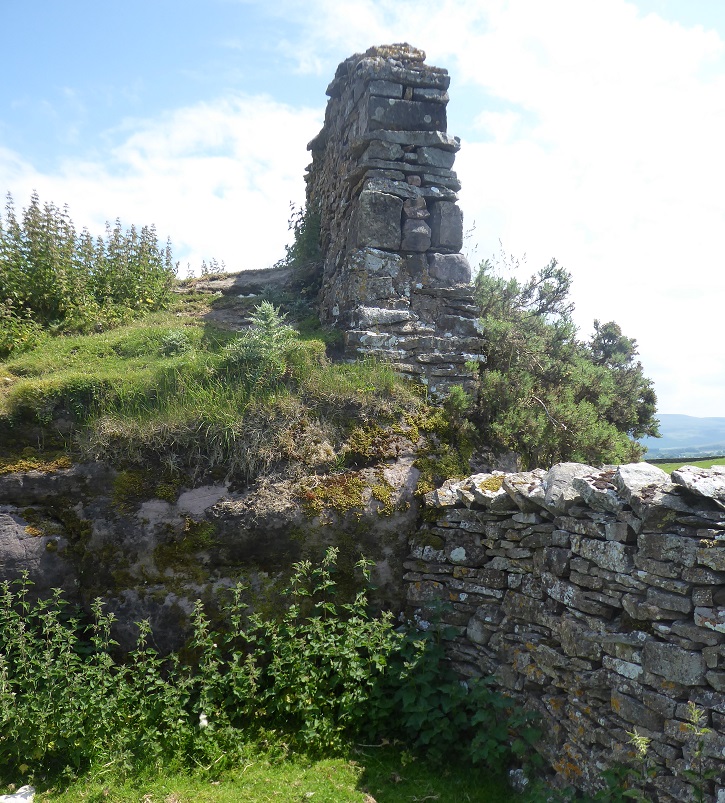
Where the limestone wall jumps to the top of a Bents boulder, the waller has incorporated chunky sandstone blocks to give the free end extra stability and majesty: limestone and sandstone intermingling their organic and inorganic origins.
Not far away, next to Natural England’s Great Asby Reserve , we are looking for something marked on the OS map as ‘Thunderstone’. On our left, a rubbly, part-tumbled limestone wall, and the clatter and growl of an approaching, as-yet hidden, quad bike. The noise stops, there is some muttering and swearing, and a man, round-faced and with thick brown hair, dressed in a mud-smeared jacket, appears by a gap in the wall. Although surprised to see us, he grins and asks, ‘All right, then?’, and we chat about the weather, and how the yows will always break down the walls. ‘Look at this!’ He gestures at the fallen stones, which he has come to fix. ‘See, it’s just bloody rubble round here – no good for walling.’ It’s true, on this stretch the limestone is fragmented and irregular, and the wall is only a single layer thick and barely four feet high: a determined tup could send it flying. We ask about the thunderstone and are told, ‘it’s just along there, you’ll see it on the corner’. And so it is, a smoothed, rounded boulder with the wall built around and on top of it. It’s a little underwhelming in terms of size, but its provenance is greater – an ‘erratic’, a boulder that was once caught up in the ice of a moving glacier; a boulder that was seized from another area, a different type of rock – Shap granite – carried away and dropped where it didn’t belong; and now incorporated in a dry stone limestone wall. [2]

Although it might seem odd that the farmer’s wall was ‘bloody rubble’ compared with the grandeur of the nearby and more recent wall around the Great Asby Scar Reserve, this reflects the properties of the local rock – wallers use the rock that is ‘to hand’. The pavements on the Scar are themselves very varied in structure and appearance, depending on how the limey skeletons were deposited and subsequently eroded. This new wall around the Reserve’s perimeter is nearly two metres high, built of blocky stones, with two layers of projecting throughs, and sturdy, slanting coping stones. It is a text-book example of ‘how to build a dry stone wall’.
‘Dry Stone Walling, a practical handbook’ [1] makes surprisingly gripping reading! I read it at breakfast and over lunch, enjoying the technical terms and their local variations, showing diagrams to my husband (who has done a fair bit of walling himself).
‘Dry stone walls are semi-flexible structures,’ Brooks and Adcock explain, ‘with the stones settling over time. The basic principles involved in building a dry stone wall are aimed at reducing the potential for movement during this settlement.’

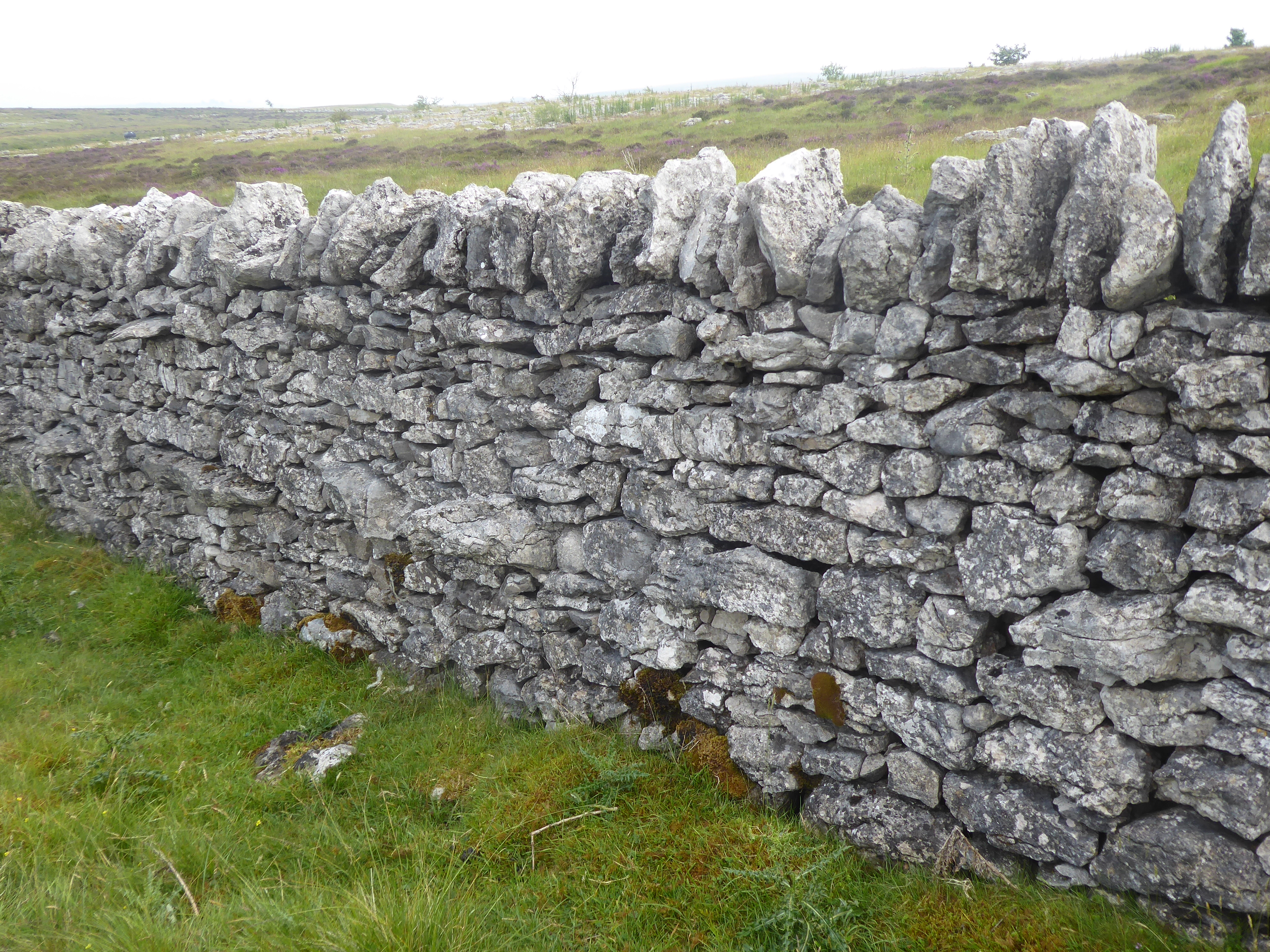
So there are the footings, which support two faces of stone courses; these are held together with throughs that straddle the wall, connecting one face with the other, ‘tying the two faces together in a single unit’ and stopping them bulging outwards. The interior of the wall is filled with rocks – without the filling (also known as packing or hearting), the face stones would settle inwards and the wall would collapse into the centre. Finally, a row of coping or topping stones caps the wall, weighing down and bonding the faces below, and protecting them and the filling ‘from the weather, animals and people’. The angle of each vertical face to the horizontal is the ‘batter’, for which a frame or template is sometimes built. There are many variations in style or height or shape, depending on the local stone and what is required of the wall – sheep (especially Herdwicks) are more agile than cattle and need a higher barrier.
Waller Arthur Robinson talks with humour about long stones and flat-sided stones, and the ‘golden rule’ of wall-building, placing the stones “one over two, and two over one” in a delightful ‘Countrystride‘ podcast with Mark Richardson [3].


The Great Asby walls are tall and ‘tight’ – they march across the moor with straight lines and sharp corners, but walls nearer to the road are freer and more curvaceous, as they drop down into the shallow valley. Walls wiggle to avoid obstacles, such as sinkholes or springs or patches of bog. In areas where there is a shortage of stone and the wall is only one stone thick, wiggles might also be constructed to give the wall strength, against the lateral pressure of the wind. (Such sinuously-wiggling walls, usually built of brick rather than of stone, are known as ‘crinkle-crankle’ walls.)
Last summer, while walking past Opinan, near Laide on the NW coast of Scotland, we stopped to chat to a woman who was clearing vegetation off a single-thickness drystane wall right by her house. The stones there were sea-worn boulders, balanced apparently precariously on each other, and she said that she had been told that because the wall looked unsteady, with gaps revealing the view on the further side, sheep would not climb it. (Our conversation led, of course, to Herdwicks – for it turned out that the woman, who had lived there for 30 years, originally came from Cumbria.) In their book, Brooks and Adcock also refer to this style of wall: ‘Single dyking is surprisingly stable, but looks so unsteady that all stock, including the notoriously adventurous black-faced sheep, are supposed to be deterred from climbing it’.

Limestone is rarely used in single-thickness walls – it’s more usual to use tougher stone like granite (as at Kippford on the Scottish side of the Solway) – but on the fellside amongst The Clouds near Ravenstonedale, there are scrappy limestone walls, some single, some built from stones cleared from the fields around the now-derelict Harry’s House. Many of the walls not ageing well, and are strung about with posts and wire.
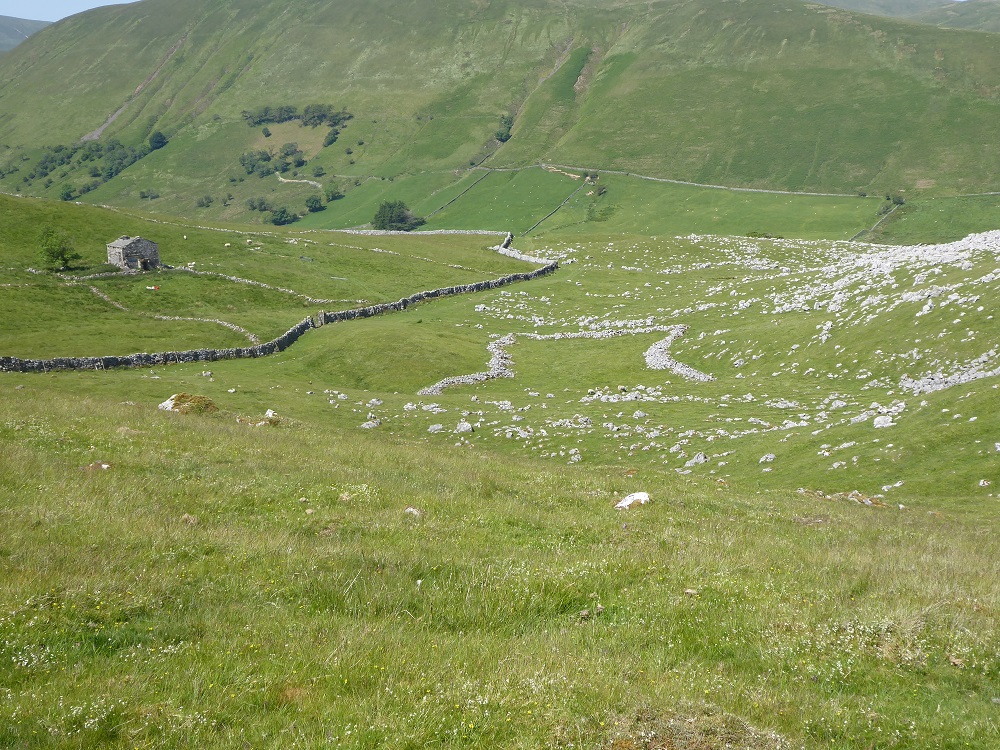
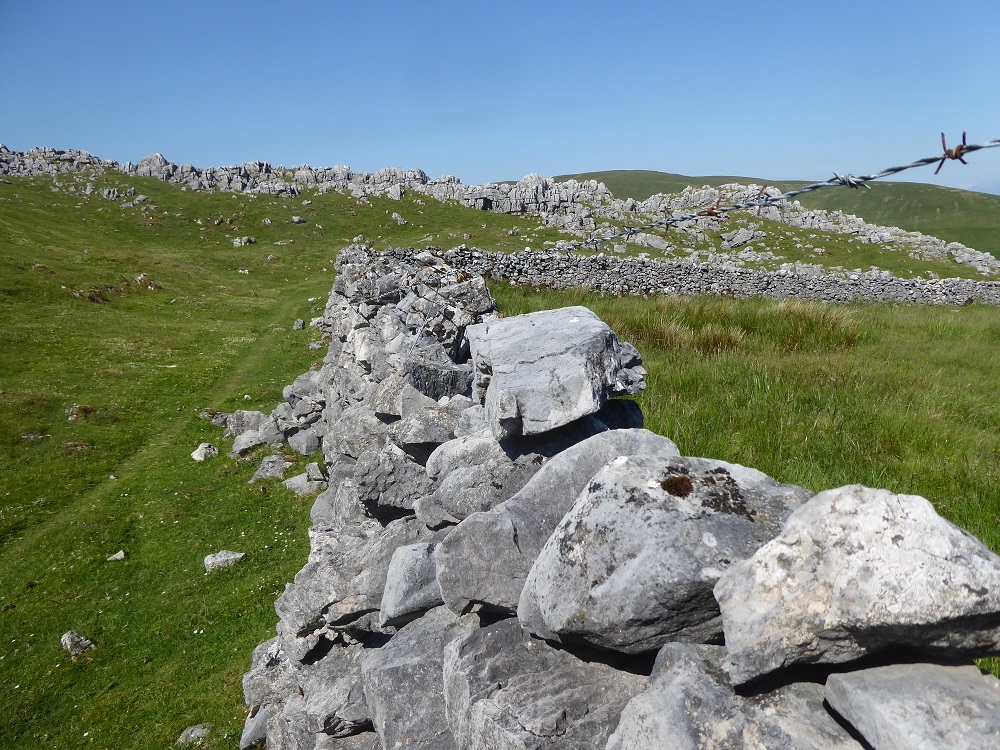
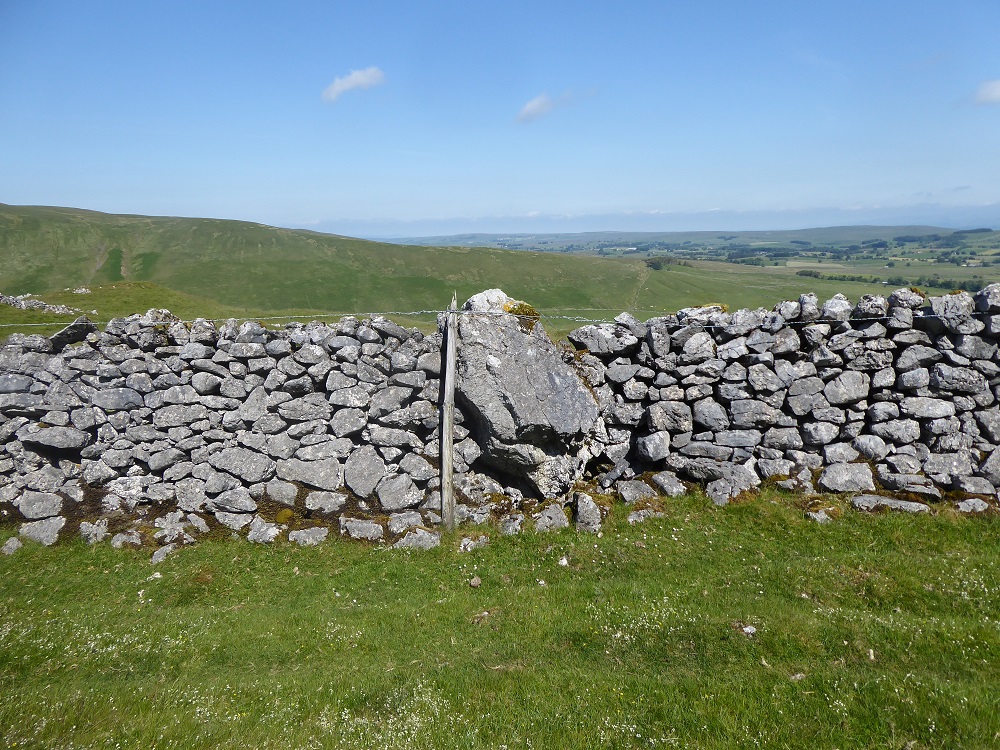
I’ve written elsewhere about the grikes and clints of my local limestone pavement at Clints Crags, but it is the dry stone walls along the northern approach that I love most. They urge me to examine them, carefully; there is a strong sense of human stories, and of the wallers’ understanding of the stone and the land around them. The walls each side of the narrow, grassy, occasionally boggy, track differ markedly from each other, indicative of different wallers for different landowners.
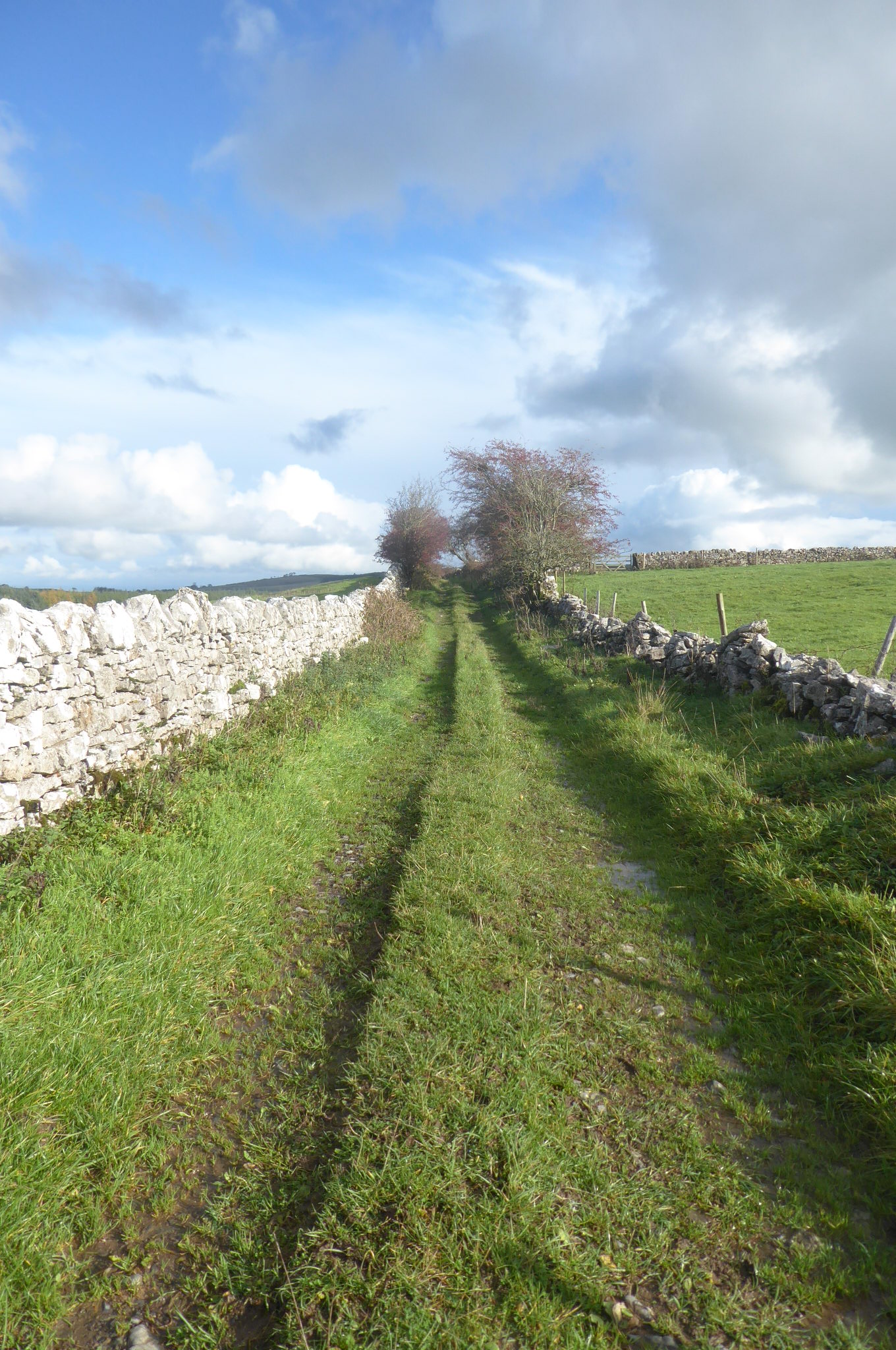
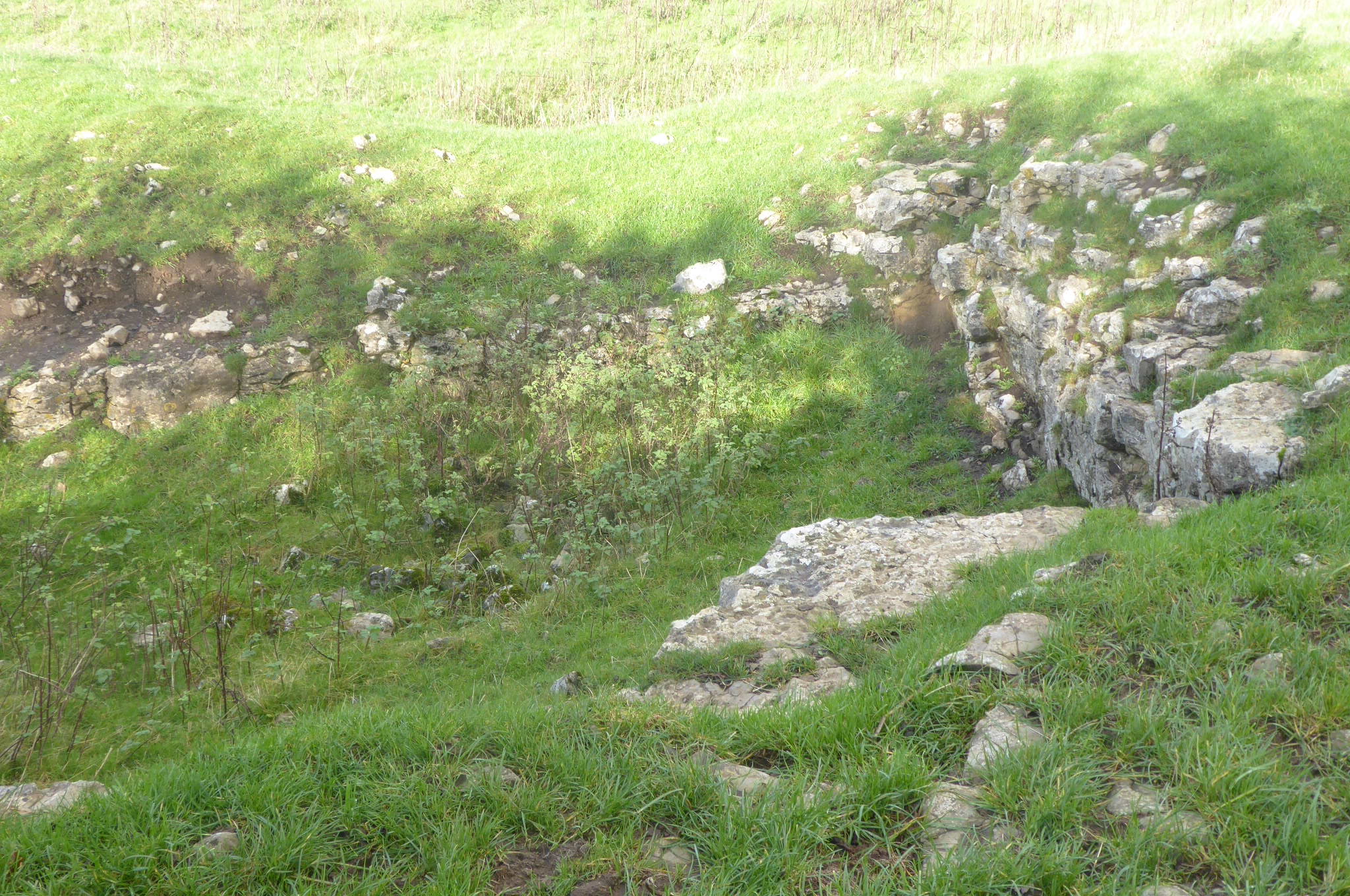
On one side a stretch of wall is intact, constructed of chunky blocks and with large coping stones. There is an unusual pit, looking man-made rather than a natural sink-hole, in the field beyond. The fraying blue twine that fastens the nearby metal gate to its sandstone stoop has been chewed by the sheep to make a tangled knot, so I climb over, and poke around in the shallow, rectangular depression in the field. It has clearly been a small quarry, hacked out by the wallers as a source of stone: water-worn vertical joints and horizontal layers have presented the limestone in handy blocks, ready for prising out and manoeuvring to the wall.


Further along the track, and abruptly, the copings vanish and the courses of stones on the face are loose and ill-fitting. In places the wall is scarcely double, more of a hybrid with a double base and single upper part; many of the stones are thin and flaky. Not all are limestone – there are broken pieces of terracotta floor tiles, still with cement adhering; there are occasional small round ‘erratics’ of grey granite; and other stones coated with a red crust, which I can’t identify.
The wall on the left had been a low jumble of stone, but now it gains height and becomes tight and topped. It wiggles sharply – and when I climb up to look, I see that the waller has had to divert around a sinkhole. Further on, the wall rises and falls, taking its footing on a small hummocky outcrop.

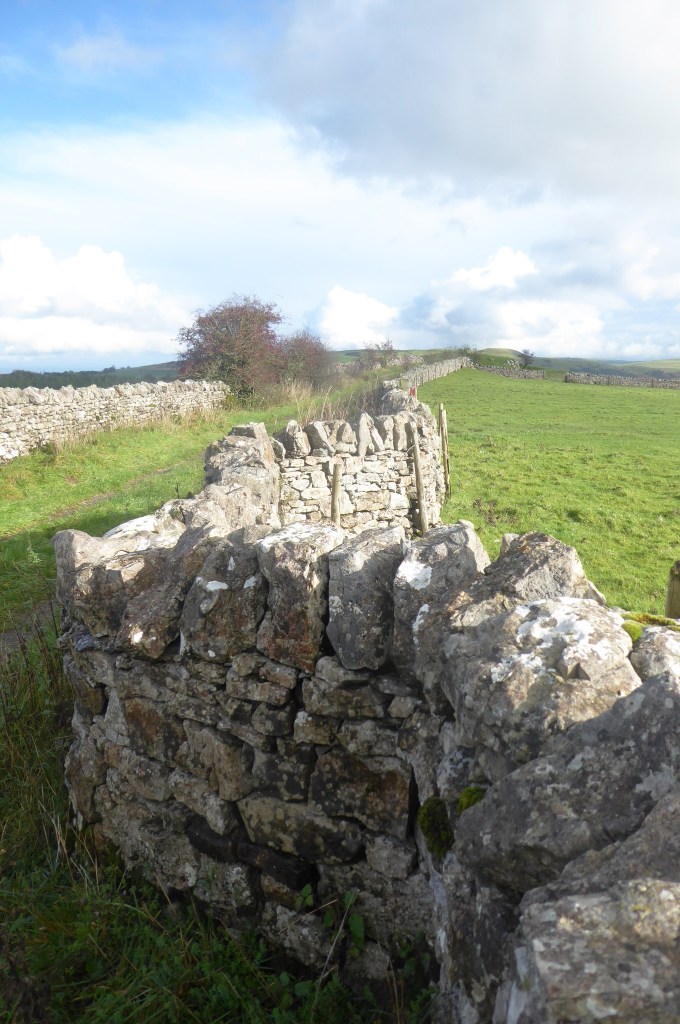
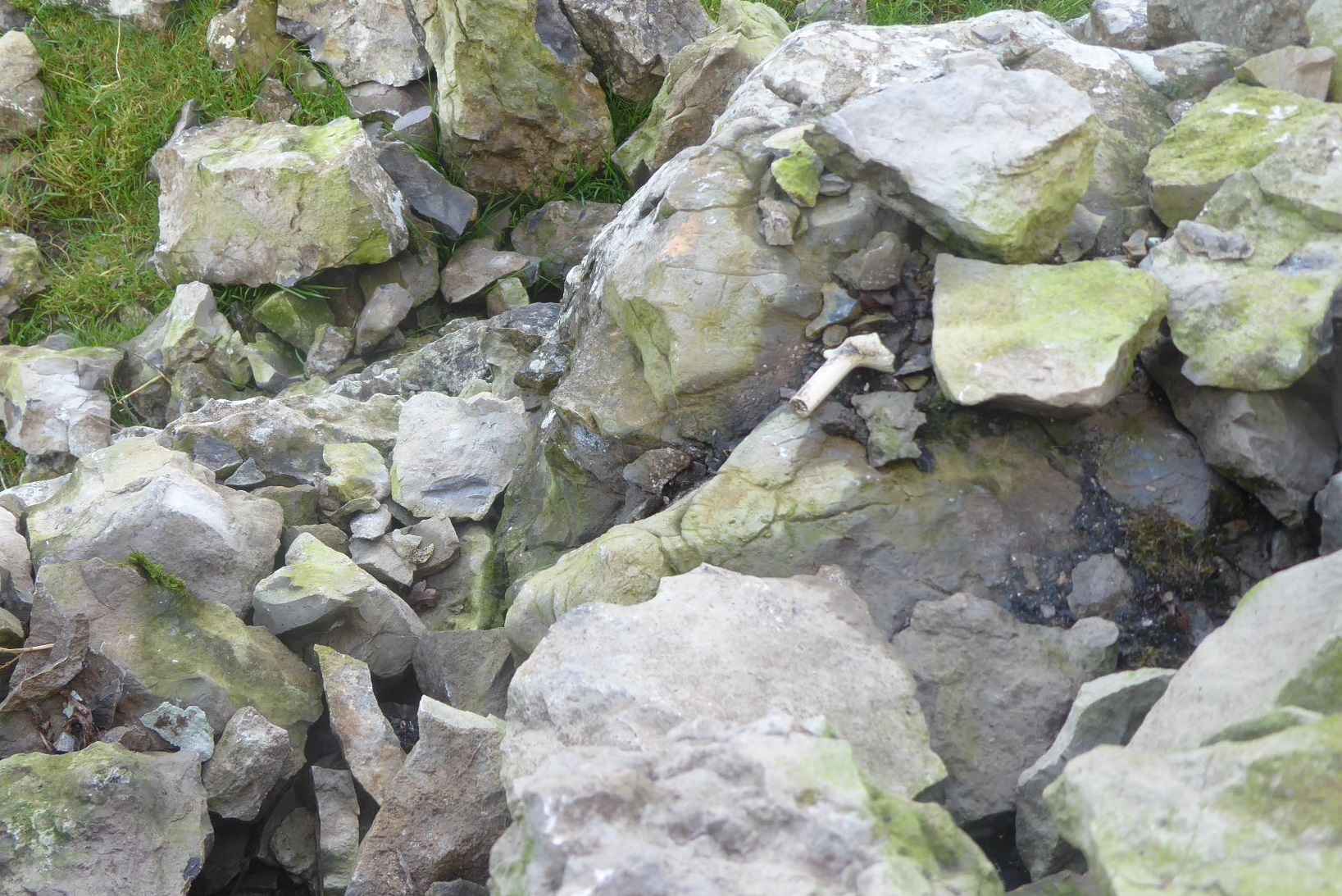
The neat wall on my right now degenerates into little more than a hopeful boundary. Sheep and the weather and old age have taken their toll on its integrity. In the field beyond, a Border Leicester tup, long-legged and Roman-nosed, stares at me imperiously from where he is standing possessively by two Swaledale ewes. I wish him ‘good morning’ and stare back, and then the light glints on something smooth and out-of-place in the interior of the tumbled wall: not a bone, but the stem and part of the bowl of a clay pipe.

Note:
This blogpost is part of my former ‘limestone lockdown’ project. For an Introduction to the project, and a guide to the list of related posts, see Limestone in the Lake District: an Introduction – and the ‘categories’ list in the right-hand bar.
[1] ‘Dry Stone Walling, a practical handbook’. Alan Brooks & Sean Adcock, illustrations by Elizabeth Agate & Linda Francis. 2nd ed 1999. Publ The Conservation Volunteers. https://www.conservationhandbooks.com/dry-stone-walling/
[2] For more about thunderstones (the erratics, not the fossilised sea-urchins which are also given that name) watch the interesting talk by Sylvia Woodhead about the Westmorland Dales (from 29’25”)
[3] Arthur Robinson on drystone walling. Countrystride podcast (from about 8 mins in)
 Solway Shore-walker