
Tubularia: its delicate tentacles wafting in the current, its stalks swaying gently, its body glowing crimson-red despite the sediment-laden tide. It’s not a plant, it’s not a sea-weed: it’s an animal which is related to sea-anemones and jellyfish, and a member of the group (Phylum) of invertebrate animals called Cnidaria.

And this year, there are dozens of them in the area of the honeycomb reefs of the Marine Conservation Zone (MCZ) below Dubmill Point.
My group of shore-walkers are laughing at my whoops of delight – it’s only the second time I have found the ‘Oaten Pipes Hydroid’, or Tubularia indivisa to give it its proper name. The first time was of a single small ‘colony’ several years ago – but for some reason this is a year when they have decided to make the MCZ their home. It’s good that there are several because they are ‘dioecious’, in other words each colony is single sex and not hermaphrodite – it takes two colonies to produce babies.

Tubularia’s lifecycle is fascinating, a cross between that of a sea-anemone (a polyp, a sedentary creature) and a jellyfish (a medusa, male or female, which wafts around the sea, free to roam). A sea-anemone may release eggs or sperm, and these fuse to form a fertilised egg which develops into a minute free-swimming larva – this settles down on a firm surface and grows into the adult polyp that you will recognise, with a colourful column containing its gut, and tentacles around its mouth.
Eggs or sperm of free-swimming jellyfish are also released into the water. The larvae that result from fertilisation also settle down – but then each grows into a small column that starts to split horizontally, ‘transverse fission’. It looks just like a stack of plates, and each plate develops into a tiny jellyfish. These eventually split off one by one from the top of the column (which has the poetic name scyphistoma, sky-fist-omah) and swim away.
Tubularia does things differently. A larva settles down and starts growing a long stalk at the top of which it grows two rings of delicate tentacles. If another larva settles next to it, their ‘feet’ grow together and they form a group, a ‘colony’ (unlike a coral colony where the settled polyps bud off other identical polyps asexually). Then, at some stage tissue buds grow out from near the mouth at the top of the stalk, and each swells and develops into a sac-like extension; this is actually a highly-modified medusa which stays attached to the polyp. Let’s give the sac its proper name, the gonophore, because I do love the ‘naming of parts’! Like a free-living medusa the gonophore produces either eggs or sperm – so each colony is of a single sex. Sperm wafted on the currents enter the female gonophores on other colonies and fertilise the eggs, and in time the larvae swim out of their ‘container’ and settle down.
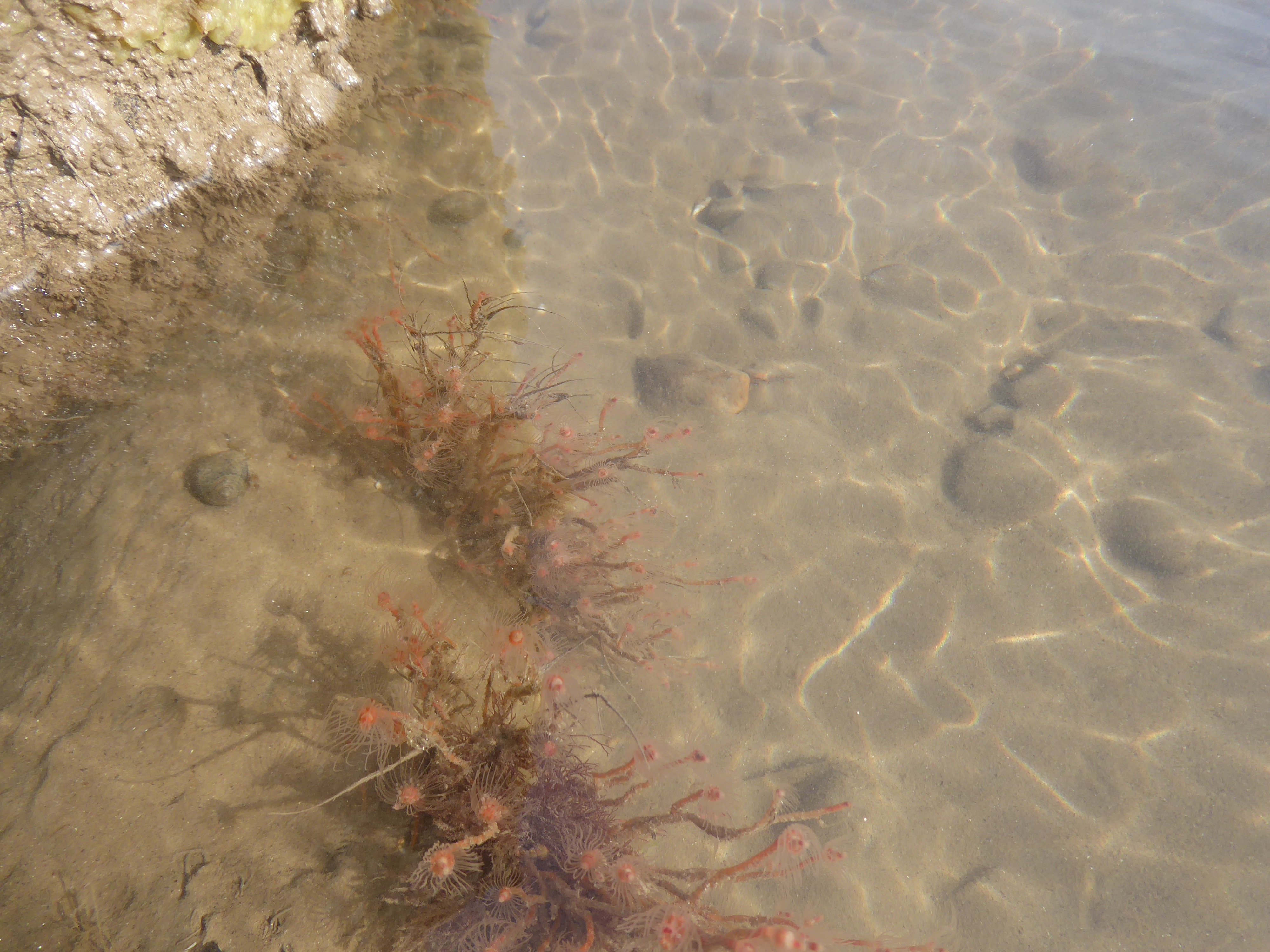
Some of the Tubularia we found on that exciting morning on the lower shore had red grape-like clusters amongst the tentacles, and these were the gonophores. The animals reproduce in Spring and nudibranch sea-slugs reputedly like to browse their juicy-looking red tentacles and gonophore, so we were there at just the right time.
I too have been browsing, on research papers about the evolution of colonies within the Hydrozoa (the sub-group of Cnidaria to which Tubularia for example belongs). I’ve had to look up a few words: ‘Coenosarc’ – a living body held in common by many organisms … by which they are in connection with each other’ particularly delights me. There is also ‘philopatric’, relevant to larvae which ‘tend to return to or remain near a particular site or area’. Loving their homeland: just like Cumbria’s Herdwick sheep who are hefted to their home fells.
 Solway Shore-walker