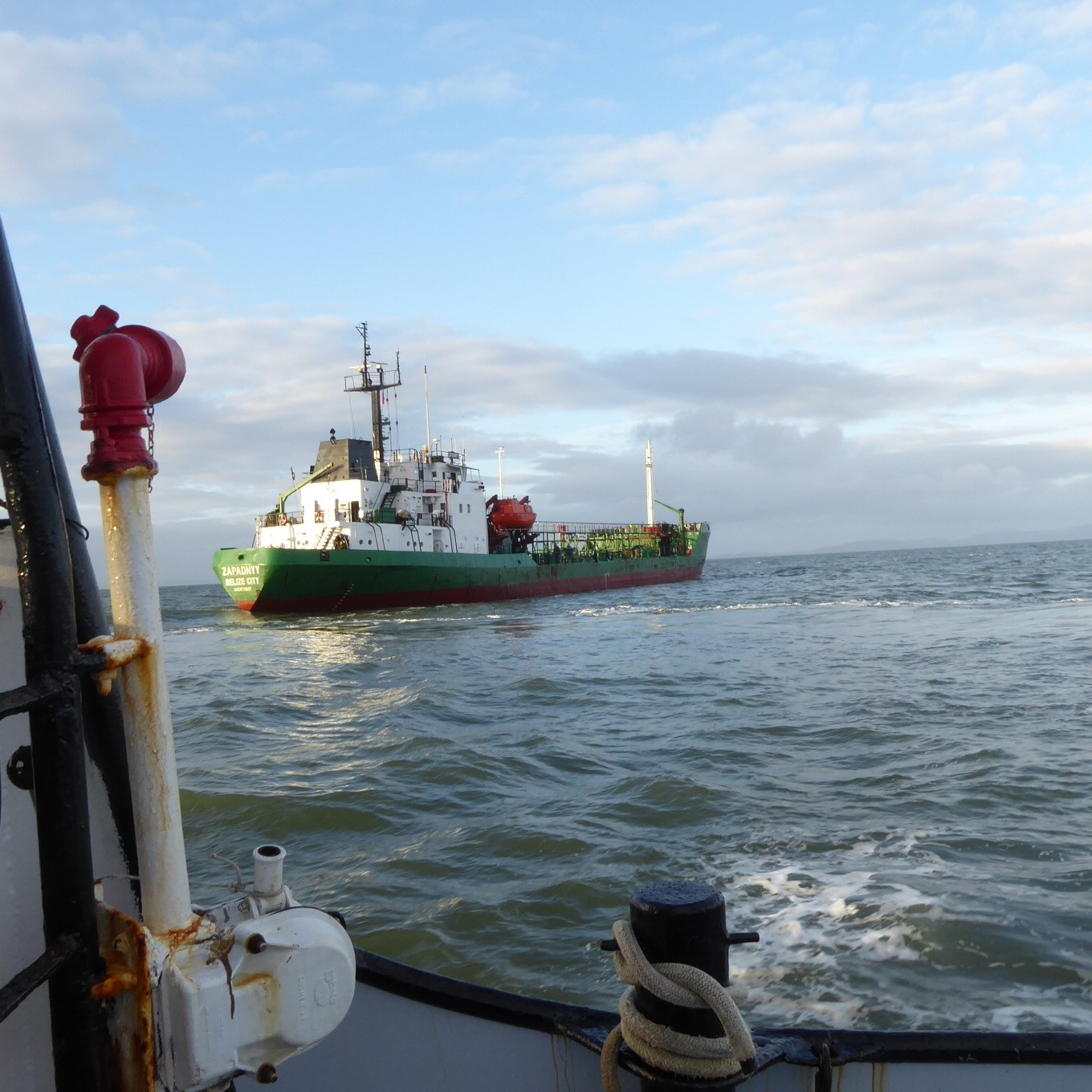
Goldilocks would have liked the tanker Zapadnyy’s cargo: molasses, at just the right temperature, not too hot and not too cold. Transporting molasses is tricky – it must be kept fairly fluid, so heating coils warm it to 24oC in the ship’s hold. If the molasses is too cold, it is impossible to discharge, but if it’s too warm it undergoes a Maillard reaction, an exothermic reaction which turns it into caramel. Eddie Atherton told me that “it’s like coke! I’ve seen people having to take a jack-hammer to it to release it.”
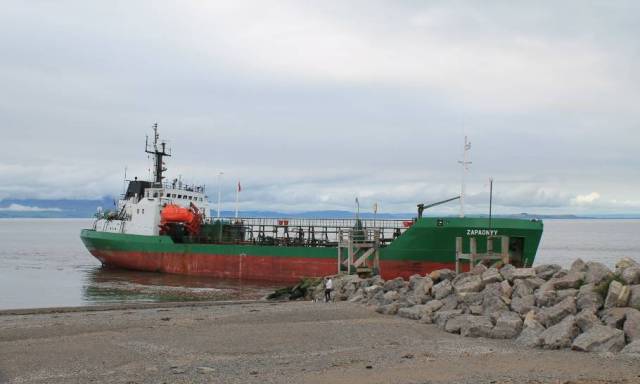
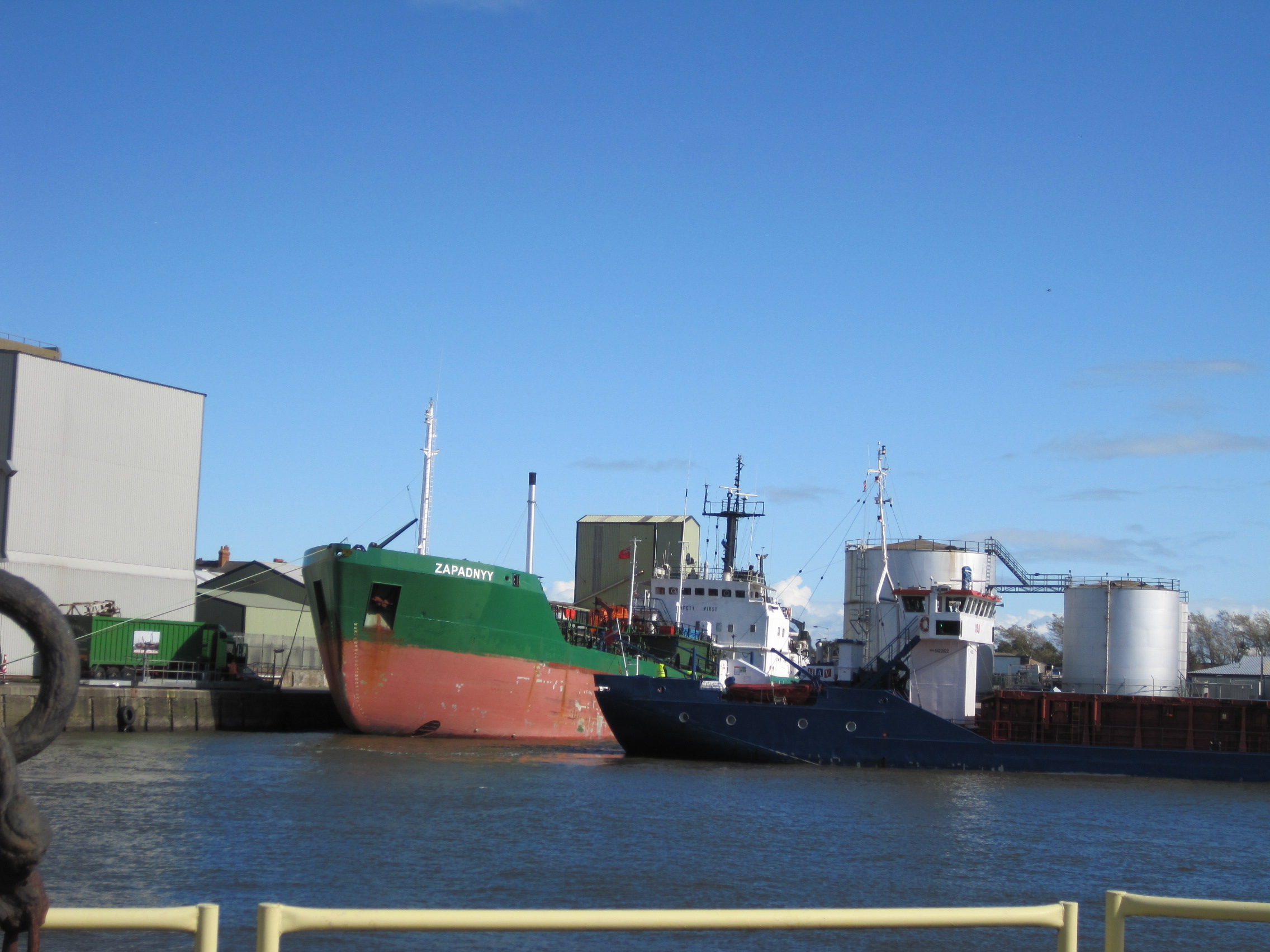
The Zapadnyy, molasses cargo discharged, at the port of Silloth
Eddie, now retired, was Production Manager at Caltech-Carrs Milling, based at the Port of Silloth on the Solway and it’s there – to Silloth – that Zapadnyy is bound.
She’s my favourite ship on the Solway, a ship whose erratic behaviour collects stories. I first heard about her in connection with some emergency welding that had to be carried out on the dock, and all the Silloth pilots have stories to tell about her. “She’s unmanoeuvrable!” (Bill Amyes); “It’s anybody’s guess which way she’s going to go” (Ed Deeley, pilot and former Harbour Master); “She’s got such a broad beam. It’s like trying to steer a coracle” (Chris Puxley, pilot and former Harbour Master).
Ships longer than 50metres going up the Solway Firth to Silloth must take on a pilot from just off the Port of Workington. It’s a 90-minute voyage with known and occasionally unknown hazards: the Admiralty chart shows uncharted areas and ‘Changeable depths’, and the pilot and ship’s Master must negotiate the English Channel – limited to the North by the Workington Bank – then pass through the Maryport Roads followed by a wiggle North/North-East through the shifting channel off Allonby Bay (see Piloting a ship to Sillothfor more stories).
This afternoon, Sunday 13th January, Zapadnyy is due in to Silloth, and Workington’s Harbour Master, Russell Oldfield, has offered me a trip out to the ship on the pilot boat Derwent. At breakfast time, I watch Zapadnyy’s red icon on the live shipping website, making her way up the Irish Sea, turning East into the Solway, and slowing and anchoring off Workington just after 9am.
The Marine Traffic website gives all her details, her tonnage, her deadweight (weight including cargo), her length and breadth (77m x 14m) and more. She’s an old ship, built in 1988, and she’s registered in Belize – but I know that she has a crew of Russians and Ukrainians who, despite political differences, apparently co-exist amicably in this confined space.
The Solway’s English ports – Maryport, Workington, Whitehaven and Silloth – can only be entered at High Water and only, in Zapadnyy’s case, during daylight, so now she must wait off Workington for the late afternoon high tide.
But the wind has got up and the rolling brown waves on the Firth are streaked with white. The forecast is bad – a north-westerly wind, Force 5 or 6, increasing Gale Force 7 later in the afternoon. Tim Riley, pilot and Silloth’s current Harbour Master, phones me at midday – none of us will be going anywhere today.
I watch online as Zapadnyy’s icon swings round to the South-West and increases speed, direction 200o. She will sit out the gale elsewhere, heading out into the Irish Sea and then sheltering off the Isle of Man overnight: no shore time for her crew tonight.
Monday January 14th: the wind has moderated and I see that the tanker is back off Workington, speed 0.0knots – her crew waiting, again. The next high water at Silloth is at 1702h; pilot Tim will need to board Zapadnyy at about 1500h, so the Derwent will be setting out to meet her at about 1430h. At Workington’s Harbour Office I’m directed towards the far end of the dock where the Derwent is moored.
Pilot boat and harbour tug Derwent by the dock gates at Workington
Since I last wrote about the port there have been many obvious changes: the green bund of plastic-wrapped bales of Solid Recycled Fuel destined for Latvia has disappeared, as has the pyramid of incoming gypsum. The main cargo entering the port these days is timber and wood-pulp for the paperboard mill Iggesund: stripped tree-trunks are piled like small mountains, new ‘Wainwrights’ in the making. Black plastic pipes for West Cumbria’s new water supply wait to be transported to the scarred countryside. The port still receives cement, but the hoped-for container traffic did not happen, and the two enormous Nelcon cranes, iconic reminders of the port’s glory days, have been sold and are due to be taken away. The quays look empty and tidy, waiting for new business.
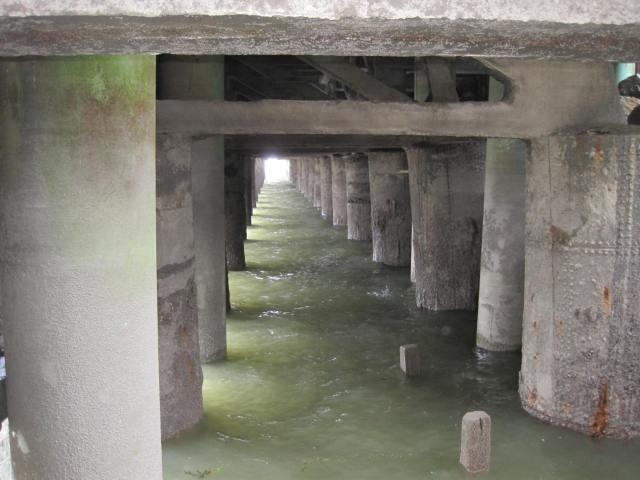
The Derwent’s deck lies fifteen feet below me, for the dock gates are open and high tide is still two hours away. Russell Oldfield is washing the deck. Despite my willingness to do so, he insists that I should not climb down the quayside’s metal ladder, and directs me to the far side of the dock next to the RNLI station (from where I drove the previous lifeboat,Sir John Fisher, two years ago) and the fretted metal ‘safety steps’. Oily water sloshes to and fro beneath them, and green and grey shadows shift and shape-change in this underworld amongst the concrete piers.
Under the quay
The cabin of the pilot boat – which is also the harbour’s tug – is surprisingly roomy and warm, and coxswain Phil Scattergood lifts a hatch to show me that there is a larger cabin below, with bunks and a ‘head’ (toilet). Then Tim and coxswain Ian Cormack arrive onboard, and immediately we are off, heading out of the gates and out to sea.
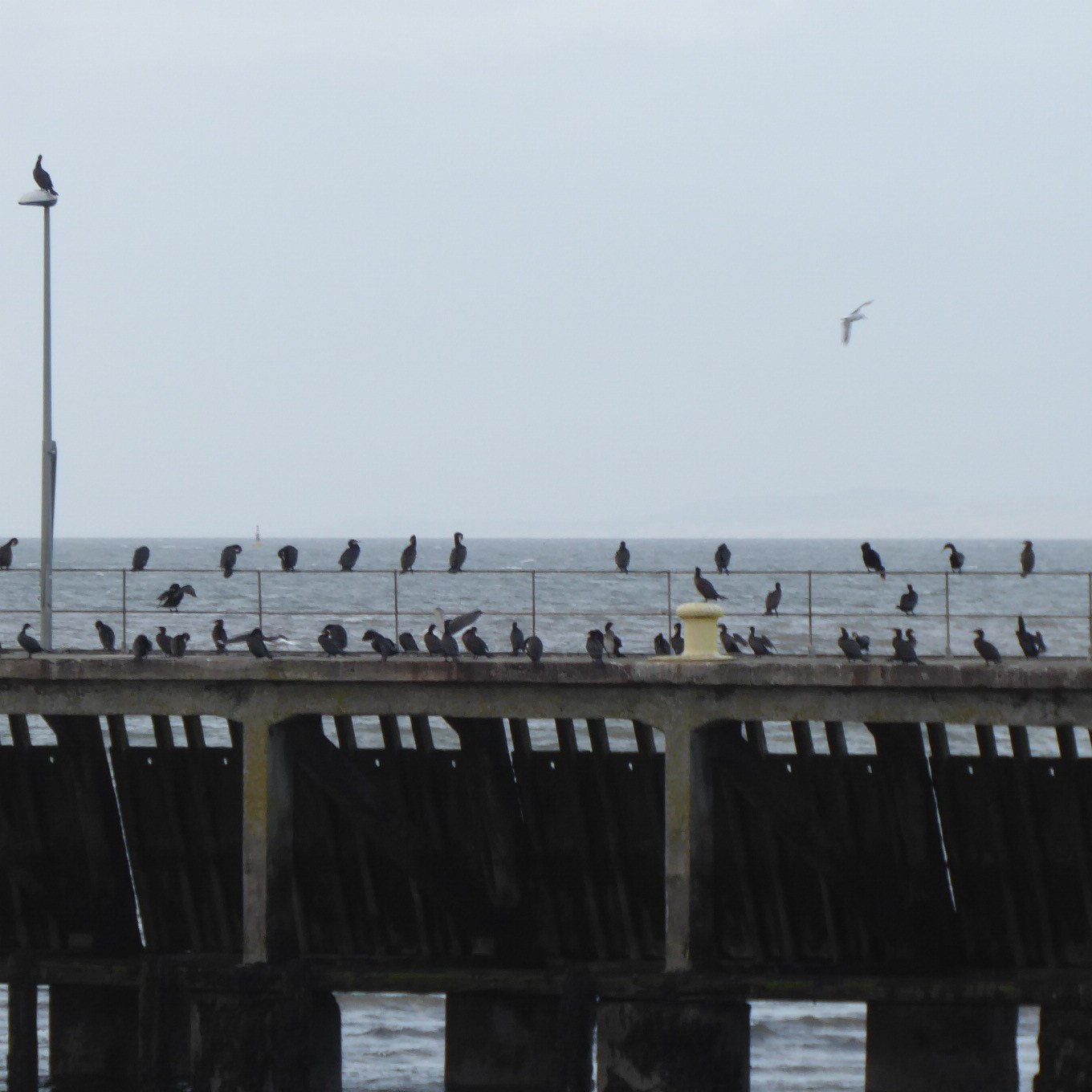
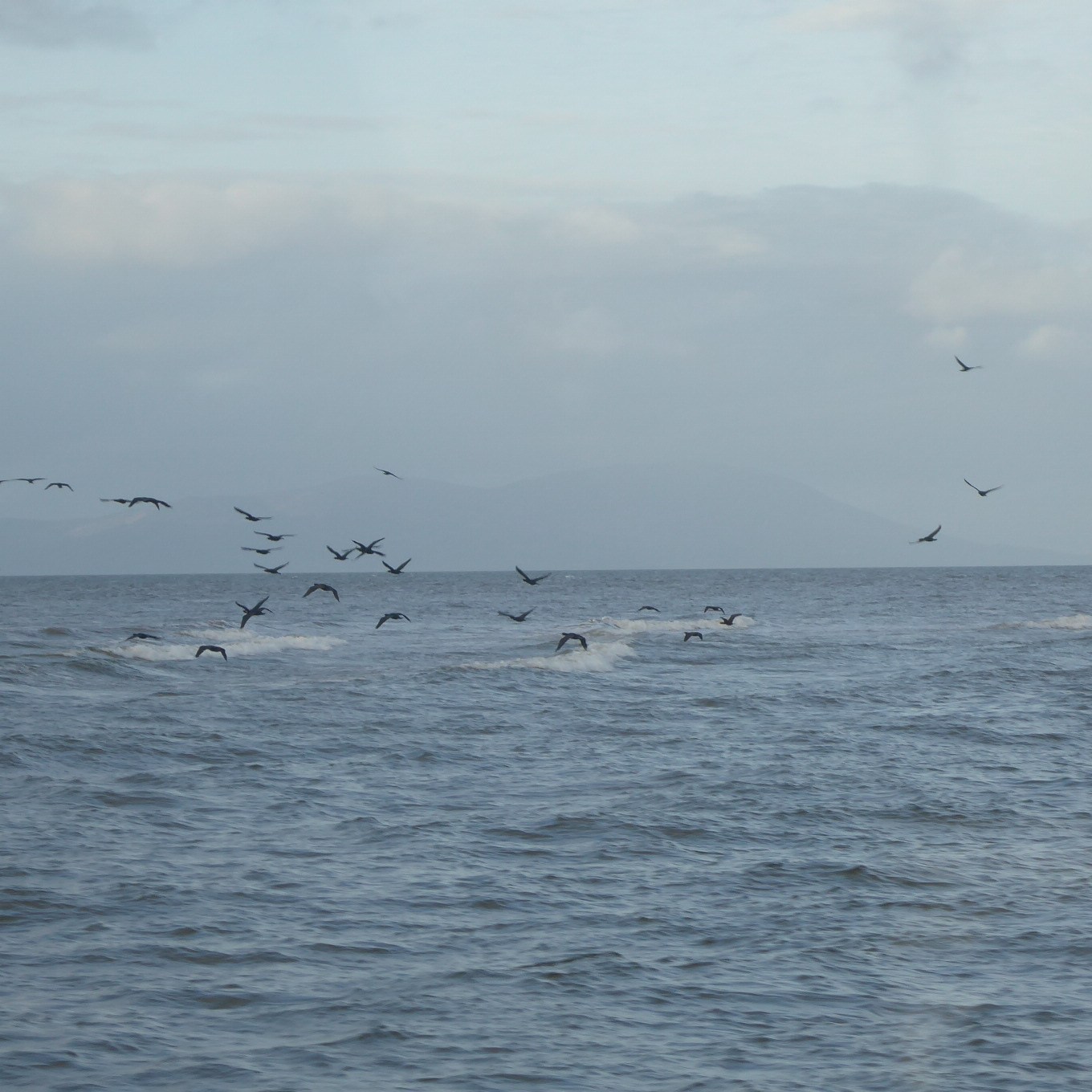
Dozens of cormorants perch on the railings of the breakwater, black as crotchets on a stave; a syncopated tune that falls off the edge of the page, its notes flying, as we roar by.
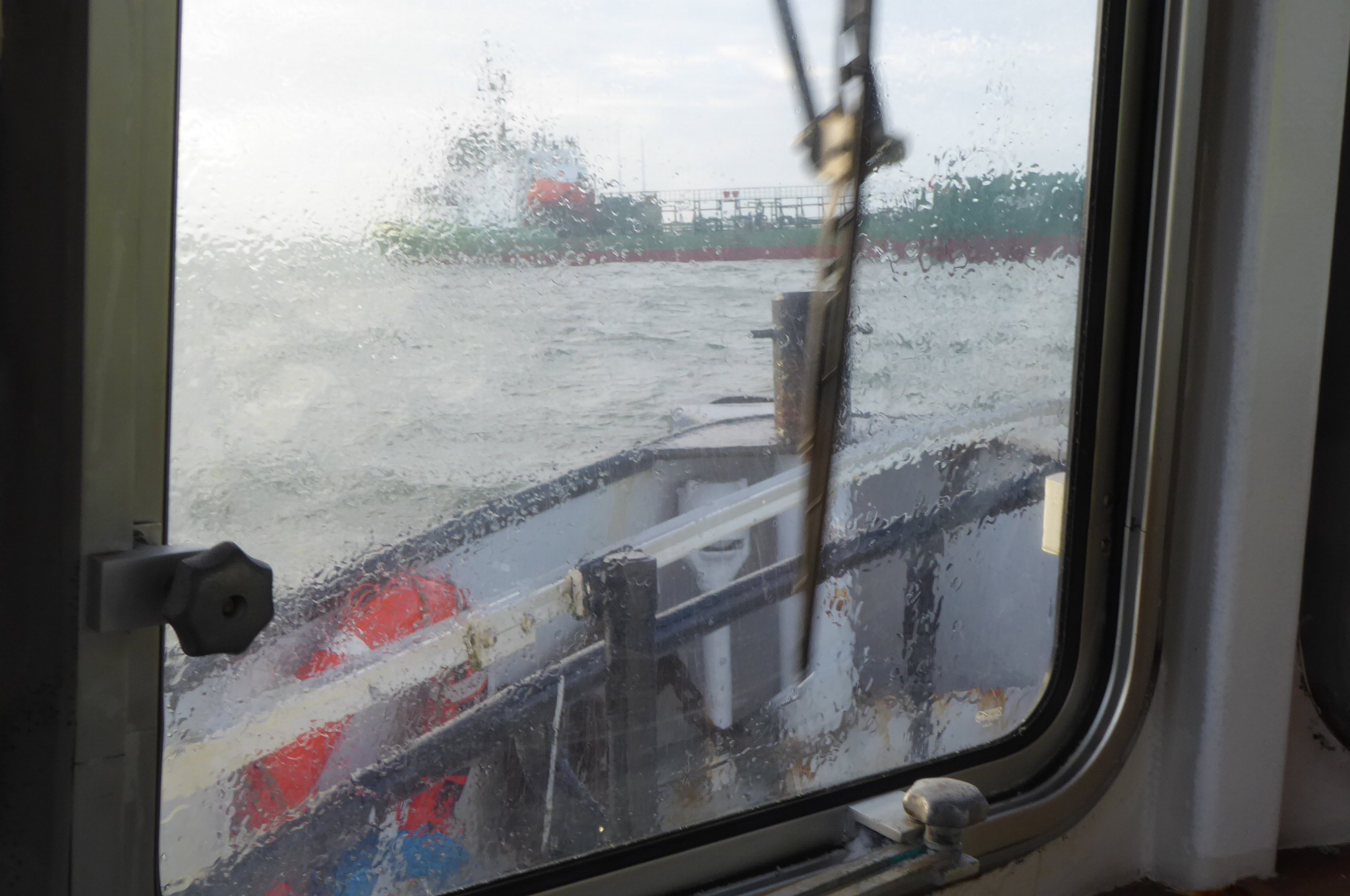
Out past the breakwater the swell is noticeable, and the view from the windows is bleared and distorted by blasts of spray as the bow plunges and slams into the waves.
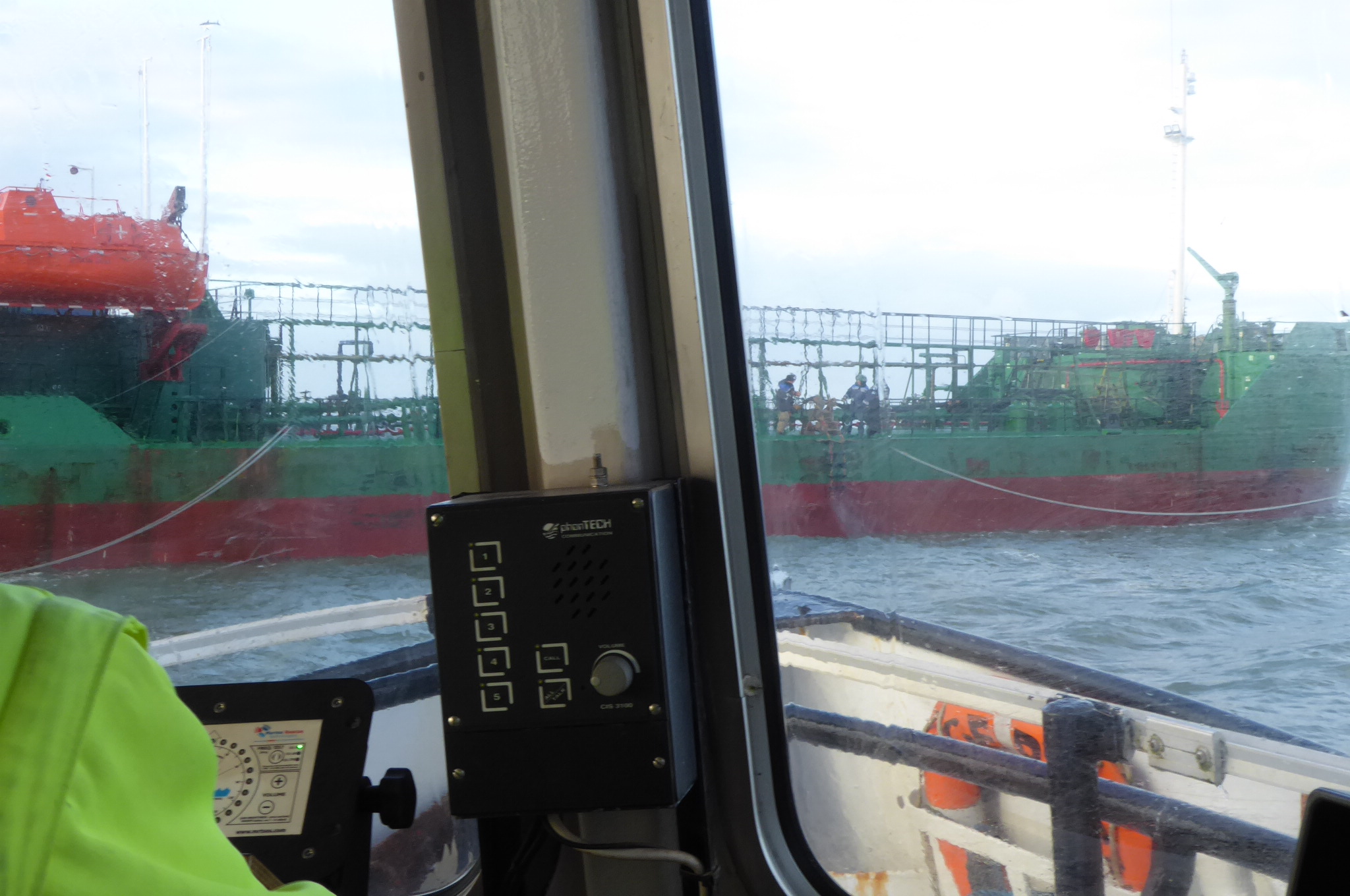
Zapadnyy is visible now, idling under motor, her bow pointing West, but she is of course expecting us, and as her captain and Phil talk on the radio, smoke puffs briefly from her funnel and she slowly turns around, wallowing gently, waiting. She has come up from Avonmouth, where she took on her cargo of molasses from a bigger tanker, but she is not fully-laden for her red-brown hull is partly visible.
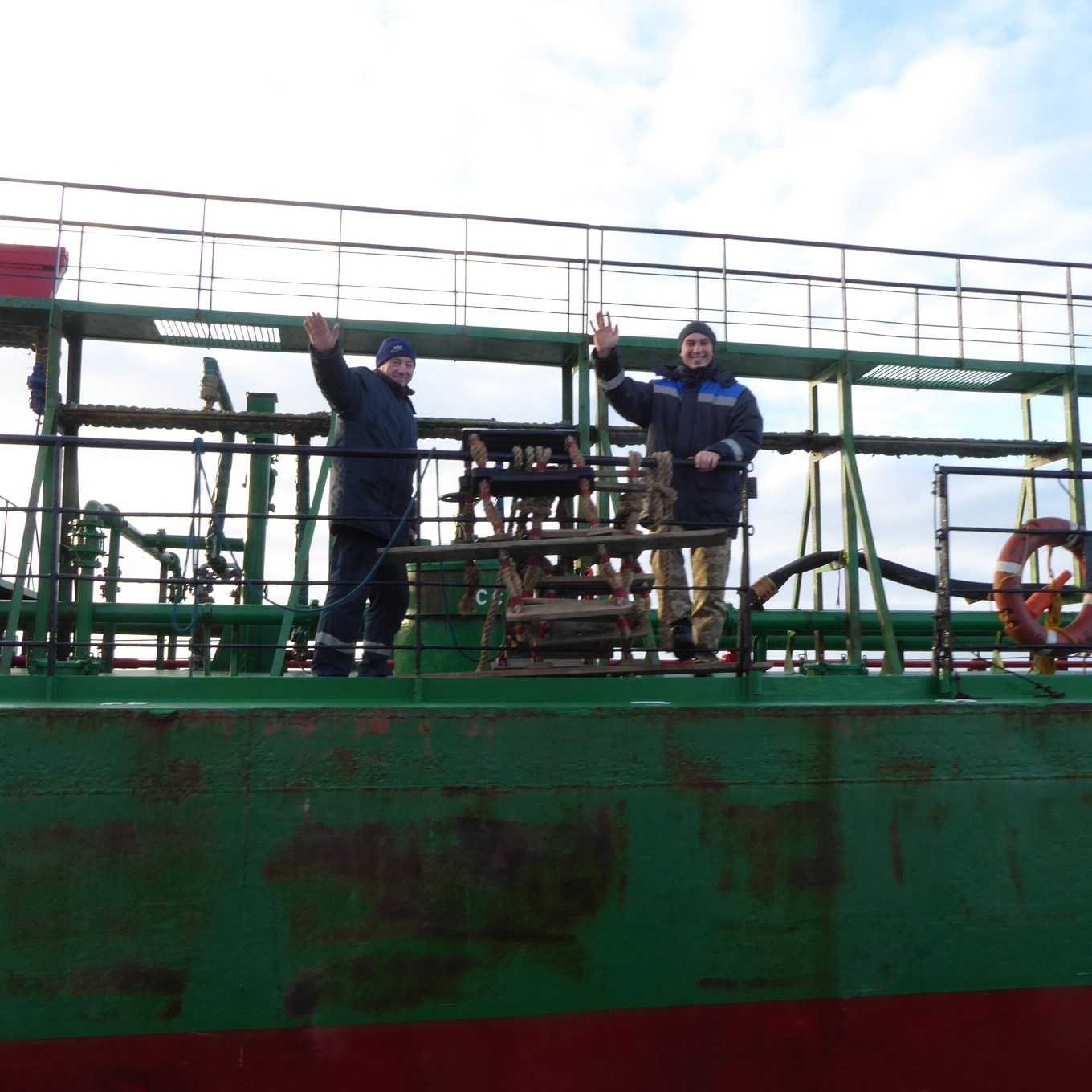
Phil slowly brings the Derwent along the starboard side, in the lee of the north-westerly wind; two of the crew are waiting to welcome Tim and – it happens so quickly that I miss taking a photo at the crucial time – Tim has climbed the short rope ladder and is aboard. Russell is laughingly sympathetic that I’ve failed to see and record the ‘pilot transfer’, the main point of my trip, and he and Ian say that Tim must be ‘camera- shy’. But Zapadnyy’s crew, rolling up the ladder, make up for my disappointment with their broad smiles.
In seconds, we’re going astern and the tanker is under way: the meeting of ships and humans of different nationalities, briefly united by the sea, has been terminated.
We loop away, and now Russell sits at a computer and Phil, watching another screen, steers us along a pre-ordained course towards the West. Under the terms of its licence to dredge, the Port has to check the movements of the dredged material where it has been dumped in the designated ‘Soil Grounds’ in the Firth, so now the boat’s sonar measures and records the depth along the current course.
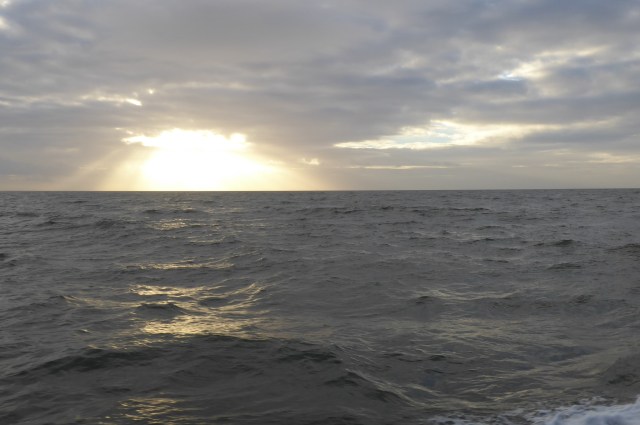
I watch, and feel, the rise and fall of the waves, and a guillemot takes off in a flurry of wings and running feet as the sun’s rays suddenly fan out from a hole in the cloud, gilding the surface of the sea.
Sunlight gilds the Solway
The dark prow of St Bees’ head stands out to the West, and the low coast around Workington is busy with turning wind-turbines and plumes of steam from the factories. A dark-grey catamaran, one of C-Winds’ service boats for the Robin Rigg windfarm, passes us in the distance, moving fast towards the port; its skipper is on the radio asking for permission to enter. Zapadnyy is disappearing up the English Channel, her green-and-brown hull merging with the coastline. The Derwent turns and heads back to port, leaving a spreading vee of frothing white water astern.
***
Zapadnyy heading up the Firth in the darkening day
Driving East along the coast road, I catch glimpses of Zapadnyy in the distance as Tim guides her through the channels up to Silloth. A smirr of rain hides her as she passes in front of Criffel, but soon she is slowly passing the harbour entrance, losing way, idling – waiting.
Someone comes down from the Harbour office to check the tide-gauge by the dock gate: he waves at me and shakes his head – not enough water yet for the tanker to make her entrance.
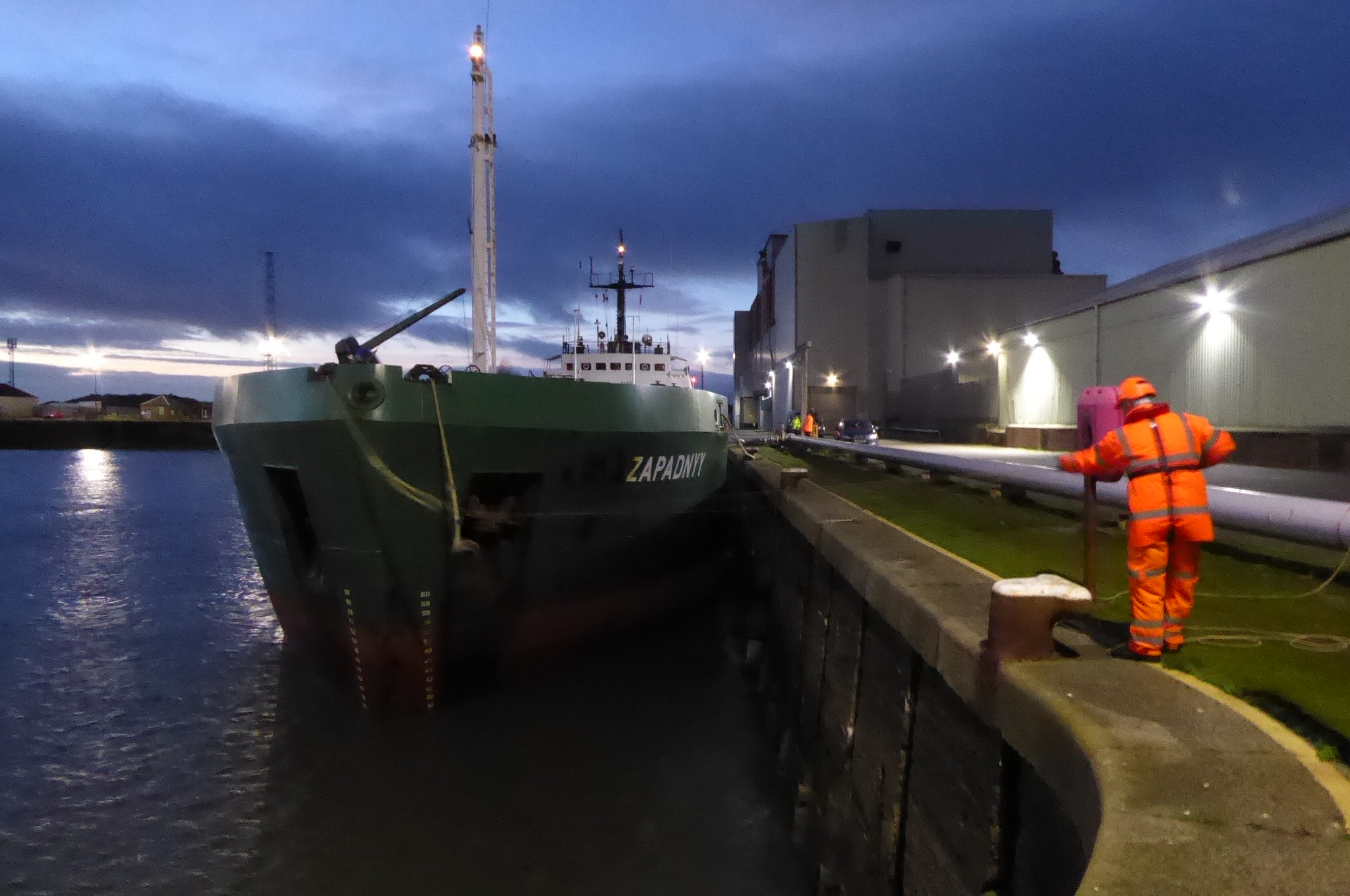
Fifteen minutes pass, and then her masthead riding-lights appear above the wall and she approaches gently, gently, delicately turning into the difficult entrance, sweetly gliding through the outer dock and setting the anchored shrimp boats swaying; gently through the narrow entrance of New Dock, and safely into port. It’s almost dark now, lights from the the warehouses glittering on the water and scattering as Zapadnyy manoeuvres to her own special place.
Her entrance was perfect.
But it has not always been so trouble-free. One of the photos on the Marine Traffic website shows her elsewhere with a spectacularly damaged bow. And here at Silloth, where wind and counter-currents at the harbour mouth make for a very difficult entry, she has on occasion rammed the dock wall – the incident when emergency welding was required – and, worse, on Ayr pilot John Munro’s watch, grounded outside the harbour on a sandbank.
The day the Zapadnyy got it wrong. September 13th 2016. Photo thanks to Danny Ferris, Solway Shipping
On that occasion, she had to stay put (much to the delight and interest of ship-watchers close by on the shore) until she could be hauled off on the night’s high tide.
This evening, though, she arrives quietly and calmly. The harbour staff in hi-vis are waiting on the quay, ready to secure the ropes and hawsers. She is declared ‘all fast’.
The crew wave to me again, and then busy themselves with their well-practised tasks. They will spend tomorrow at Silloth – there should be time to go ashore – and then Tim Riley will guide them back down to Workington on the falling evening tide.
Meanwhile, the pipe will be connected and warm molasses will start to flow, to be stored then mixed in the harbour-side factory to make Crystalyx for sheep and cows. Zapadnyy may be difficult to steer but, as pilot Ed Deeley says, “She’s got a very competent bridge team as well as a very good echo-sounder! And she’s the only vessel that manages to keep molasses in a good state.”
The Port, the Firth, and Scotland (photo: Ann Lingard)
Red line marks steamer pier; oval the position of the locks (photo: Ann Lingard)
(September 2020: you can now also view two videos about Port Carlisle, made for the launch of my book The Fresh and the Salt. The Story of the Solway: links are on the website.)
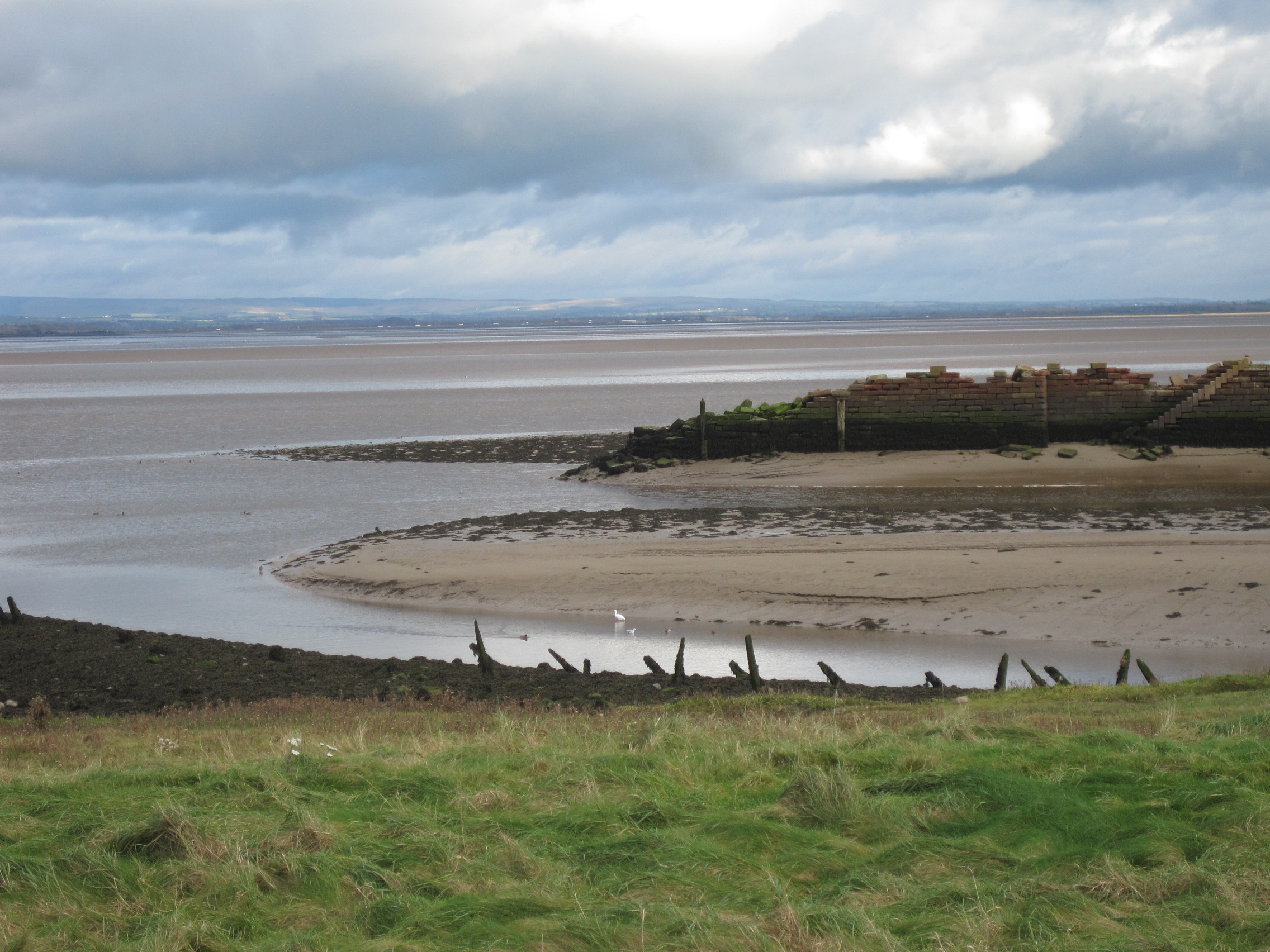
When the tide is out, Port Carlisle’s former life is laid bare in stark, dark shapes.
A line of rotten wooden stumps, marching out across the mud, scarcely hints that here was once the steamer pier.
Posts of the steamer pier, the dock, and the coaling wharf
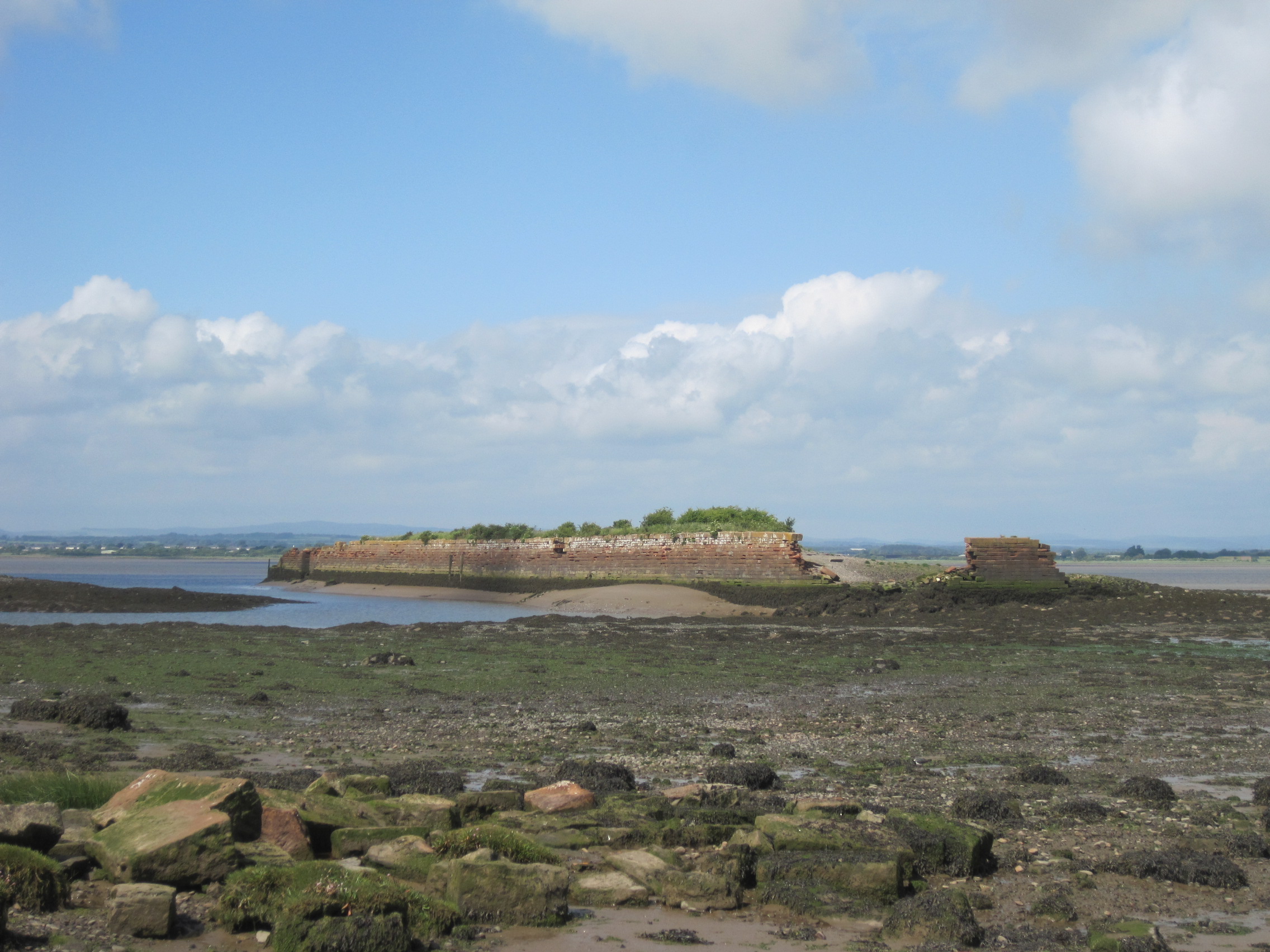
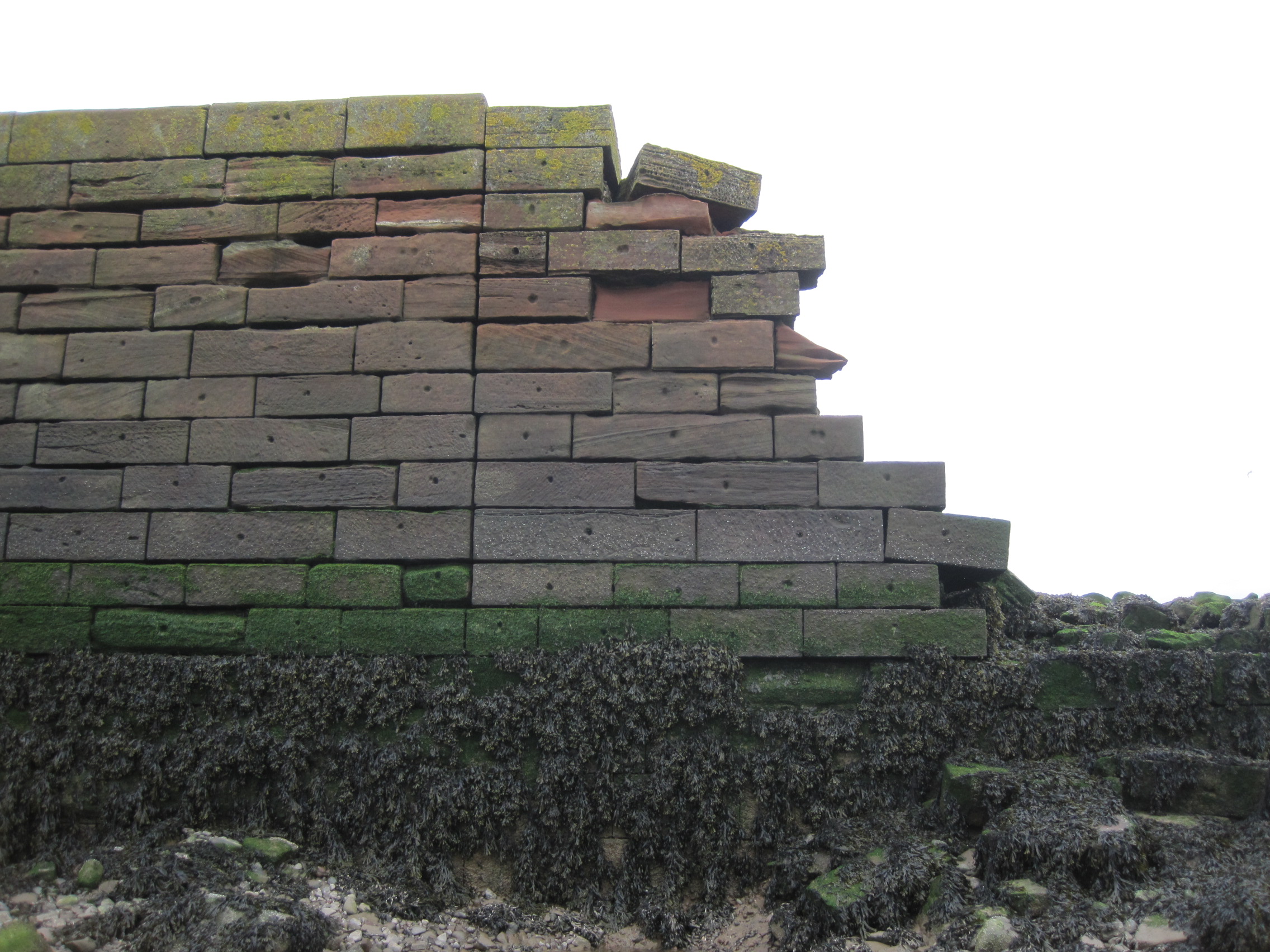
Out beyond the whale-back of mud and stone in the centre of the dock is a long, stone wharf, a jumble of straight lines and ragged edges: red sandstone blocks, their intertidal surfaces dark with fucoids, greened at the high tideline, and speckled with yellow and grey lichen – the coaling wharf, disconnected from the shore, disconnected from the sandstone quay, disconnected from the village.
The coaling wharf (and ‘garden’)
To reach the wharf I squelch across mud and shelly sand, noting the footprints and beak-probes of waders; I climb over fallen blocks of dressed sandstone, coated green with Ulva, up onto what was the working surface of the wharf – and find a wild garden of blazing yellow gorse, grass and pink thrift.
Remains of wall on the seaward side
Looking towards the steamer pier
Out on the wharf
Wooden fender, steamer pier in the distance
Out on the wharf
Re-colonising the coaling wharf
On the wharf
There is a wall of part-dressed red blocks, some shifted by the tides, and granite bollards, pale speckled grey, geologically incongruous – fallen sideways, unmoored. Sandstone steps, green and slimy, lead down to the muddy seabed of the dock. I find strange shapes of flattened metalwork in the stone, bolts that are twisted and rusty, decayed wooden fenders, and dislodged sandstone, the edges of the wharf no longer neat and protective. And a strong sense of the past, a place of bollards and hawsers, where boats came up from Liverpool, picking the right tides to negotiate the Firth’s notorious sandbanks; and tied up to collect or deliver coal and goods and people, that were then transported up the canal to Carlisle.
On the wharf
Granite bollard
Bollard unmoored
The eastern, seaward side slopes gently towards the water, a shore of mud, red clay and shells, from which pebbles have been scooped and thrown up onto the wharf.
Standing on top of the wharf I look North across the Solway to Scotland and the sheds of Eastriggs munitions depot, that are low and an unnatural pale-green, failing to be inconspicuous. To my right is the vast Rockcliffe marsh at the head of the Firth, barely visible beyond a low headland that anchors the shiny mud of the low-tide bay in place; intersecting lines of mud and sand and water, silver, pewter, ochre, where oyster-catchers and two curlews pipe and forage. And here on my left, across the dock, are the houses of a port that was once an insignificant place known as Fisher’s Cross.
That dark mound in the centre of the dock, that rarely gets covered by the tide, is not a merely a heap of pebbly sediment, swirled and dumped by the tides: originally built as a stone breakwater, it forced a splitting of the ebbing and flowing tides, to reduce the silting of the harbour. Beyond it, the red sandstone of the quay where ships once unloaded passengers and goods, is still visible.
Looking across to the harbour wall
From the top of the harbour wall
Winkles pick their way …
A stump of one of the wooden supports for the tramway
The tide is coming in fast now, the wave-fronts creamed with brown froth, and I pick my way back across the mud, where the mouths of tiny burrows spurt water with each footfall. The mudflats are home to a rich community of animals. Winkles crawl amongst the pebbles and spiralling fucoid fronds, and the empty valves of pink tellins and chalky grey clams crunch underfoot. A Little Egret, shocking in its whiteness, flaps slowly along the shore. I find a few ragged-topped wooden stakes, blackened and soft, which hold memories of the narrow rail track along which horse-drawn wagons teetered to the wharf; the tree-rings are still clearly visible in the timber, and winkles colonise the stumps.
The quay by the village is disrupted by a gap, through which a sluggish stream of water trickles across the mud at low tide. Here is the ghost of the sea-lock that marked the end of the Carlisle canal.
Wall of the outer lock
The outer lock
The tide creeps in
Granite blocks at entrance to the sea-lock
Little remains except the sandstone walls, and it’s not easy now to imagine the two lock-gates with their associated wheels and handles. Between 1823 and 1853 the canal was the route to the Solway, and thence to Annan, Liverpool and Ireland, for ships carrying goods from the warehouse at Carlisle, and for goods and coal in the other direction, brought up along the coast. Laden barges and ships travelled in both direction along the canal, being swung round in the now-overgrown turning circle by the lock. High walls of dressed stone are almost hidden by shrubs and dangling ivy.
People travelled, too, mostly away from Cumberland – to Scotland, the Isle of Man or Ireland or further, emigrating from Liverpool to America. The jagged line of stumps, like broken teeth, to the West of the port are all that remains of the steamer pier, which was built out into the Firth so that arrivals and departures would not be limited by the tides. Outgoing passengers and sight-seers crammed onto passage-boats that left the Carlisle basin and travelled along the canal, the schedule timed to rendezvous with the steamer.
The bath-house today
The former Solway Hotel and the Steam-Packet Inn offered shelter and refreshment; a bath-house with heated sea-water pumped from the Firth provided ‘spa’ facilities, and the Wesleyan Methodist chapel on the outskirts looked after people’s souls.
All ports require a Customs House, preferably large and imposing, and new local housing was equally smart: a terrace of elegant Georgian houses – now Listed – each with individually designed fan-lights above the door; a house with a sandstone Roman altar embedded in the stone-work; a Wesleyan Methodist chapel.
Fanlights
Fanlights
Fanlights
Fanlights
Port Carlisle had style, it had stunning views, it was busy, a tourist destination and a stepping stone to the New World. By 1854 it even had a railway station. The canal’s working life had been relatively short, and eventually uneconomic. It was filled in – and railway tracks laid. At first steam trains carried passengers and freight. When that too proved a financial embarrassment, passengers were pulled in the horsedrawn ‘Dandy’ along the rails between Burgh and the Port. But finally, after a range of transport methods had been tried and failed, the line closed and was dismantled.
Station platform
Back in the village I wander round a weedy, grassy rectangle, kicking weeds from the low brick-edged platform which is all that remains of the station terminal. The station house itself has been converted into a private dwelling.
The Port’s former life is imprinted in large detail on the landscape and the shore. It’s not too difficult to imagine the comings and goings, the excitement of a new vessel’s arrival up the Firth; the driving rain and fast-ebbing tides that kept ships stalled across at Annan; the passage boat’s arrival at the final lock, laden with sight-seers, emigrants, and their baggage; the wet, impatient, hungry, passengers drinking in the pubs; the racket of the crane and laden shaky wagons; or the soft light of a tender Solway day encouraging walkers to stroll along the road.
But it is the small details that stay in my mind: letters ‘JW’ precisely engraved in a block by the canal; rusty bolts; flattened metal shapes found both on the wharf and on the quay; the zoned colours of sea-weeds, weathered and wave-washed sandstone and lichen; the glistening mud speckled with stones; the single dark pockmark on each dressed block where pincers lifted it into place.
Details
“J.W”
A square-sided bollard
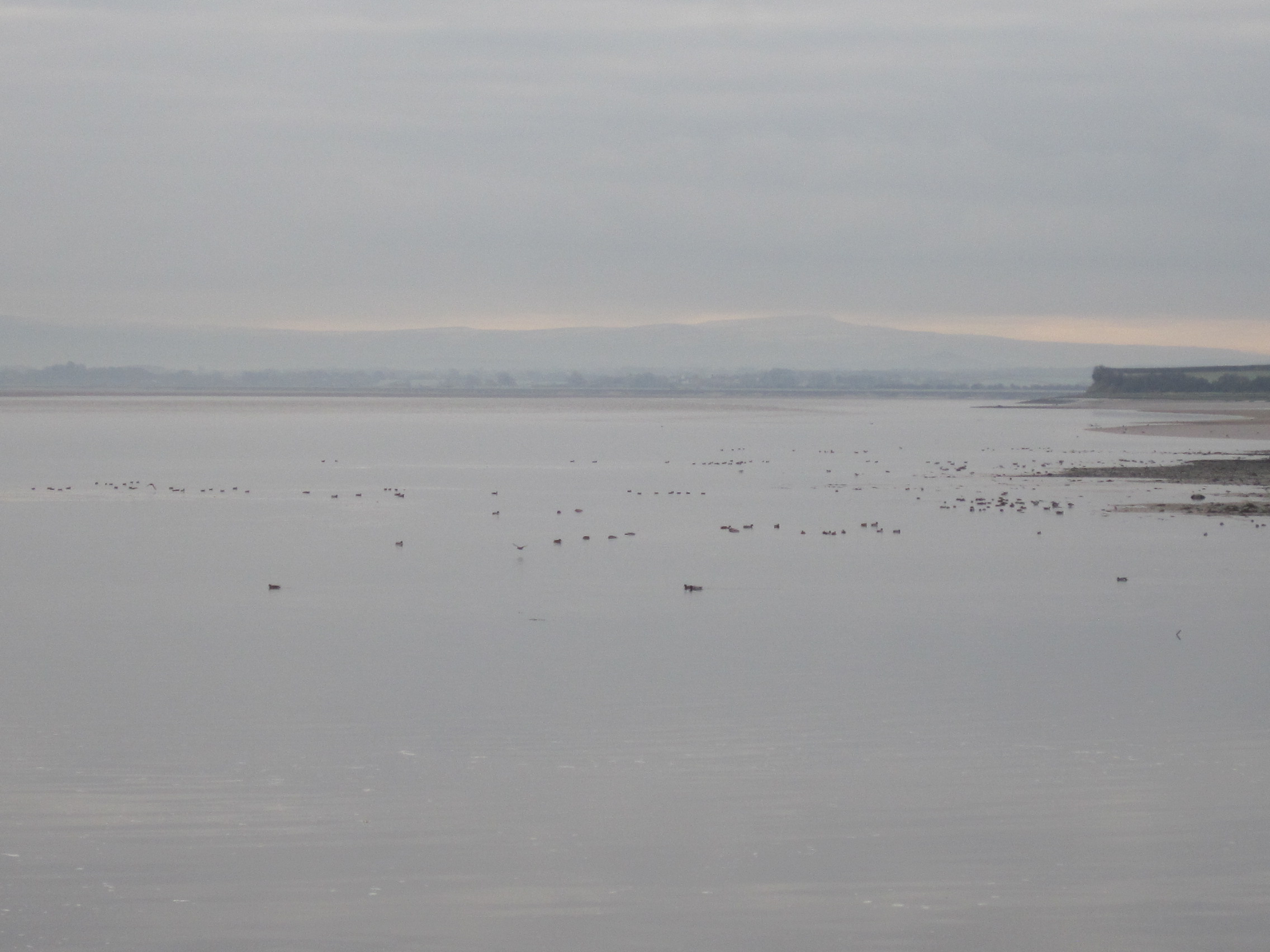
As the tide flows into the vacated basin of the port, the place is again populated, with hundreds of gulls and ducks, sitting quietly on the silvery surface of the water, enjoying the ride.
The incoming tide
And now …
This is not a sad place. There may no longer a busy-ness on the streets and quay, but the inner life of the village is full of pride and warm memories. The lady who lives in the former Bath-house once invited me inside to look at its original features; friends have been given impromptu conducted tours along the quay, and recently villagers and other local people took party in the ‘Remembering the Solway’ oral history project, meeting regularly in the Methodist Chapel: their reminiscences were recorded and transcribed, and in the accompanying film Daphne Hoggs remembers learning to swim in the harbour, and how she and her friends would swim from the central ‘island’ to the wharf steps.
The ‘heritage’ group discuss the lock
One result of the Heritage Project
Oral history in the Methodist Chapel
In the related ‘Port Carlisle Heritage Project’ run by the North of England Civic Trust, the villagers explored the Port’s history, and illuminated it for visitors with helpful information boards.
It’s a place where people get on with their daily lives, yet are able to delight in their village’s very special place on the edge of the Solway Firth, a stepping-stone between land and sea and distant countries.
Where to find out more:
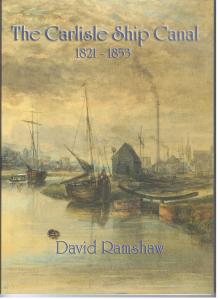
David Ramshaw’s history of The Carlisle Ship Canal, 2013, P3 Publications, ISBN 978-0-9572412, is packed with photos, newscuttings and maps.
Remembering the Solway oral history project. In the film, Daphne Hogg remembers her childhood, and swimming at Port Carlisle
The Port Carlisle Heritage Project: Ruth Lord gives an illustrated talk about the Port and the project
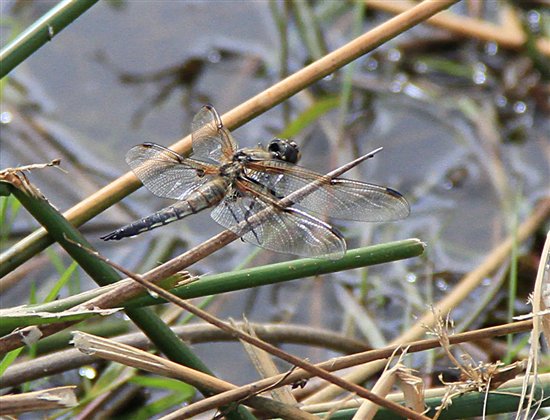
Triops cancriformis adult (photo thanks to Larry Griffin)
In August, after the long weeks of cloudless blue skies, and heat that shimmered over the cracked mud of the merse, the rain came. The jet stream had looped into another orientation, and the rain fell day after day for a week. Dr Larry Griffin emailed me: “the rain after the heat has brought the eggs out of stasis in at least two pools” and so he was ready to take a small group to have a look.
Larry is the Principal Species Research Officer at the Wildfowl and Wetlands Trust (WWT) Caerlaverock Reserve on the north coast of the Solway Firth, near Dumfries, and Caerlaverock is one of only two places in the UK where the rare and elusive tadpole shrimp, Triops cancriformis, is – occasionally – found. [1]
The modern story of Triops is a story of discovery and loss and re-discovery. But this is an animal that has scarcely changed since the Triassic period – its fossils date back two hundred million years. It is a freshwater Crustacean, belonging to the Order Notostraca, and looks very similar to (but is unrelated to) a small horseshoe crab as it trundles around on the bottom of a pond: its head and thorax are covered by a carapace, like a shield, so that from above its legs and mouthparts are scarcely visible.
Was it always the case that Triops lived, fed and bred in freshwater pools? This is a dangerous life-strategy yet despite, or because of, this danger the animals evolved a means of surviving when the pools dried out. Today, they are found only in ephemeral pools in the New Forest and on the saltmarshes (merse) and wet pastures around Caerlaverock. They can live for two to three months, or until the tide inundates the merse – and when the pools dry out under the hot summer sun, the adults die and disappear. But in the drying sediment their eggs live on, yet ‘switched off’ in a state of diapause.
When the rain comes and the pond re-wets, the eggs are stimulated to hatch – and the larvae feed and grow very quickly, so that adults are ready to lay eggs within as little as two to three weeks from hatching. As Larry says, “They can flash in and out of existence – it’s just luck whether you find them. It needs an inquisitive person … in the right place at the right time, who thinks ‘Oooh, what’s that?’ ”
This explains why the Triops’ story has been so exciting and challenging; for me even more so because this special animal survives just across the Solway from where I live, and I now have a chance to see the creatures alive, rather than – many years ago – pickled in formalin in an undergraduate Invertebrate Zoology class.
It was more than 100 years ago that Triops (then known as Apus) was found on the merse, by F. Balfour-Brown. Forty years later, in 1948, in a paper to Nature, he wrote (or narrated – the style of scientific writing was much more like story-telling than it is now):
“In September 1907 I discovered two shallow grassy pools on the Preston sea merse, near Southwick, Kirkcudbrightshire, in which Apus was present. In one of these it was so abundant that when I raised my eleven-inch ring net out of the water it was half full of specimens, mostly full-grown. I searched many other pools in the same area but without finding it and, returning to the same pools a few days later, I found the edges covered with the shells and very few specimens left in the water. The gulls had discovered this mass of food and had destroyed most of the Apus. I have visited the area many times during the last forty years but not until this month, working the merse near the mouth of the Southwick burn, have I again seen Apus. My son found three specimens in a pool which then yielded us about thirty or more, and several other pools near the first produced small numbers, mostly immature.”
These pools were subsequently lost through erosion of the merse, but Tadpole Shrimps were found again, nearly 20 kms away, in 2004.
Larry grinned as he told me about his own discovery. “I’d been out looking for natterjack tadpoles, it was quite a late season. I thought I might as well have a look in that pool – and there they [the Triops] were, tons of them!”
A Triops in the hand …
Several Triops and other invertebrate animals
He wasn’t immediately sure what he had found, until he took some of the animals back to the lab. “It was a gradual dawning… I was looking in the back of a Collins book, I think it was – there was a drawing, a silhouette. And then I had a memory of someone from the RSPB, who had been talking about trying to introduce them somewhere – and then it was ‘hang on, this is that incredibly rare thing’!”
Collaboration with Dr Ruth Feber [2], from Oxford University’s WILDCru, and Professor Colin Adams of Glasgow University’s Scottish Centre for Ecology and the Natural Environment (SCENE), and their colleagues, led to discussions, then further investigations and research at WWT Caerlaverock.
Colin and colleagues collected sediment from the bottom of 86 ponds at Caerlaverock. It was known that the eggs or cysts needed to be desiccated to enter the quiescent, diapause, state, so samples were dried out and then incubated in fresh water at 20oC. Samples from just two ponds produced living larvae (nauplii). And then, “During the preparation of this [scientific] paper, on 29 July 2010, a population of c. 100+ adults of various sizes up to 3cm were discovered by chance in another ephemeral pond 80m west of the original 2004 site on the Caerlaverock upper salt marshes. This pool was largely created by tractor wheel ruts and cattle movements in an area of gorse (Ulex sp.) and rushes (Juncus effusus).” [3]
As a result of this serendipitous discovery, just three ponds at Caerlaverock were found to be home to Tadpole Shrimps!
Rubbing post & pond where Triops has been found
Cattle on the merse
It’s thought that eggs are spread in several ways – through the guts of animals, on the feet of cattle, deer, or geese, “Anything traipsing around, really,” Larry says. This includes the tyres of tractors and quad bikes, and because the Tadpole Shrimps are hermaphrodite, “It just needs one egg, and after it hatches and survives, you could then get hundreds.”
Sometimes the shrimps themselves have been found, other times it has been the presence of the eggs in washed and filtered sediment samples. Larry reckons there could be stores of eggs of different ages in some of the sites. “I feel a lot better knowing that it’s not just in the one pool!”
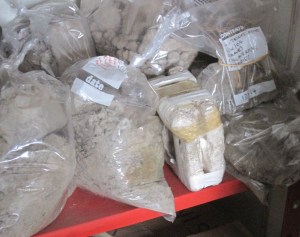
Dried mud samples in the lab
He has collected mud from the ponds, as a safety precaution and also as part of his research. There’s a shelf in his office piled with polythene bags that contain mud-samples dating back to 2008. “I wet them every September – so far, they’re still hatching out. This year will be the tenth year [to test them].”
Larry uses tanks of de-chlorinated tap-water, bubbled with air for a day to oxygenate it, then throws in the mud-sample containing eggs. “It’s really low-tech! I feed them on fish food and a bit of sea-weed to provide some iodine. They show good behaviour! They learn that when I come into the office, I’ll feed them. They come up to the surface – and I sprinkle the food on the surface, and they turn over and swim on their backs so they can take it with their little legs.”
The adult shrimps lay their eggs in little scrapes in the mud. From an egg less than 0.5mm diameter, an adult can grow up to 7 cm long when reared in the lab. It reaches maturity by passing through several larval stages, each of which grows then moults its skin, or exuvium, before passing on to the next stage.
How often does Larry find the Triops out on the merse? “Most years. It depends on the weather, but if conditions are right, you can easily see them crawling around. One clue is the exuviae, you find them wind-blown at the end of a pond.”
When Larry emailed me after the rain, it was because he had seen these papery skins at the edges of a pond and found some nauplii. But finding a date for even our small group of privileged people to join him proved impossible – and the pools dried out again. This was not to be the year when I would see living Triops in the wild.
Are they living on the other Solway saltmarshes, at Rockcliffe, say, or at Campfield or Newton Arlosh? After all, these are no distance as the goose flies (and large flocks of geese do fly between these sites).
Barnacle geese at Caerlaverock, February 2016
People have looked, and Bart Donato, of Natural England, who has a great interest in Rockcliffe, says the shrimps have never been found there. But it needs someone to be there at exactly the right time, someone who can recognise what they are seeing.
Now, though, there’s a new molecular diagnostic technique available, to test environmental samples for a range of ‘eDNA’ – fragments of genes that are species-characteristic and which may have been left ‘lying around’ in the environment. Graham Sellers from Hull University has recently developed this ‘DNA bar-coding’ technique for Triops and, working with Larry, has established the existence of the shrimp in six ponds at Caerlaverock. [4]
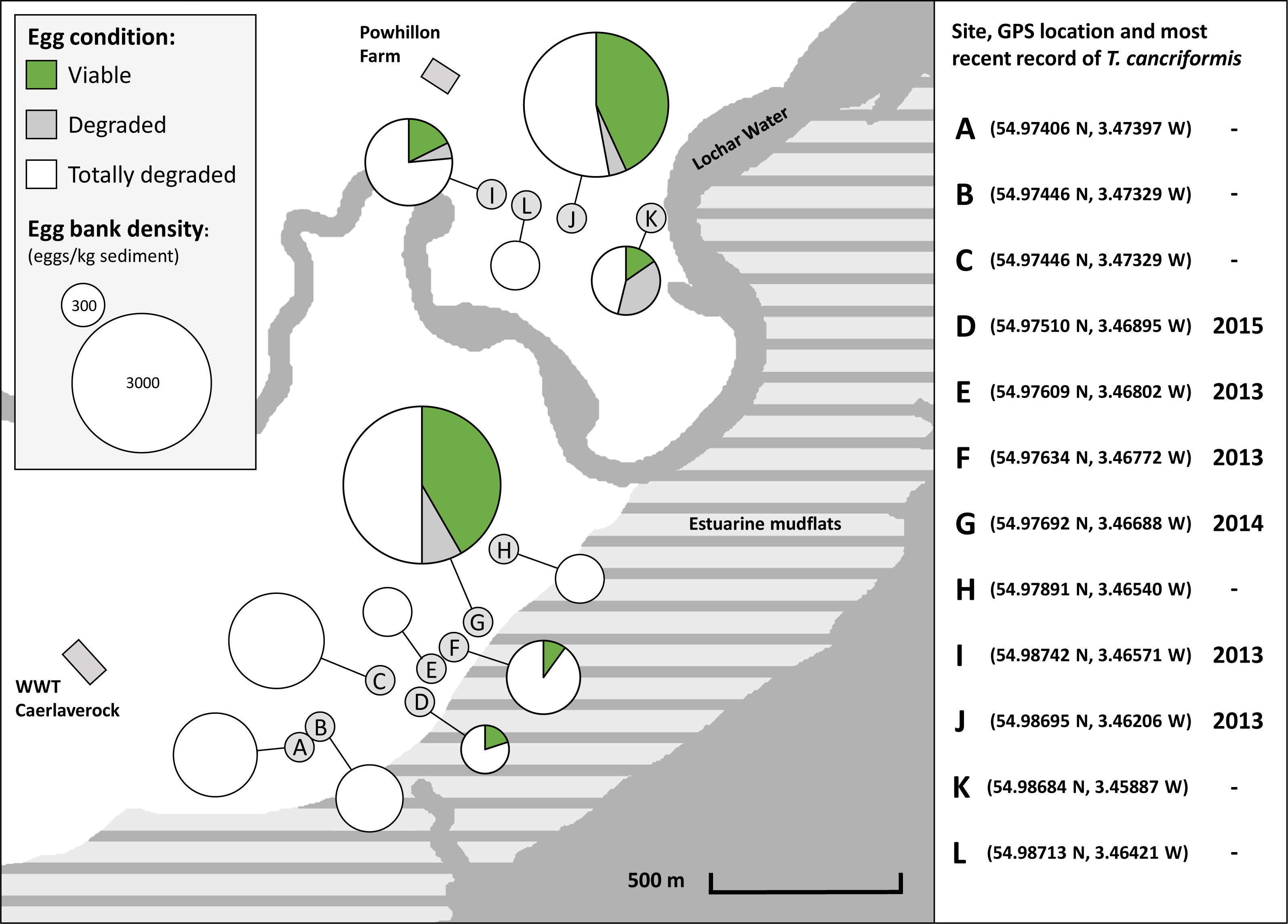
Location & condition of Triops egg-banks: Fig 4 from the paper by Sellers et al 2017 (see below)
Perhaps this technique can now be used for pools on the other Solway saltmarshes?
It would be exciting, and a relief, to find that the story of the rare and elusive Triops can be expanded to a few more chapters: that this enigmatic survivor will remain an important addition to the other ‘shrimps’ – brown shrimps and mudshrimps – of the Solway.
Meanwhile, I’m hoping for a hot dry summer in 2019, followed by a spell of rain …
Notes:
1.Triops cancriformis is classified as Endangered, listed as a priority BAP species, and specially protected under Schedule 5 of the Wildlife and Countryside Act 1981.
2. Ruth Feber et al. June 2011. Ecology and conservation of the Tadpole Shrimp, Triops cancriformis, in Britain. In British Wildlife, p334
3. Colin Adams et al. 2014. Short range dispersal by a rare, obligate freshwater crustacean Triops cancriformis (Bosc). In Aquatic Conservation: Marine & Freshwater Ecosystems. 24: 48–55
4. Graham Sellers et al. 2017. A new molecular diagnostic tool for surveying and monitoring Triops cancriformis populations. PeerJ 5:e3228; DOI 10.7717/peerj.3228
Why we need to pay attention to the other living species with whom we share this area, and identify and record them. My thanks to Deborah Muscat, Manager of the Cumbria Biodiversity Data Centre based in Carlisle, for writing this guest post.
In mid-April Cumbria Biodiversity Data Centre (CBDC) and the Solway Coast AONB launched the Solway Nature Networks as a small project to encourage people to tell the CBDC what nature they had seen on their walks and travels around the area. So why are we doing this – surely everyone knows what nature there is on the Solway?
First, a bit about me. I have some very early memories: one is looking at wiggly things in a hole filled with water in a tree, another is poking snails to make their eyes go in. Cut to fifty years later and natural history still makes me excited – just as it did when I was four.
Having lived here for many years I have explored both the Solway coast and the plain. I know that we live with wildlife that my friends in the South can only dream about; Hares, Natterjack toads, Curlew, Grey Partridge, Corn Marigold, Mudwort (more about these later) etc. But, because we have so much wildlife it becomes commonplace, and that is when it starts to become overlooked.
This was brought home to me when I started to work in Tullie House Museum for the CBDC, a small organisation that few people have ever heard of, but one that has a unique insight into 150 years’ of Cumbria’s natural history.
A wildlife (or biological) record consists of: what was seen, where it was seen, when it was seen and by whom. Currently, CBDC has over 2.2 million individual records from the whole of Cumbria, and they include flowers, ferns, trees, seaweed, snails, worms, butterflies, beetles, flies, fish, to name but a few. But digging deeper into the data, it was clear that apart from information about birds and toads, CBDC receives only a few records from the Solway area each year.
Why does this matter? All decisions about land use, management and development must consider biodiversity and this is where biological records are vital. Increasingly makers look at dots on maps to discover the presence or absence of a species. However, an absence of a dot does not mean that something isn’t there! But if decisions are made this way then we need to make sure that we record our wildlife so as to put the dots on the map.
This leads me on to another issue. Observations of common species like the brown rat are not noted down; sightings of rare species like red squirrels are always recorded. This skews our view of what is really out there. Take the rat as an example. According to the National Biodiversity Network Atlas, an online source of information used by Government about the distribution of species in the UK, there are two records of Brown Rat on the Solway Plain. Experience tells me this is not true! The Atlas also shows a similar number of House Mouse records. Once a common sighting, few ecologists have seen a House Mouse recently and it could be becoming extinct without us even noticing. Thus we need to start recording the common species as well as the rare and interesting ones.
It was this last fact that started to make me feel guilty – I hadn’t sent a record to CBDC for years. So, inspired by our new Solway Nature Network project I too have started to take a note-book and camera with me on my local walks.
I know a bit about wildlife but I am far from being an expert. Like a lot of people I rely on photographs, books, other people and the internet to find out what I am looking at. But even with my basic knowledge I am finding out what a remarkable place the Solway is.
Anyone travelling by Dub Mill at this time of the year will see a field yellow with flowers. These are corn marigolds (Chrysanthemum segetum), a species which was probably introduced to the UK in Neolithic times with grain from the Mediterranean. Once an abundant sight in the cornfields of Britain is becoming rare.
Corn marigolds (photo: Debs Muscat)
Similarly, the nationally scarce Mudwort (Limosella gallica) thrives in the Summer on the dry muddy edges of Edderside pond. Found on only 6 sites in Cumbria this small unassuming plant is disappearing as UK ponds are not allowed to dry up, or are lost altogether.
Many people are aware that the traditional Bluebell (Hyacynthoides non-scripta) is also in decline as it hybridises with the larger Spanish Bluebell grown in many gardens. Here on the Solway Plain most of the ones we see are the native variety. This fact inspired one of the new Solway Nature Network volunteers to go out and map the Solway’s bluebells, especially those on the banks at Crosscanonby.
The more volunteers we have the more eyes there are to spot rare and unusual wildlife. One such plant is the endangered small-flowered catchfly (Silene galica). I spotted this in New Cowper several years ago. It had previously been seen in Silloth in 1877. The catchfly has now almost disappeared from Northern Europe, and I have not seen it since in New Cowper as the field was reseeded with more vigorous clover and rye grass. However, the catchfly could still be lurking in sandy soil around the edge of a field close by.
Having rediscovered the four-year-old in me I am always looking under stones, logs and leaves for “bugs”. It is surprising what has turned up. On a dog walk at very low tide near Mawbray I picked up some sandstone. Underneath I spied something that looked like a woodlouse. It turned out to be a waterlouse (Sphaeroma serratum). As it was only 0.5cm long I am not surprised that it is not something anyone had recorded before. Because I am not a waterlouse expert I needed help from someone who is.
Fortunately, CBDC is part of a network of wildlife recorders and museums and we can usually track down someone who will confirm what has been found.
Indeed, a little brown thing, about 1 cm tall that I discovered on a leaf in Flimby Woods took a year to identify. I found out from a gentleman in Scotland that it was a chocolate tube slime mould. A Google search followed and to my astonishment I learned that a slime mould consists of several different types of single-celled organisms that exist as slime on decaying plant matter. When the food starts to run out or conditions are not right these single-celled organisms begin to move and join together to create the reproductive structures that I had found. I then read that there are scientists currently studying the slime mould “decision making” algorithm which is described as “a tendency to exploit environments in proportion to their reward based on previous experience”. Apparently this is similar to the algorithm used by Amazon when it finds items that you might like to buy based on previous searches!
Stemonitis, the chocolate tube slime mould (photo: Debs Muscat)
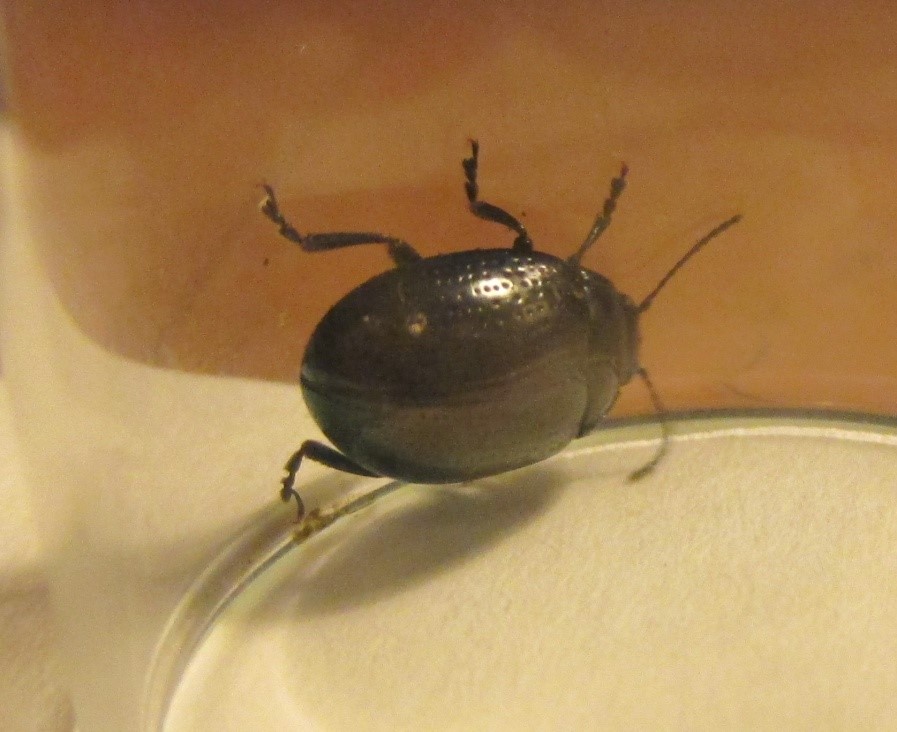
More recently a shiny black beetle caught my eye. Looking closely at the indentations on the wing cases and the shape of its “feet” I decided it could be the rare Chrysolina oricalcia, one of the leaf beetles. This time I sent my pictures to John, a reknown beetle expert in Whitehaven. He agreed with my identification and followed it up with “this beetle has not been seen in Cumbria since 1835.”
The beetle Chrysolina oricalcia (photo: Debs Muscat)
The more I look the more I am inspired to look again, and the more I learn – just as when I was four. We really do live in a place that is home to some amazing plants and animals. Our area is special and we should be proud that we haven’t lost as much of our wildlife as other parts of the UK. However, we still need to know more about what is here to keep it that way.
So why don’t you rediscover your inquisitive inner child and join the Solway Nature Network volunteers to find out about the wildlife on our doorstep?
To join in or find out more contact CBDC on 01228 618717 or visit their website.
At first light on a Sunday morning in late September, Norman Holton sat on the edge of Campfield Marsh near Bowness on the Solway. On the Scottish side the starlings were, as usual, gathering in great wheeling clouds, and as usual there were several sparrowhawks flying above them, attempting to pick off a few for breakfast. This time, though, the starling-cloud spiralled round and round, and the mass of birds coalesced and flew across the Solway. Norman estimated that there were two million birds: “They were flying low, about 10 feet above the water, coming straight towards me. I couldn’t see the ends of it, from Cardurnock to beyond Herdhill Point, the flock was so wide. It must have taken 10 minutes to pass over – it lifted slightly to pass over the marsh, flying right over my head. The noise! And the wind of their wings, the draught! I was absolutely plastered in crap. But it was fantastic – the hairs on the back of my neck are standing up just telling you about it!”
Creeks at the edge of Campfield Marshfurther up the Solway (photo: Ann Lingard)
Norman Holton [*] was Senior Sites Manager of the RSPB’s Cumbria Coast Reserves until 2016, and not one to exaggerate about bird numbers. The Campfield Reserve, based at North Plain Farm, and situated between Anthorn and Bowness-on-Solway, has 2 miles of coastline and about 50 hectares of saltmarsh, as well as about 500 hectares of arable land and raised bog, and it is host to thousands, sometimes tens of thousands, of wildfowl and wading birds. But on the day I first met Norman, back in 2004, the tide was well out and the bird-flocks had dispersed to feed across the miles of glistening sand. Our wellies made perfect prints in the overlying layer of mud as we, too, left the saltmarsh and walked out into the estuary.
There was food all around us: small shore crabs scuttling; patches of tiny black flecks that were snails, Hydrobia; the surfaces of shallow pools suddenly churned by the skittering of minute fish and gammarid shrimps; sandy coils ejected by lugworms; minute holes made by burrowing shrimp-like Corophium; and the empty shells of cockles and pink tellins that, when alive, had burrowed in the sand near the low-tide mark.
Even though the Scottish coast was only three miles away across the Firth and houses and cars startlingly clear, the space and emptiness – and silence – were almost overwhelming. Sheep and cows were grazing the marsh in the distance, the sun was a pale disc above the haze, and for a while, until the tide turned and the birds returned, there was peace; a privilege.
Grazing stock at Campfield Marsh (photo: Ann Lingard)
If you stand on the bridge at Boustead Hill, between Drumburgh Moss and Burgh by Sands, and look North-East, the salt-marshes of Burgh and Rockcliffe are pale green and deceptively smooth. Cattle are grazing or dozing, and beyond them lies a gleaming sliver of water in the channels of the Esk and Eden; there’s little movement except the speeding rectangles that are lorries on the distant motorway near Gretna – it’s all very domesticated and safe. But common sense as well as the notices warning of quicksands and dangerous currents will tell you that it’s probably not a good idea to wander on the sands here at the head of the estuary, that the sea will come charging in when the tide turns. Of course you could hurry to the safety of that smooth green saltmarsh … Norman spoke about a day on Rockcliffe Marsh when the tide came in fast, quickly rising to cover the grass; grabbing his tripod and telescope he hurried back towards his car, trying to watch for hazards in the turbid water – and fell into a deep creek. “It was February, freezing cold,” he said, “it took me ages to get to the car and I had no dry clothes.” “So what did you do?” “Put the heater on high, stripped off and drove home in my underpants.”
However, on a warm August day at Campfield he led me across the saltmarsh, stepping over deep potholes, jumping across creeks, and following the cattle-trails that divert around the meanders and oxbows of the water-courses; it is certainly not a smooth, safe surface.
Accretion and erosion after the winter 2015 storms (photo: Ann Lingard 2016)
The topography of marsh is always changing, a balance between water and plants. Norman pointed to a metre-high tower, capped with grass but with steep bare sides: some of the towers and hummocks collapse, while elsewhere the sediment builds up, the amount changing every day with every tide.
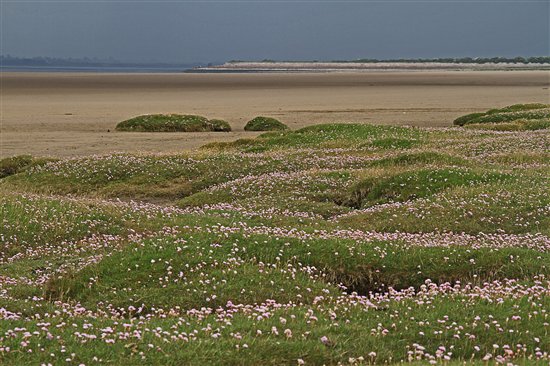
Despite the mutability of the lower reaches, if you look carefully at the marsh and its surrounds you can see that there is a logic to the structure. The single-track road is built on a raised beach, and the marsh steps down from it in three tiers. At the top there is gorse and tough creeping couch-grass, thistles, clumps of pink-flowered rest-harrow, and low purple asters; damp hollows are filled with rush, Juncus, and sedge. Walk towards the sea and you step down a small “cliff” of sand onto the next tier, where the salt-tolerant grass, Pulcinellia maritima, is like shiny wire, and there are low broad-leaved plants like silverleaf. The vegetated cushions, speckled with pink thrift, taper down towards the sand and there, at the edge and marching outwards towards the sea are the “pioneer species”.
Solitary, upright, their limbs pointing defiantly upwards, they appear intrepid and surreal. I had a distinct impression that they would advance a few centimetres, triffid-like, the instant I looked away. Some had gathered a little sand around themselves to form an embryo island, some of the islands had accumulated a tuft or two of grass; each island would consolidate and grow and the marsh would spread outwards. The plants are samphire or glass-wort, Salicornia, pale-green and fleshy. Norman said he used to fry them in butter and eat them when he was an impoverished RSPB worker on The Wash, and he picked off a piece for me to try. It was juicy and salty and delicious. I was an instant convert.
Samphire & Pulcinellia grass
Samphire: brave pioneers
On the seaward side of a small green island is a mat of a surprisingly spiky plant, Spartina anglica. Spartina, too, is a pioneer and in more than one sense, for the genus is an import from America.
Spartina on the right-hand side
“It’s an absolute pain,” Norman told me. “Once it gets a foothold it spreads and spreads.” The seeds come in on the rising tide, and get deposited as the tide goes out; they germinate and grow and trap silt, raising the level of the marsh.
Later we found perfect unblemished mushrooms, but the most exciting though inedible find was a crumbly, grey deposit, thumb-sized, that glitters with fish-scales when I picked it up. Otter droppings! I’ve been told (by an otter-spotter) that otter spraint smells of violets unlike that of mink which stinks – and it certainly smelled sweetish, although “violets” didn’t instantly come to mind.
Down the coast, the sea nibbles away at the dunes, sea-walls and shores. The northerly longshore drift and storms that stir up the shallow Solway ensure that at high Spring tides or when the wind is driving the water up the Firth, the waves deposit their load of silt on the saltmarshes. A so-called “mucky tide” may deposit a few centimetres of sandy silt, and thus the potholes gradually get filled in and vegetated, the meanders get cut off – and the grass becomes salty and unpalatable, ungrazed until the next rain.
It’s astonishing to realise that the Solway marshes have been grazed for over 1000 years. Grazing has made them the globally – not just locally – important places that they are, the place where “the world population of barnacle geese”, as many as 30,000 birds, overwinters, for example, and because of this the marshes have a string of initials after their names: SSSI, SAC, NNR … all those somewhat distancing though extremely important conservation acronyms.
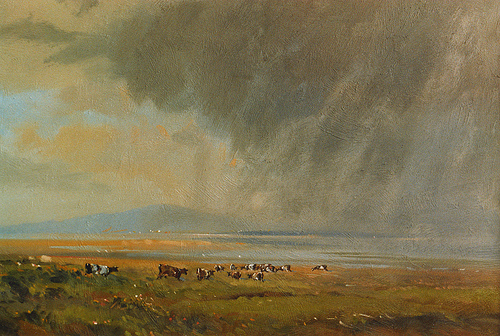
“Summer Shower – Grazing cattle on Campfield Marsh.” John Rogers
(My grateful thanks to John for permission to use this image)
In 2001, during the Foot & Mouth crisis when the grazing stock was “cleared”, the Solway’s salt-marshes changed dramatically. Brian Irving, Manager of the Solway Coast AONB which includes the Skinburness marsh near Silloth, told me: “It was the first time in my lifetime that I saw the marshes really flower, you know. The first time in their history of grazing – an increased level of genetic diversity going on because the plants were allowed to flower and set seed, rather than propagate by roots and suckers. Stunning, the quality and texture of the marshes. A once-in-a-lifetime sight – and it was there for all the wrong reasons,” and he enthused about the overall orange hue, the buttery-yellow, the coppery tones of the fescue, and the pink drifts of thrift.
Thrift at Campfield. (With thanks to Judith Rogers)
Most of the marshes are predominantly common land whose area is divided into “stints”; a Marsh Committee allots each grazier a certain number of stints, each of which may carry a set number of cattle or sheep. The animals roam free, the stints are not limited by fences – except around the RSPB Reserve, where a neighbour’s Texels, probably muttering about their right to roam and humming “the other man’s grass is always greener” were that day chomping at the turf. However, they casually, without quite appearing to capitulate, wandered back towards their home stints when they saw us. Campfield is grazed by up to 100 beef cattle between May and October; in theory the stocking density is 0.6 units per hectare, the optimum to get the sward “into condition” for feeding and nesting birds and to minimise trampling of lapwing and redshank nests.
Norman told me that his system for managing the grassland was simple: “When I came here 12 years ago my complete knowledge of farming came from ‘The Archers’. But with the help of the local graziers we’ve learnt to balance the birds’ needs with the cattle’s needs. Basically, when the grass is up to my ankles it’s about right, below that I need to take a few stock off. Managing the grass looks very scientific, but in the end, it’s how far it comes up your wellies!”
Cows at Campfield
Sheep on a flooded saltmarsh, Grune Point, Moricambe Bay (AONB, SSSI, SAC, SPA, Ramsar)
Redshanks prefer tufts of grass to nest against; lapwings like to nest in open areas; roosting waders prefer short grass so they can watch for predators when the tide pushes them off the mudflats. The diversity and number of birds that come to the Solway coast is astonishing, and sightings are well-logged on many websites and blogs – for as well as the expected waders like dunlin, knot, red- and green-shank, godwits, curlews, oystercatchers, and the species that prefer the fields and wooded fringes like the plovers, tree-sparrows, linnets and so on, there are sightings of cranes, spoonbills, egrets, red kites, short-eared owls and ospreys. While Norman and I searched the edges of the small pools on the upper tier of the marsh for natterjack toadlets, a green sandpiper swooped down to the water, and a ruff had been seen the day before.
Then there are the geese. Their arrival is an event of local importance, something to anticipate. “Are the geese back yet?”: everyone is listening for their honking and calling; looking upwards, away from the flickering masses of knot and dunlin skimming over the sands and the black-and-white binary flashes of the oystercatcher flocks, hoping to see geese circling to land instead of passing over in a V.
In mid-September, the first of the Pink-footed geese start flying in from Iceland; most carry on to The Wash and Martinmere from Iceland, but a couple of thousand remain on the Solway. Those who went further South start moving North again in the New Year, and from mid-January to mid-March you can see them in vast numbers on the salt-marshes and fields. Barnacle geese from Svalbard arrive on the Solway in early October, and they stay, right through to the end of April and early May.
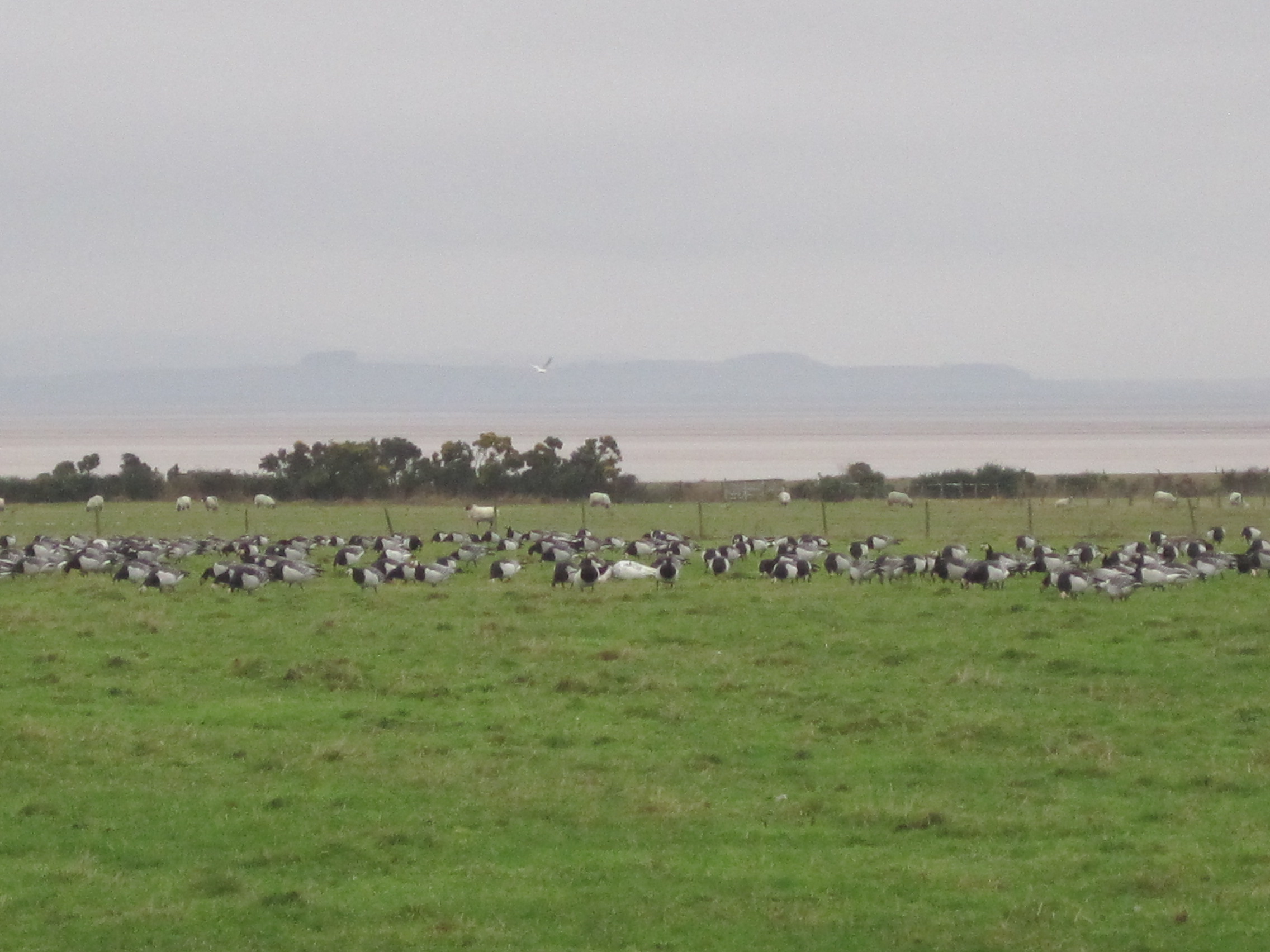
Barnacle geese on a field next to Campfield Marsh
It is during that period, from mid-September to April, that the grasslands and the carefully-managed sward on the saltmarsh are especially important as they provide grazing for the geese that are escaping the Arctic temperatures of the far North.
But you don’t have to be a “birder” to fall under the spell of the salt-marshes – even here, where the Firth is narrowing down, constrained by its banks at the top of the estuary, it seems to be the sense of spaciousness and wildness that exerts the strongest emotions.
“It’s the wilderness … to come back to the Solway and sit on the saltmarsh at dawn … Everything has got its place. The birds start to fly off the sands, the golden plover first, then curlew, godwit. Every dawn is different because of the tide – the different height, different wind, it’s very variable. It’s rare for there to be the same conditions from one day to the next. I love the dynamism of the tides and the wildness of the marsh. On the seaward edge there are no street-lights, you can’t hear any traffic. Even after all this time it still makes the hairs stand up on the back of my neck,” Brian Irving told me.
John and Judith Rogers’ house overlooks the Solway, and the salt-marsh’s character is part of their lives: it can be “transformed in moments by a storm sweeping in from the Irish sea: the wind picking up – hail showers sweeping across, pushing the tide relentlessly into the creeks and channels and overflowing, even on to the roads… But all this can change again within the hour. The tide goes out, the clouds disappear … sunlight sweeping across the mud flats; highlighting swathes of golden gorse; catching the sudden glint of gulls and flocks of waders wheeling back and forth …”.
And Brian Hodgson, a wildfowler, told me, “I just like being out here and being part of it, the early morning, the solitude of it.”
In memory of Norman Holton.
“If I was a cow, I’d be happy on the marsh! It’s just the best place to be”
(Photo: Ann Lingard, 2004)
***
[*] Norman Holton died in the autumn of 2016; a great ‘Solway man’, he continues to be very much missed by his many friends and colleagues.
***
The first version of this article was published in Cumbria Life in 2004; I have since updated it with extra information and photos.
RSPB Campfield Reserve, tel: 016973 51330, is a reserve that is open to all. The Solway Wetlands Centre is also there, with an information area and a comfortable room in which to sit and drink coffee!
There is an excellent blog by John and Judith Rogers on what is to be seen at the Campfield Reserve.
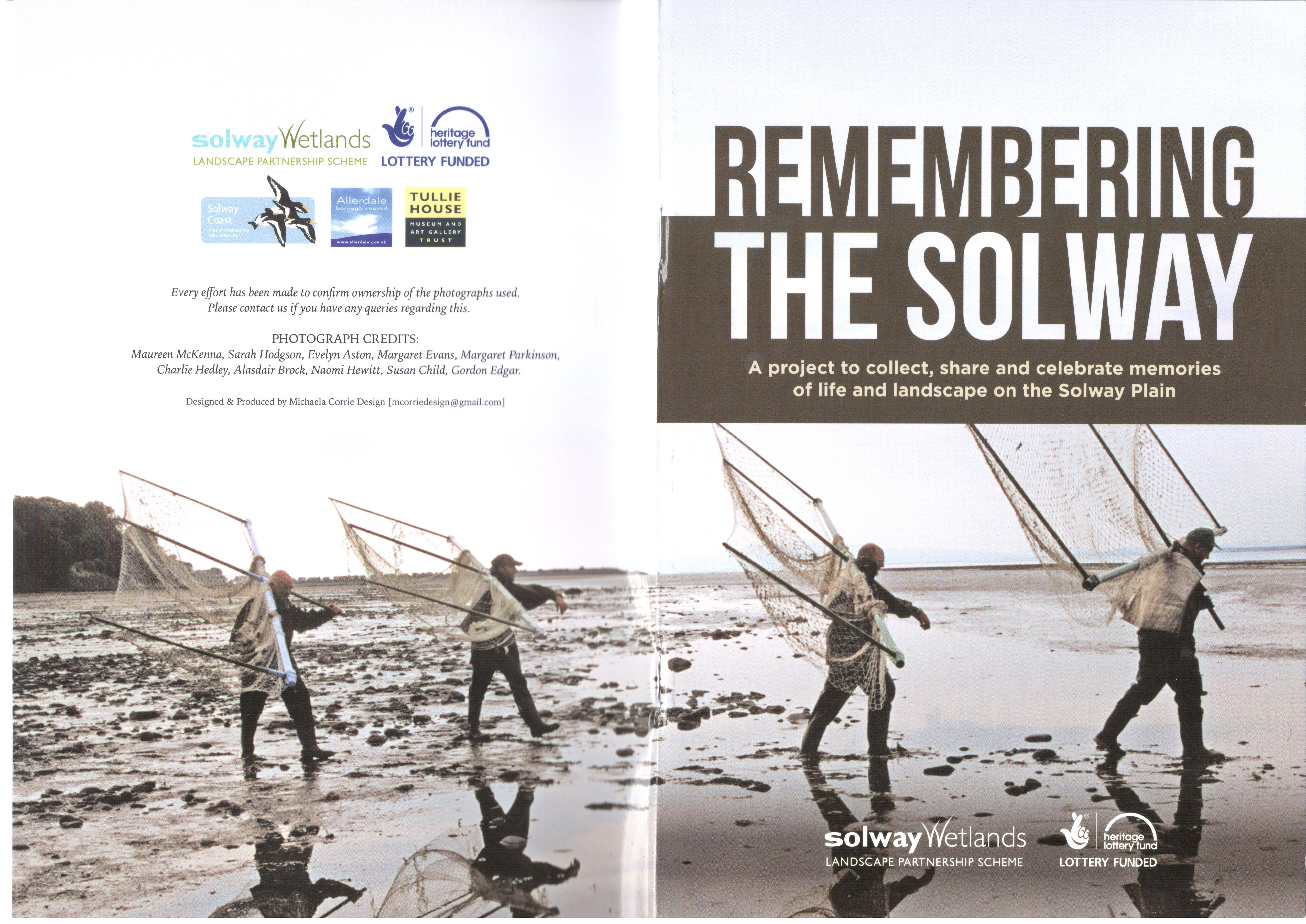
Pupils from Kirkbride Primary School look at ‘Household Objects’ (photo: Naomi Hewitt)
‘I’ve enjoyed every single bit of it – every interview, every person has been a sheer gem,’ Jean Graham told us at the celebration that marked the end of the oral history project, Remembering the Solway. ‘And how marvellous it is that all these people are gathered here enjoying a few hours of reminiscing – and it isn’t a funeral!’
Naomi, currently Assistant Manager of the Solway Coast AONB and former Manager of the SWLP, has overseen the project since its inception about three years ago; Remembering the Solway has been one of the 29 schemes in the Solway Wetland Landscape Partnership’s four-year HLF-funded project.
‘We wanted to capture the memories of people who have lived and worked on the Solway Plain,’ Naomi Hewitt said. ‘The idea came from Sarah Hodgson of Drumburgh Farm – she waylaid me with the idea, and she persisted, she didn’t give up! Jean Graham was another great advocate for the idea.’
The unusual land- and sea-scape of this small corner of England that is tucked in next to the Solway Firth and the border with Scotland was sure to have imprinted unusual stories in the minds of those people who have lived here, in some cases for as long as 90 years.
So, more than three years ago, there was a meeting in the Methodist Chapel at Port Carlisle to make plans and, Naomi said, “We knew we had the foundations of a good project.”
They brought in Susan Child from Creative Horizons, an expert in oral and community history, and she trained the nine volunteers in how to gather oral history, how to do the recordings – and, importantly, in the ethics of carrying out recordings.
As Sarah Hodgson said at one of the planning meetings at the Chapel, “Interviewees need security, they need to know we’re not going to be rummaging through their belongings. Many of them are in their eighties or nineties and we tiptoe round until we get the opportunity to record them, we can’t just plough in.”
There is so much information, so many memories, to gather and preserve. Naomi explained, at the celebration, “We knew we were time-limited, so we decided to concentrate on on the central and North areas of the Solway Plain, from Kirkbride up to Burgh and down to Cardurnock. And being able to use the chapel was great – it’s such a great community and historical asset.”
Port Carlisle chapel
A drop-in and update session in the chapel
I went to a couple of the planning and update meetings in the little white-washed room at the chapel, and ideas were flowing fast as to which topics needed still to be covered, who could be contacted and, hopefully, interviewed. There was a buzz of laughter and chatter over the coffee and biscuits. “The group had a huge amount of energy,” Naomi said.
Which of the many topics should they choose? Farming, peat-cutters, ferrymen, the WRENs who came in the War, the Anthorn Camp, the Shooting Range at Burgh, turf-cutting for (it was said) Wembley, the people who were in service, the Home Guard …?
The list was finally narrowed down to farming; the railways; peat-cutting; fishing; growing up; and the Solway itself.
The group held frequent Open Days throughout the two years so that everyone interested could come and meet their friends and hear how the project was developing. I went along on a mid-June afternoon in 2016. There were about twenty people crammed into the tiny room, as well as the recording volunteers. Cake and cups of tea were being handed out, and around the room were boards and tables with photos, scrap books, letters and several transcripts of recorded interviews; people were poring over them, exclaiming, pointing out friends or acquaintances in the photos, this sometimes leading on to suggestions for further interviewees. Susan Child was sitting in the corner feeding letters and photos into a scanner. After a while she put on her head-phones and we all settled down to hear one of the recordings, then Jean Graham, a local writer and poet as well as one of the volunteer interviewers, read three poems based on her interviews and her own experiences.
In the last year the pace has increased: there was the film to be made, the transcripts to write, the recordings to tidy up, the booklet to publish.
Naomi Hewitt (2nd left), and Susan Child (2nd right) with some of the peole who took part
Before the lunch
Jean Graham reads her poem ‘Black & White’ about hound-trailing
And finally, on July 14th 2017, the end of the project was celebrated with a lunch at the White Heather Hotel, Kirkbride. More than 150 people came, and the room – and the lengthy queue for the buffet lunch – was echoing with conversations and laughter. As Jean told me, “Some of these people probably haven’t seen each other in years – they’re not always able to get about, they’ve been isolated on their farms …”
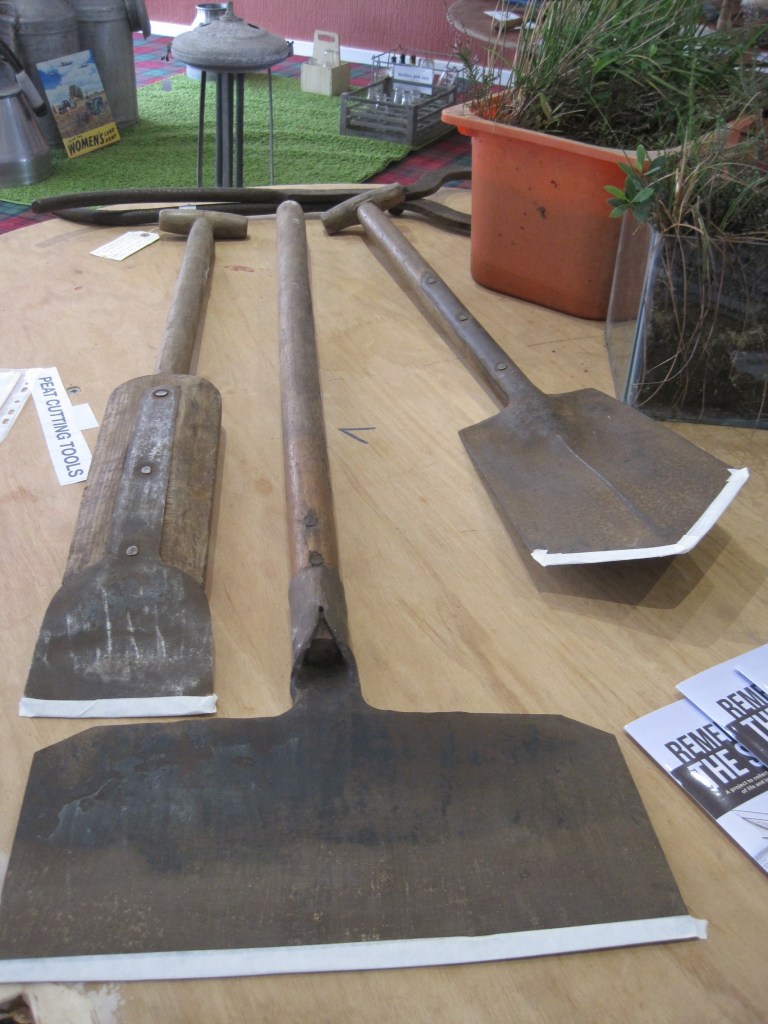
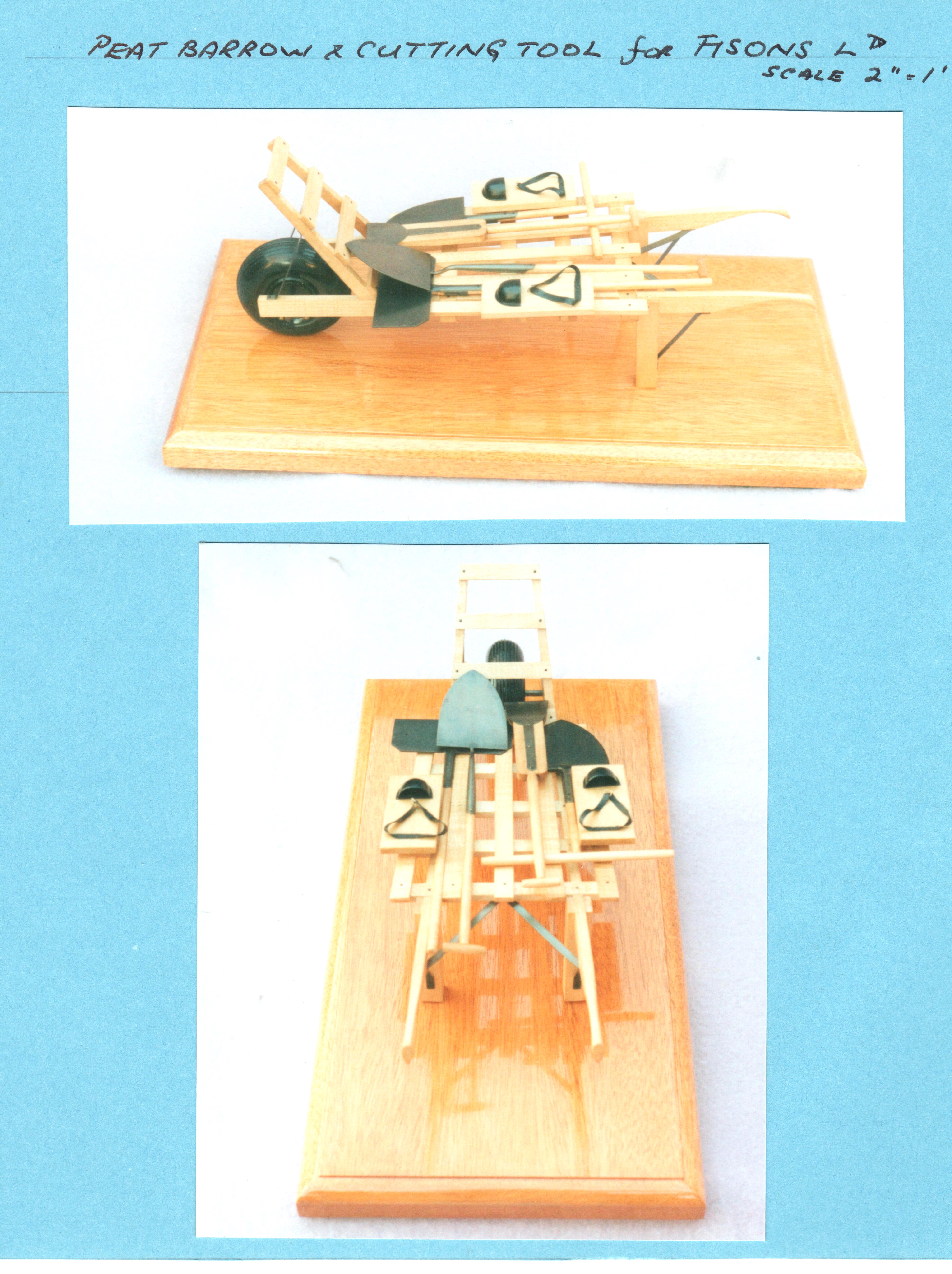
Tables around the room were piled with memorabilia such as farm implements, peat-cutting tools, kitchen equipment and school-books.
The celebration also included a showing of the film, made by Tony Wilkinson of Red Onion Video, and the ‘launch’ of the free booklet that includes extracts from some of the interviews.
In all, there have been 46 recorded interviews, involving 53 people (some of whom were unable to do a final recording through ill-health). Each person who had been recorded received a CD of their own interview to hand down to their families, and the written transcripts will be given to the Cumbria Archives at Carlisle.
‘It was an agonising task to choose clips for the film and for the book,’ Naomi said. ‘They’re very much tasters of the wider archive. And we know the archive will be preserved for generations, though the book and CD will have a shorter life.’
There were hints that future funding may be secured to continue the project: after all, there are still several important topics that have not been recorded, like hound-trailing, ferries, ‘HMS Nuthatch’ and so much more!
We all have stories to tell, some may be dull and repetitious but others are important in reminding us of how our attitudes have changed, and how we have changed the world around us. Many of us will be wishing, far too late, that we had encouraged our own parents to record their memories in some way. Even though aural recording technologies change, the oral stories can still be captured using the simple technology of pen and paper.
Susan Child talks about the delivery of the Remembering the Solway project, at the Solway Heritage Conference, Burgh-by-Sands 2017
‘Remembering the Solway’: the film, starring David Hume (peat-cutting on the Moss), Margaret Sharples (railways on the peat-moss), Geoff Hodgson (bird-nesting), Daphne Hogg (swimming at Port Carlisle), Allen Hodgson (farming and milking), Jean Graham (playing on the peat-moss)
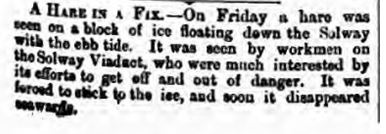
A hare in a fix (Carlisle Journal, February 4th 1881)
The polar bear on the ice-floe is the iconic image of climate change and the warming of our seas. Here on the Solway Firth nearly 140 years ago, the climate had changed in the other direction – towards a bitter winter. If ‘social media’ had existed, this hare would have been the iconic image for that time.
***
The hare, although presented on a plate, is not still.
Legs scrabbling, eyes bulging,
she tests her sea-legs.
The ice-floe zig-zags across the watery border
between the lands,
buffeted by waves, spinning,
so that the hare no longer knows
which is Scotland or England
(if she ever did).
She is immersed in noise, the sound
of wind and rushing water;
ice groans and rasps
and iron squeals against iron.
Men’s arms point like guns,
and she flattens, black ear-tips
pressed into her soft back fur.
The floe thuds against dark pillars,
tilts, swings free.
The hare, shivering, splays her legs, and
pounds her feet against the unforgiving ice.
Then, body too cold to melt a hollow,
she squats, past fear.
But when the fast-ebbing tide wedges
the floe against a sandbank,
the hare opens her eyes.
Her back legs unfold and gently catapult her ashore
onto a cold, moist island lacking green.
Leaving the ghosts of foot-prints,
she scoops out a shallow form.
Safe.
Until the tide turns.
***
or:
A gull screeches in low, head tilting,
hoping for a meal in the huddle of fur.
The hare opens her eyes and watches its flight.
“Bugger this for a shit start to the year,”
she mutters.
And stretches.
“I’ll go where he’s going, thanks.”
Scrabbling aboard the beached floe,
she kicks off.
Her back legs unfold and catapult her afloat
as the slack tide turns
and pushes the ice-raft back upstream.
Gliding ashore on the Scottish side,
she slides off onto glistening mud,
leaving deep indented footprints.
“Och aye the noo,” she tries,
in her Cumberland accent,
and she staggers stickily upwards
towards the green edgeland.
***
The explanation of why there were ice-floes on the Solway Firth and why the hare heard the noise of iron squealing against iron, is in Chapter 10 of Crossing the Moss – the intriguing Victorian and present-day story of the raised mire or ‘Moss’ of Bowness Common and the Solway Junction railway.
This was a project in which photographer James Smith and I collaborated, with support from the Solway Wetlands Landscape Partnership (to whom, needless to say, we are very grateful!).
The mental image of the hare on the ice-floe was too good to waste (and why she found herself there, in deep winter, raises many questions with regard to extreme cold, hibernation, food and foraging).
If, like me, you have had enough of sad and disturbing news, choose the alternative ending …
“The first thing people do is stroke the walls – it’s tactile, there’s something about it that makes people want to touch it.” Alex Gibbons
March 2017 (before the floor was made)
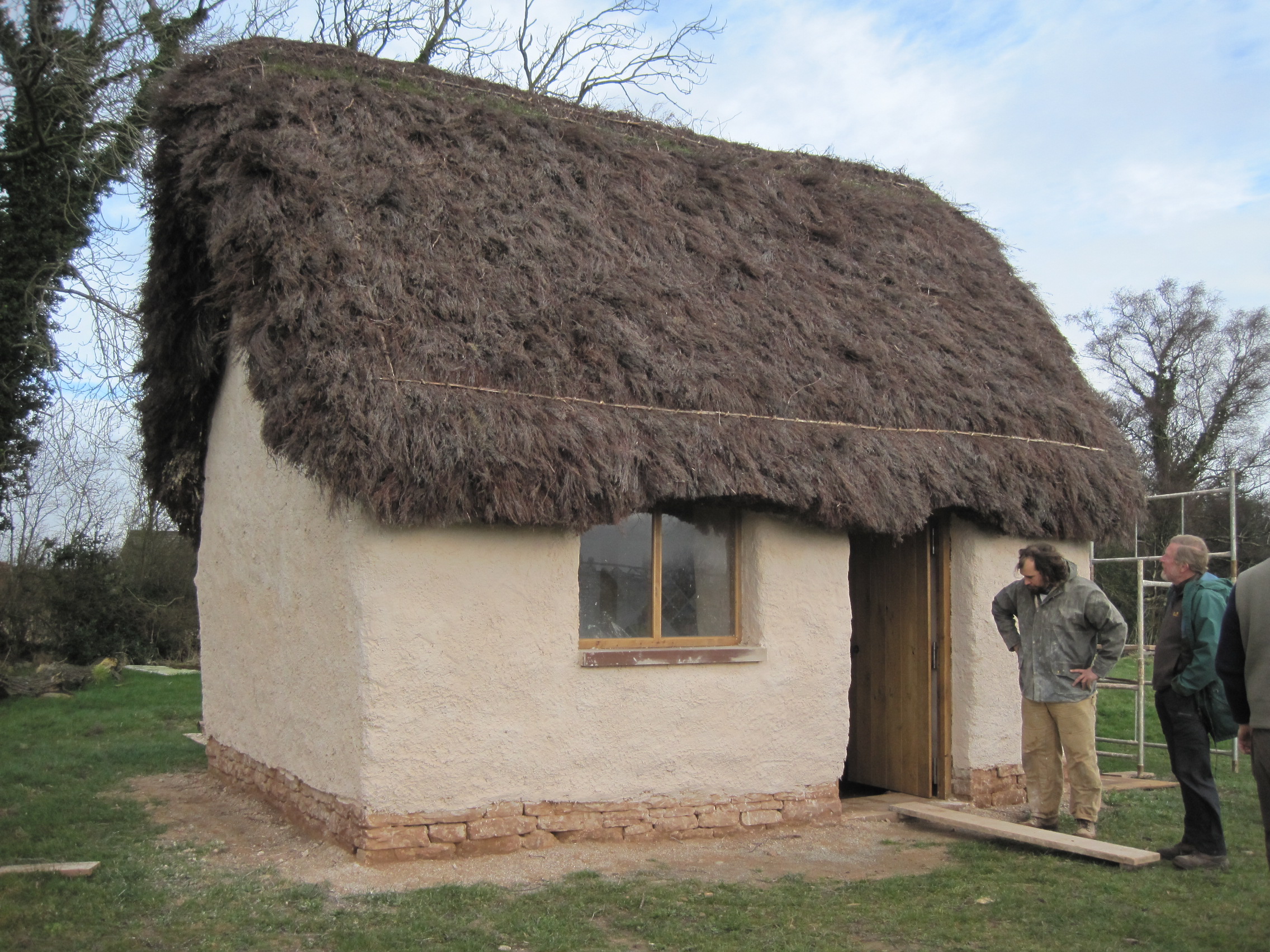
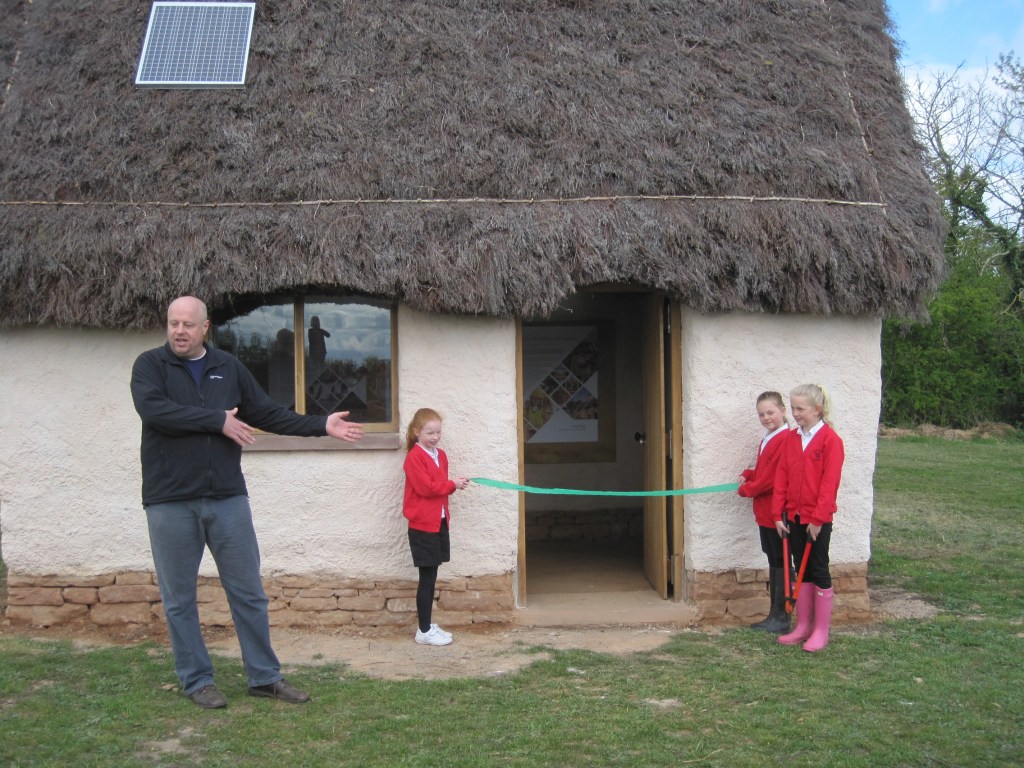
On April 28th 2017 the first clay dabbins building to be constructed on the Solway Plain for more than a century was officially opened.
It has been an interesting story, driven along by the boundless enthusiasm of Peter Messenger, Chris Spencer and earth-buildings specialist, Alex Gibbons.
***
Last July, Clayfest 2016 – a week-long celebration of traditional building techniques, organised by Earth Buildings UK and Ireland (EBUKI), Solway Wetlands Landscape Partnership, and the RSPB – was taking place at the RSPB’s Campfield Reserve. Tents and campervans formed a small encampment behind one of the barns for, despite Clayfest being held at Bowness, on a corner of the Upper Solway coast, people had come from as far away as the USA and the Netherlands to take part.
There were talks, and tours, and workshops on the ‘rammed earth’ technique of building, and on techniques for making and using earth plasters. Chris Spencer, Manager of the Solway Wetlands Landscape Partnership, was running the clay dabbins workshop, using the traditional method of layering straw and wet clay to build a bird hide overlooking the pond.
I had dropped in briefly half-way through the festival, on the hottest day of the year. It was lunchtime and everyone was sitting in the shade, chatting and eating healthy-looking mixtures of vegetables and fruits but Chris immediately broke off from his more substantial lunch to give a quick tour.
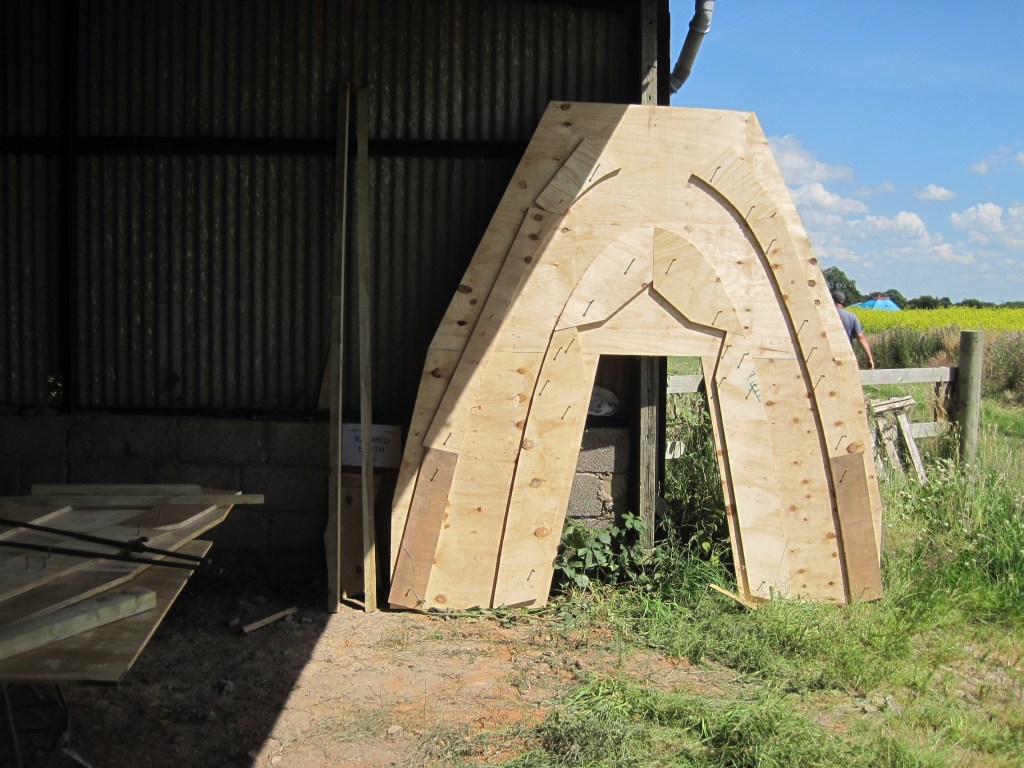
Mudpies in the earth plaster workshopEarth plaster workshopForm for the rammed earth archThe start of the clay dabbin bird-hide
In one of the barns a mound of reddish local clay was ready to be mixed into plaster; more clay was down by the developing bird-hide. “Three hundred tonnes,” Chris said. “It was dug up from near one of the ponds just along the track.”
In the ‘rammed earth’ area, plywood was being cut and screwed together to make the large arch-shaped ‘form’, into which clay would be pounded.
Further along, what looked like sandcastles were lined up in front of a straw-bale wall; books and a whiteboard suggested theory rather than practice had been occupying the time. “They do a lot of talking,” Chris explained with a grin.
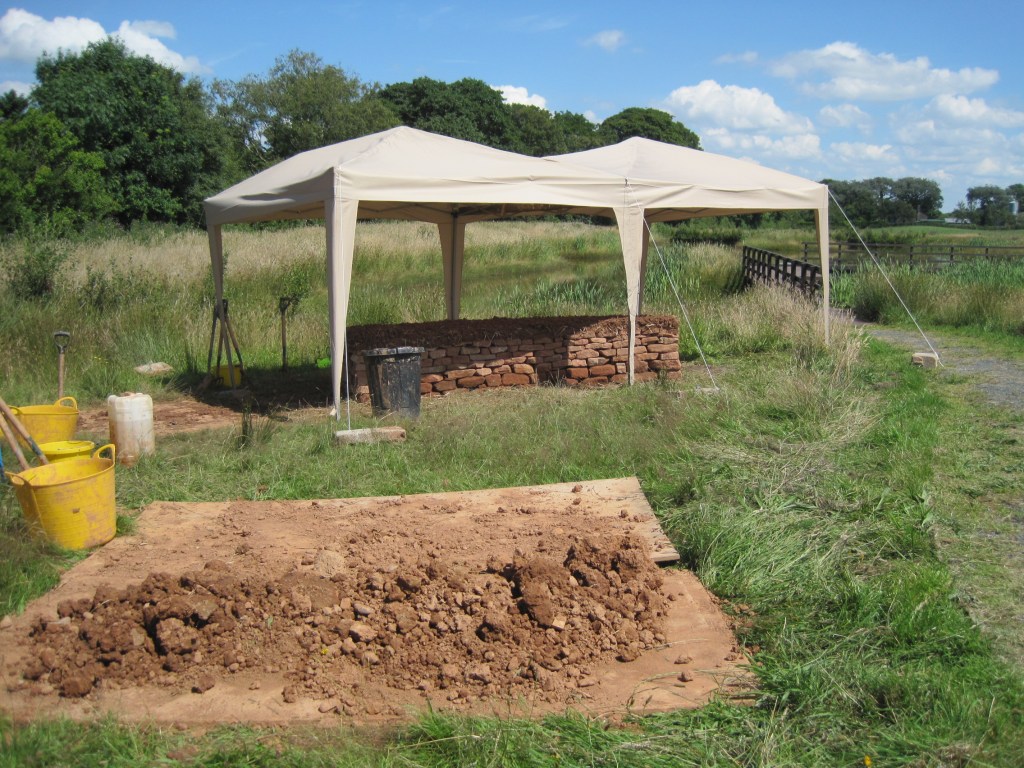
Down by the pond, Chris’ group had not only been talking but had been working hard. The hide was progressing fast, the first layers of dabbins already in place on top of a low drystone wall of red sandstone blocks.
May 2016High-tech kit
Next to it, the early stages of the Clay Dabbins House – which would eventually be an exhibition area to explain the Solway’s clay dabbin heritage – were baking gently in the sun, the layers of straw and stamped wet clay now hardened and firm, the walls awaiting a roof and inner and outer lime-plaster coatings.
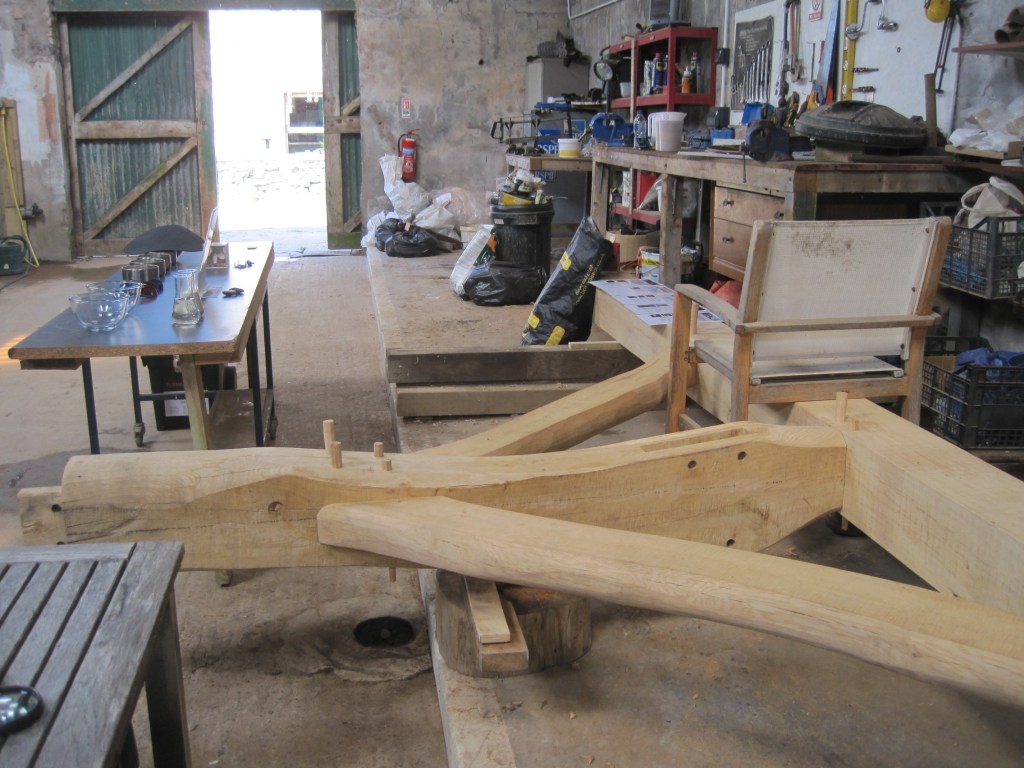
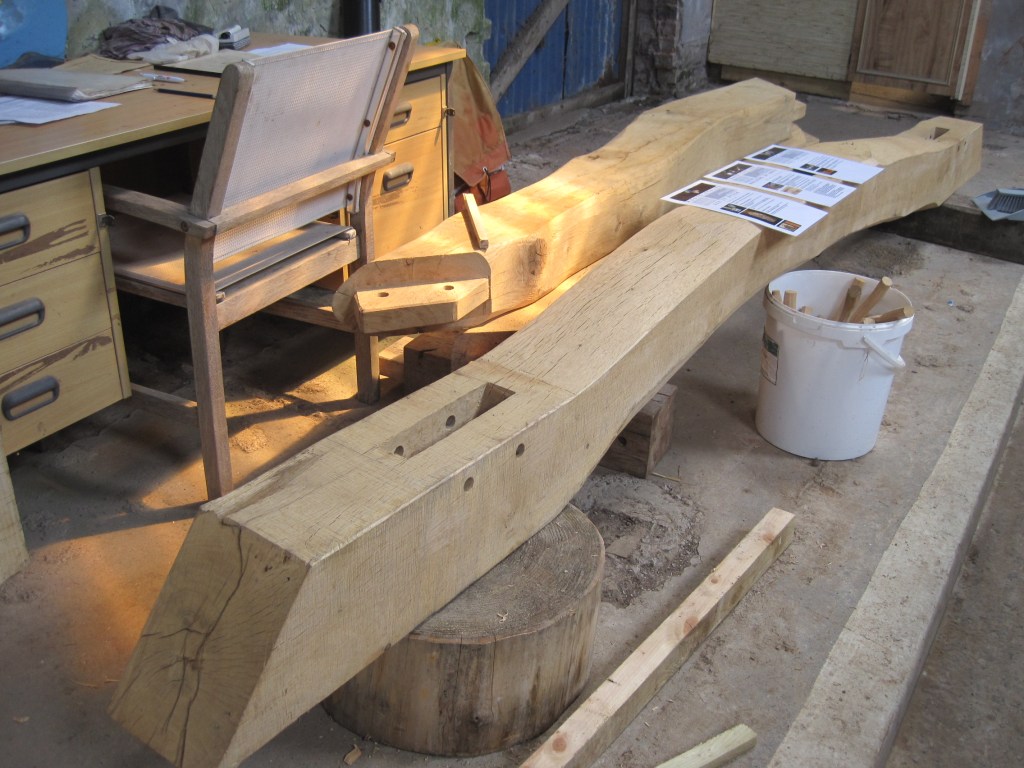
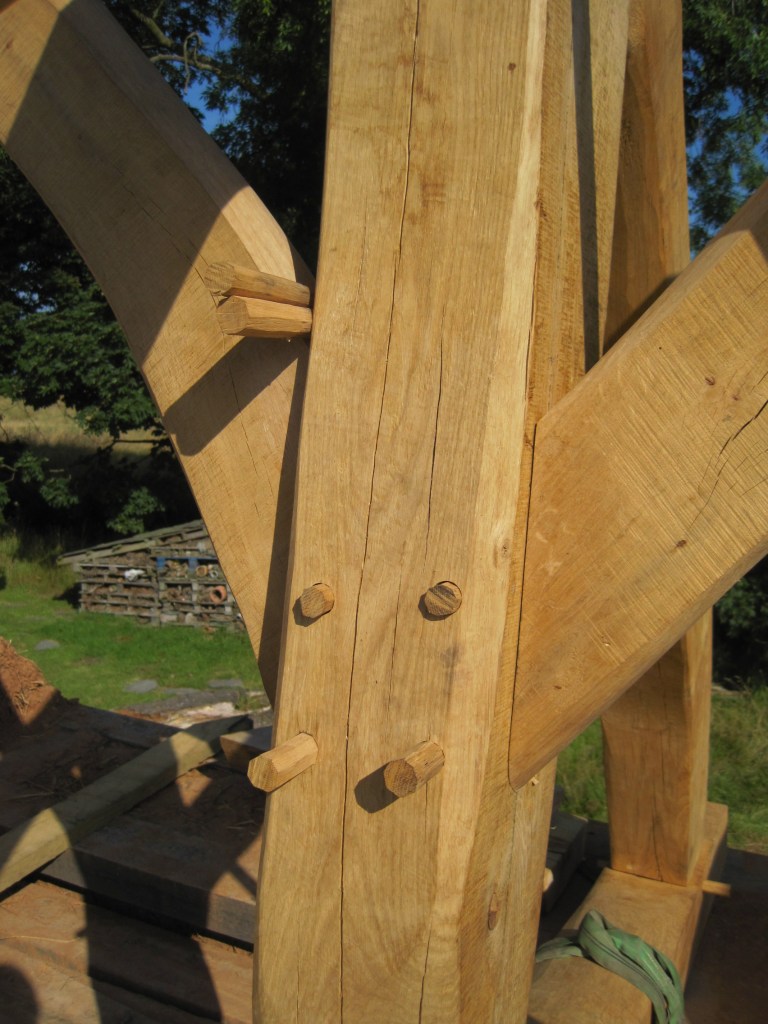
In one of the Reserve’s other barns, an intriguing array of jars and earth materials were being laid out for a Clayfest demonstration, but more eye-catching was the future roof of the clay dabbins building. Here were baulks of oak which had been cut and chiselled into traditional curves; holes drilled, offset, ready to receive the wooden pegs that will hold the pieces together – a functional structure, yet sculptural and majestic.
Oak Truss timbers in the barnMilled roof timberpegs in the off-centre holesHoles awaiting pegs
What and where are the clay dabbins buildings?
Before we tell the story of Campfield’s little clay dabbins house, let’s look at clay dabbins buildings in general, a type of vernacular architecture found previously on both sides of the Upper Solway, but now mainly – and in decreasing numbers – on the Cumbrian side.
In a landscape formed on glacial till, gravel and mud, with very little ‘country rock’, how do you build a dwelling? You use the materials to hand – the earth and clay, and straw, and whatever trees you can fell for timbers. You need some stone too for a plinth, the foundation of the walls, lest rising-damp gradually liquefy the clay construction; perhaps the ruins of Holme Cultram Abbey or the Roman wall can provide a source, otherwise cobbles or field-stones must do. And if your friends and neighbours will help you tread and mix the clay with straw, then the walls will rise quite quickly.
‘It is conceivable that it could be done in a day, using lots of people from the village, say. People with the fitness of the 18th century, rather than someone like me who stops for an egg sandwich!’ Alex Gibbons.
The advantage of the dabbins method is that it is quick. Peter Messenger is a local expert on the Solway’s dabbins buildings, and has written a delightful and well-illustrated article with practical instructions about their repair.
A “serviceable mixture [of earth for the walls] could contain 30% (by weight) of stone/gravel (from 5mm to 40mm); 30% of coarse and fine sand; 15% silt and 25% clay. There are examples on the Solway Plain where the proportion of silt and clay in total can be as high as 80% and these walls are as hard and compact as others which have 50% of stone and gravel. So there are no hard and fast rules.”
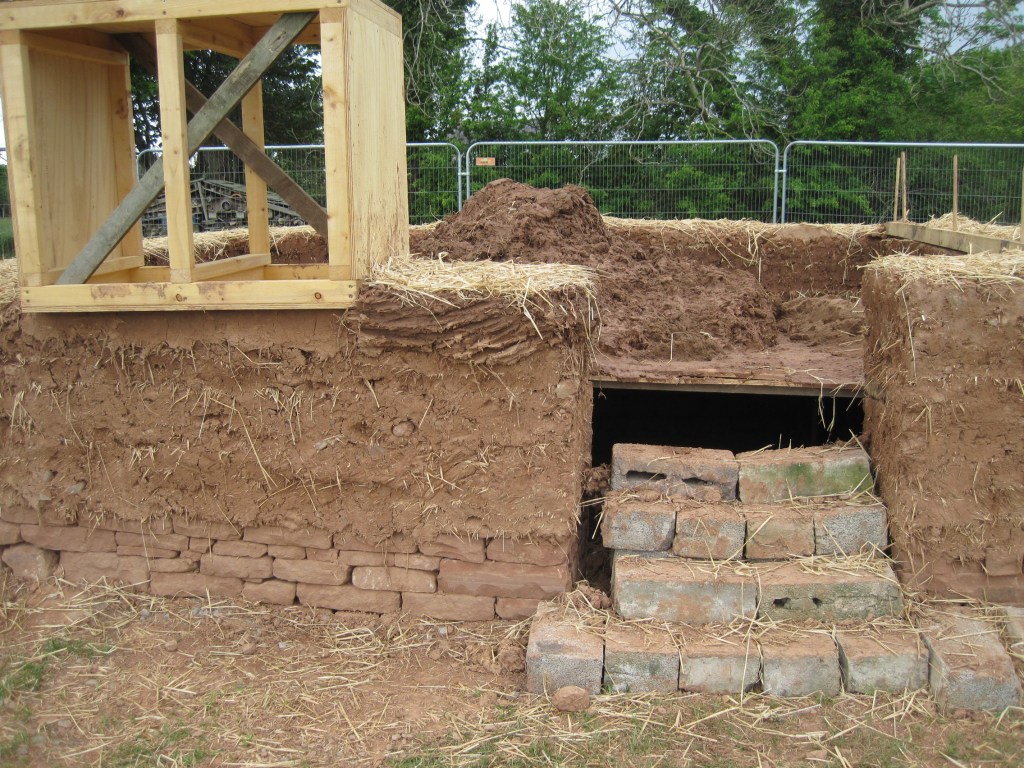
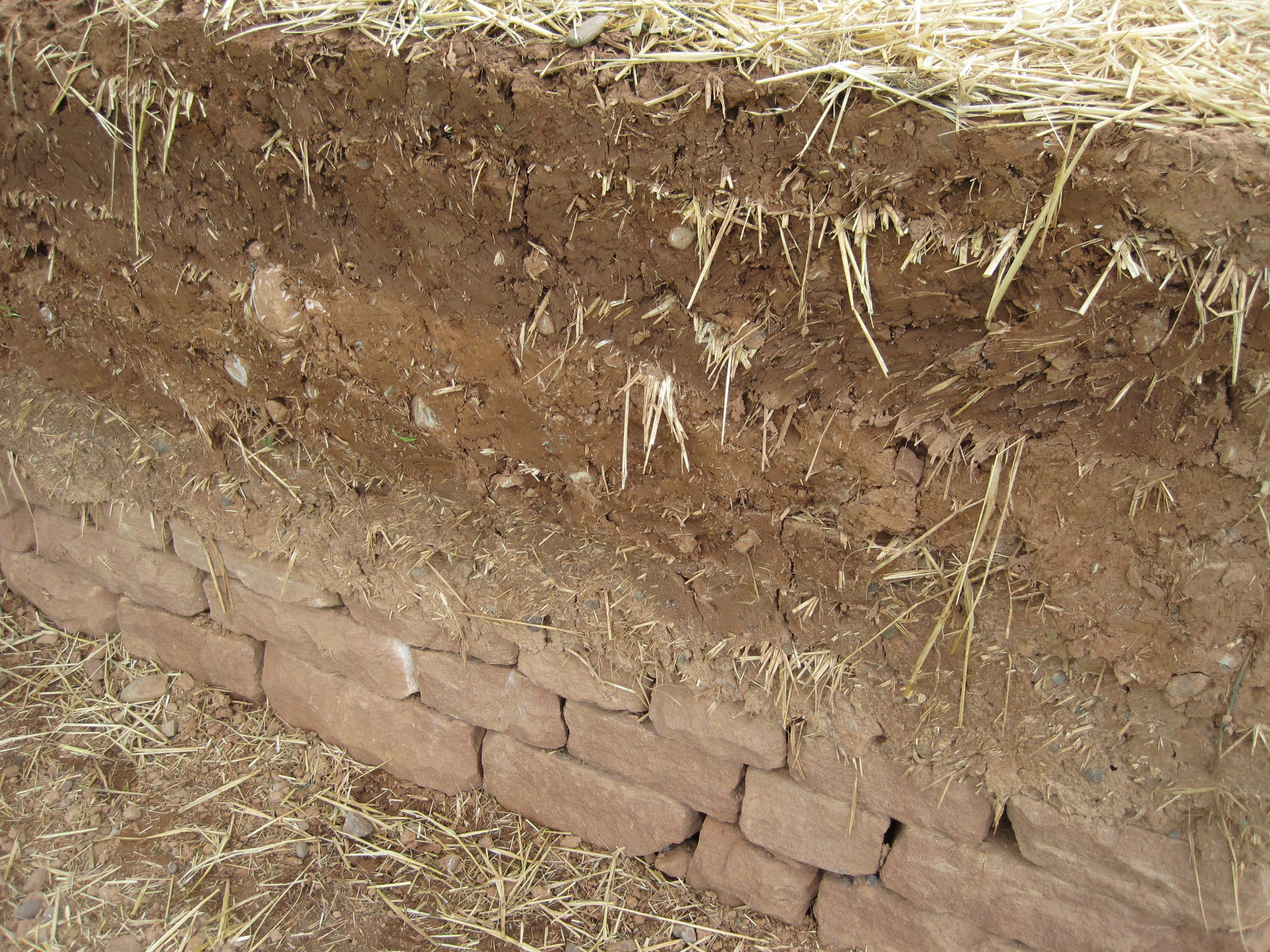
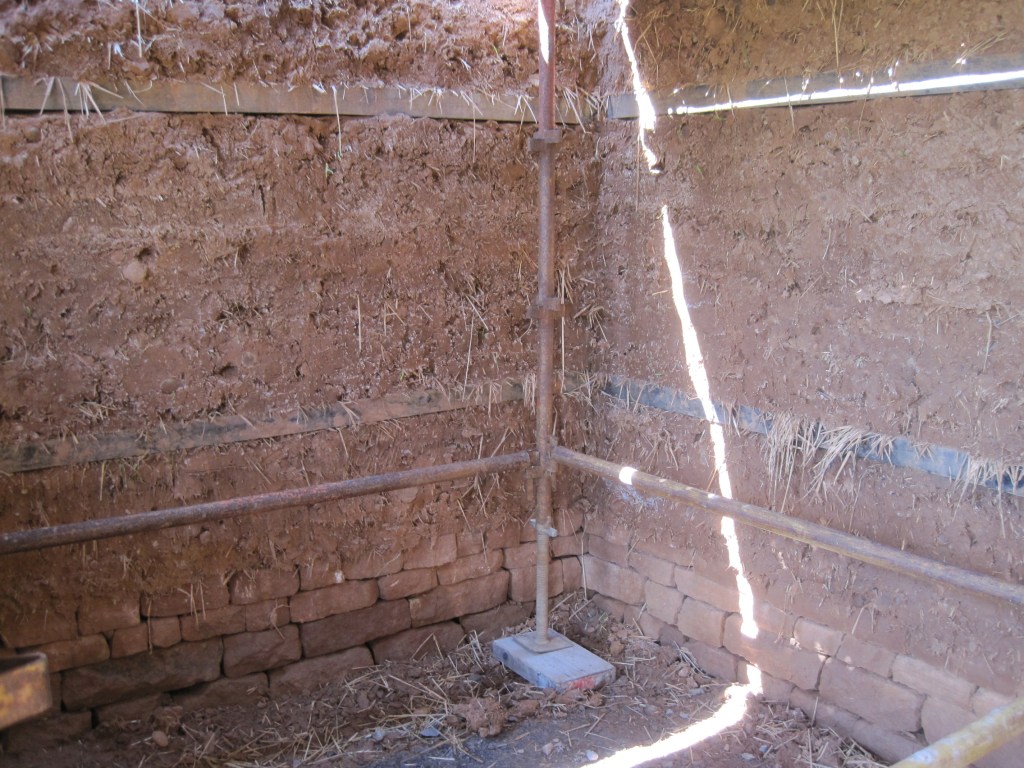
Sandstone plinth, layers of clay dabbin and straw
By adding straw, the whole becomes, essentially, a ‘composite material’ – the straw lends strength and prevents cracking. The amount of water added to the mix is critical (neither too much nor too little, cf Goldilocks).
“The ratio of straw to mud is when it looks about right! You get in as much straw as possible, it adds tensile strength.Sand helps with the plasticity, so it’s not too claggy.” Chris Spencer
Then the well-trodden mix is lifted onto the wetted plinth, and spread and trodden again.
Peter Messenger writes that
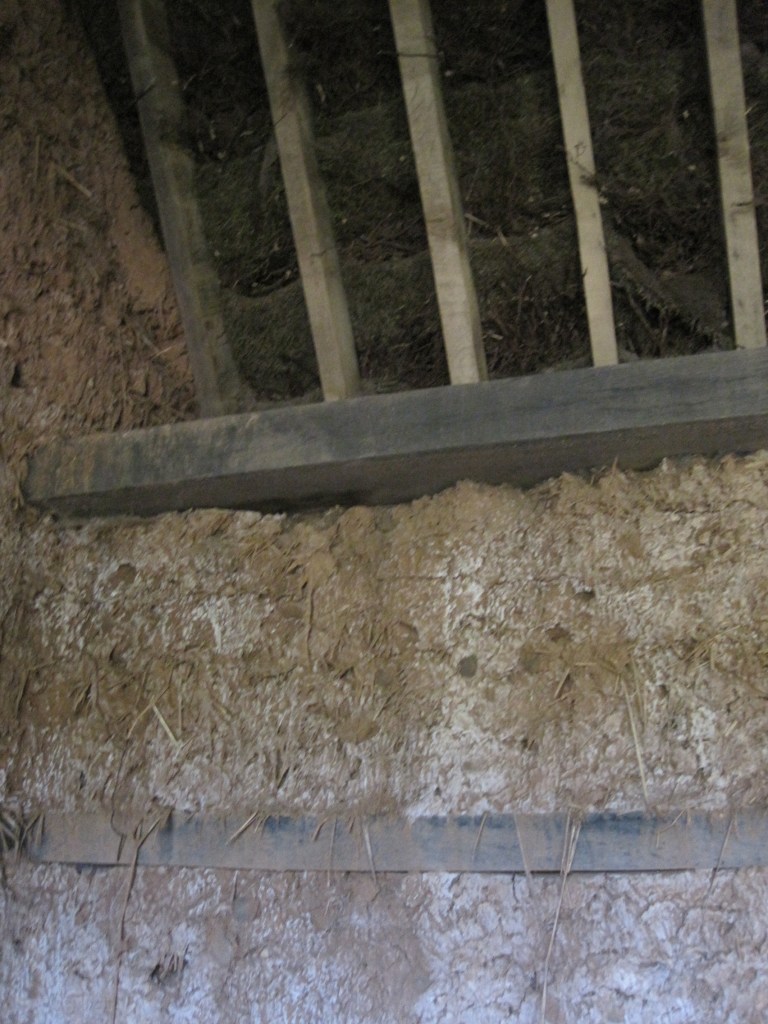
“The layer should protrude a little beyond the line of the plinth (c. 50mm) and once a depth of c.100mm has been reached a thin layer of loose straw is spread over the surface of the lift. This will appear to be about 50mm deep but once the next layer has been laid on top of the straw its depth will reduce to about 15mm or less.”
These interleaved layers of straw act to suck out the moisture from the mixture, and because all the layers are thin the wall can be built to its full height without having to allow intermittent periods for drying-out.
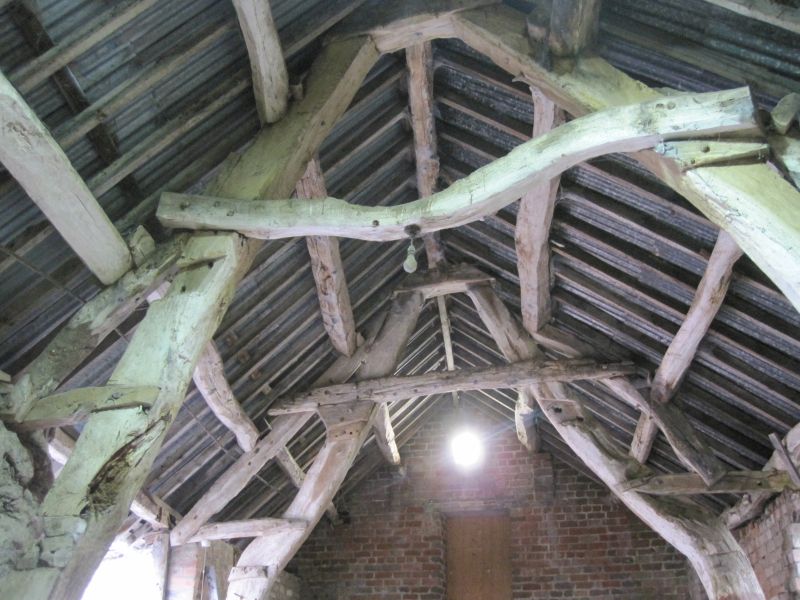
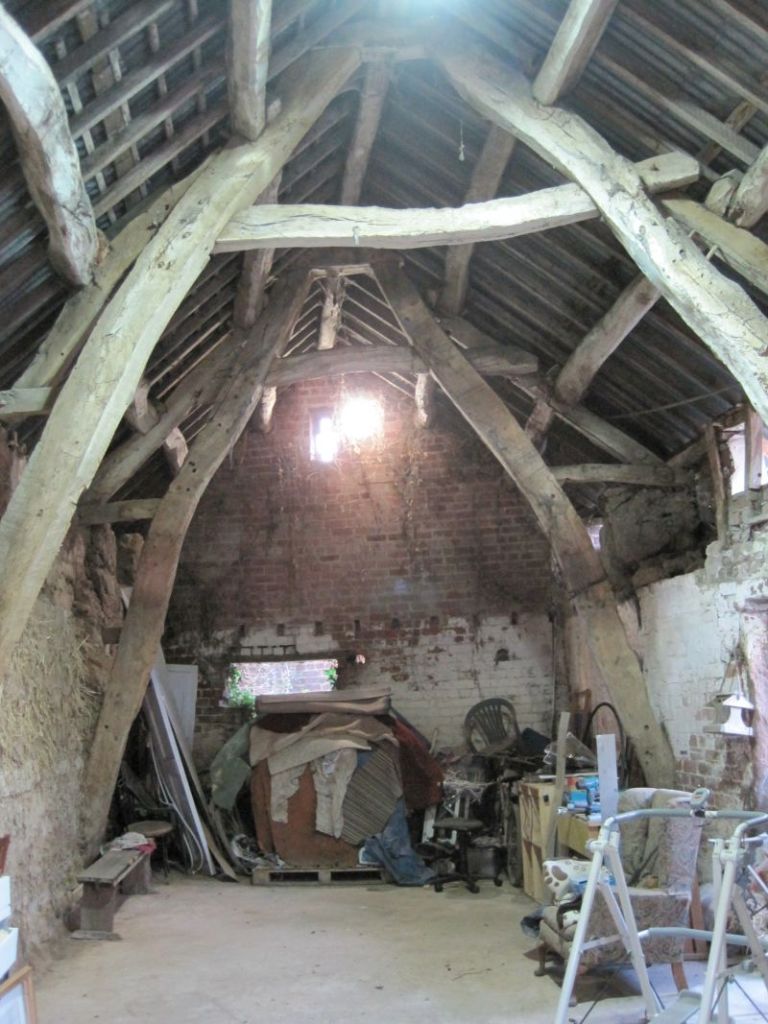
During construction, lintels for doors and windows are put in place, and traditionally the supports for the roof were wooden ‘crucks’, tied together by wooden cross-trees, often with purlins running the length of the roof.
Cruck fraem in a barn at Burgh-by-SandsCruck-framed barn at Burgh-by-Sands
Various materials – including turf and heather – were used for thatch, and the walls were rendered inside and out with lime-render, to prevent rain penetrating the dabbins and causing it to slump.
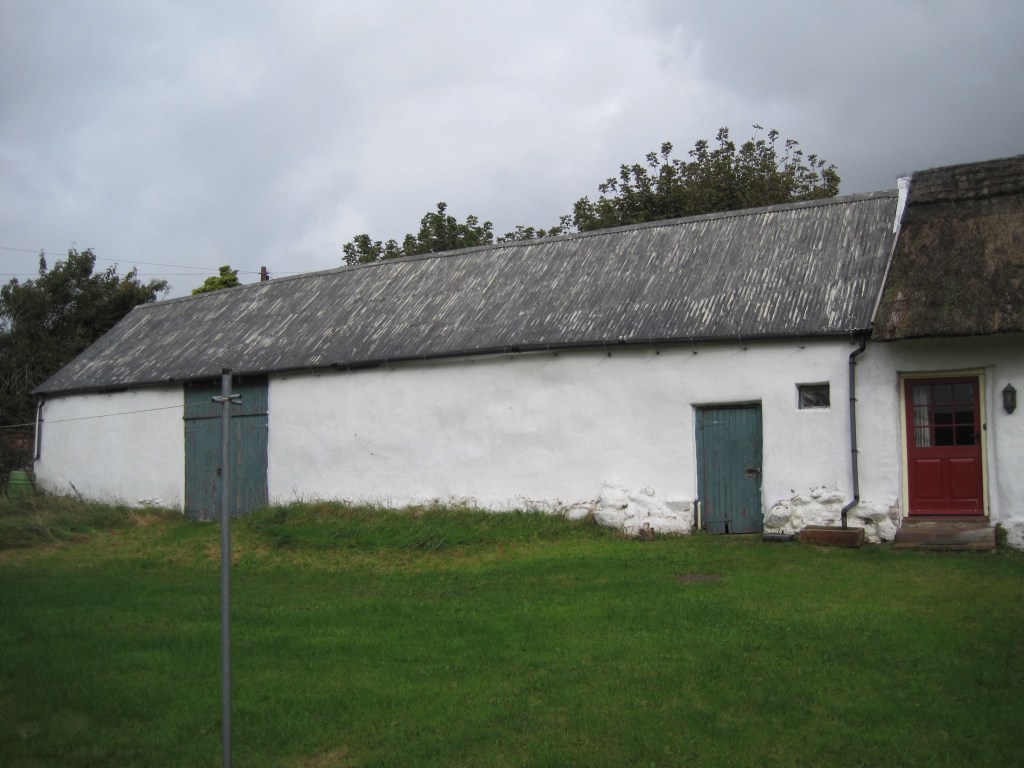
Dabbins house at Burgh-by-SandsPart of a ‘long-house’
A few years ago, I joined one of Peter Messenger’s walking tours around Burgh-by-Sands, where several dabbins buildings (variously decaying or restored) and cruck barns remain. He showed us a typical ‘long-house’, the living end of which was separated from the byre by a cross-passage; on another house, the cement-rendering had come away to show the layered dabbins underneath. A handsome cruck barn behind a farmhouse had been recently patched with new dabbins.
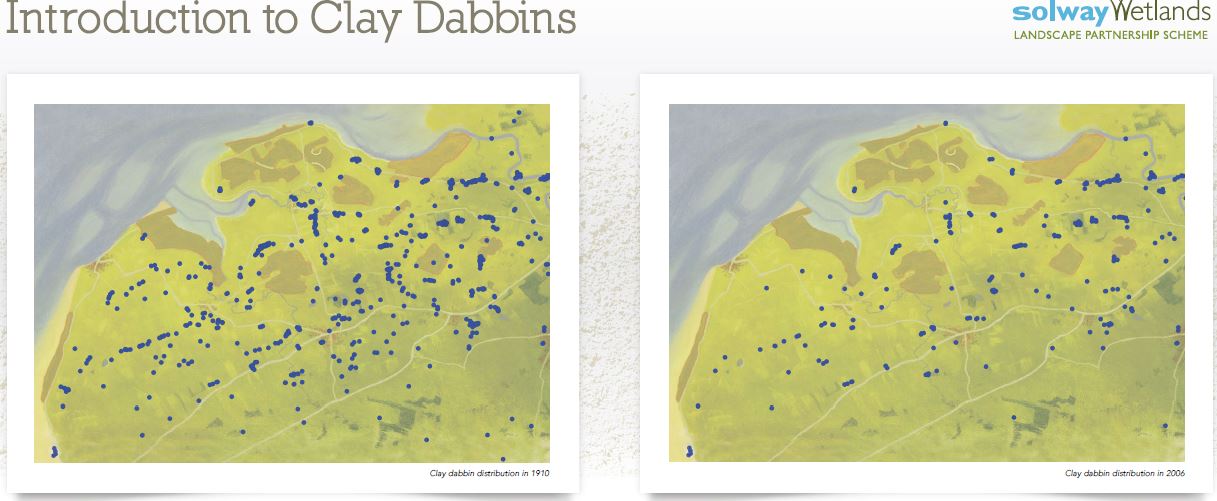
An early 1900s survey found about 1500 dabbins buildings around the Solway Plain, but by the time Nina Jennings carried out her own survey nearly twenty years ago there were only about 300 remaining. Her 2003 book, Clay Dabbins: Vernacular Buildings of the Solway Plain is the classic reference book, containing entertaining stories of some of the home-owners – and Jennings herself was an extraordinary woman, who started a degree in electronic engineering, was a member of the anti-war Committee of 100, active in CND, and a keen walker and skier; she died in 2015.
Peter Messenger’s own surveys have found many dabbin buildings in a sorry state of disrepair, with damaged rendering and unstable walls. The problems are caused by water ingress – “Waterlogged clay turns to mud, which slumps and collapses.”
He was instrumental in persuading Alex Gibbons, a William Morris Craft Fellow specialising in earth buildings, to move to Cumbria and become practised in restoring dabbins buildings. (An update on Alex’s work is in my ‘Quicklime’ post, as part of the ‘Limestone’ series.)
They, and Chris Spencer of the Solway Wetlands Landscape Partnership (SWLP), realised that to help people – owners surveyors, builders – understand how to protect and repair this special type of building on the Solway Plain, a practical demonstration would be not only useful but an entertaining (and muddy) project that could gather local volunteers – of all ages – to its heart.
And so, on April 25th 2016, the dabbin building was started, with financial and other support from a large number of organisations: it was part of a four-year grant to the SWLP from the Heritage Lottery Fund, and has been constructed on the RSPB’s Reserve at Campfield near Bowness-on-Solway.
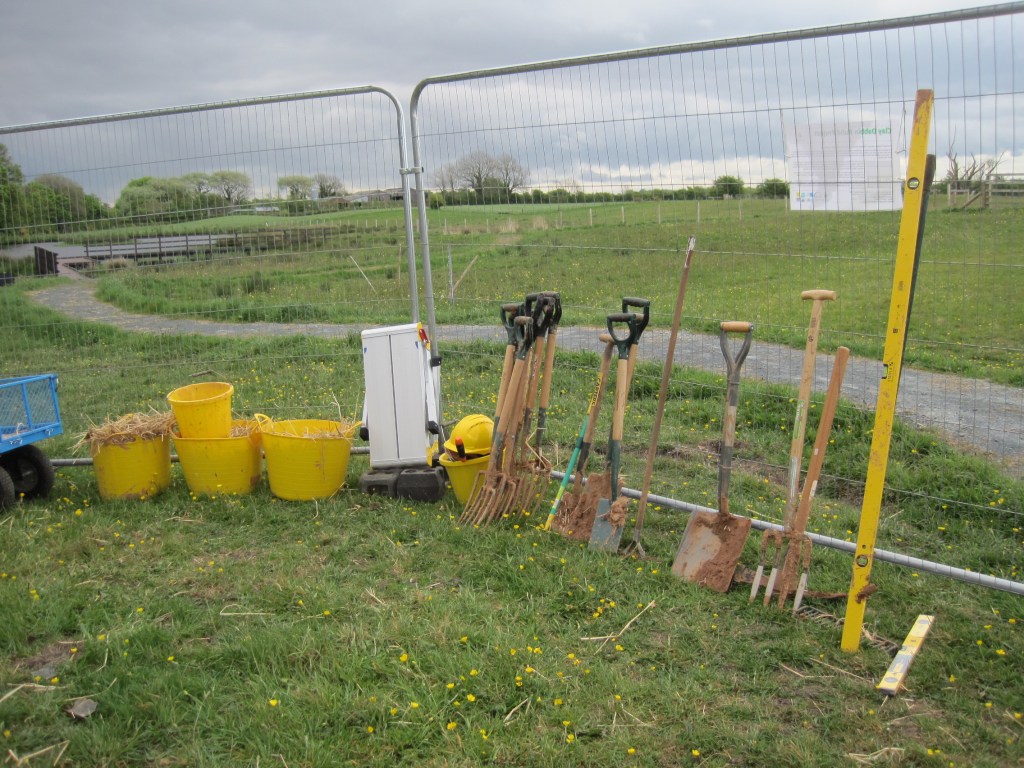
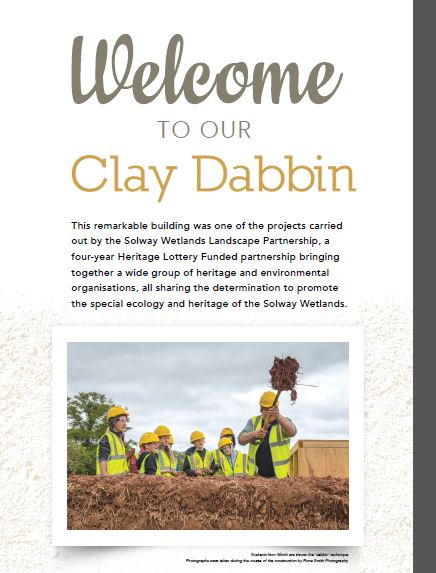
It’s been a wildly popular project. Hundreds of volunteers have helped, including a group of land-agents and RSPB wardens, fit retirees and conservation volunteers of all ages. “A group of building inspectors came out to do several training days – before that they had no idea about dabbins buildings,” Alex said. Chris worked especially with groups of school-children: more than 150 students came from seven local schools. “Local kids came from villages where there were clay dabbins buildings. They used their hands – hand-balling the mixture – and then forks. It was a great opportunity for them and we loved having them around. It helped that it was fantastic weather!”
The plinth of Penrith sandstone was laid, marking the base of the 4 metre by 5.5 metre building. “There’s no damp-proof course,” Alex explains. “The stones have gaps between them. As long as you use breathable materials, any water should evaporate. It’s all about being able to get the water away again.”
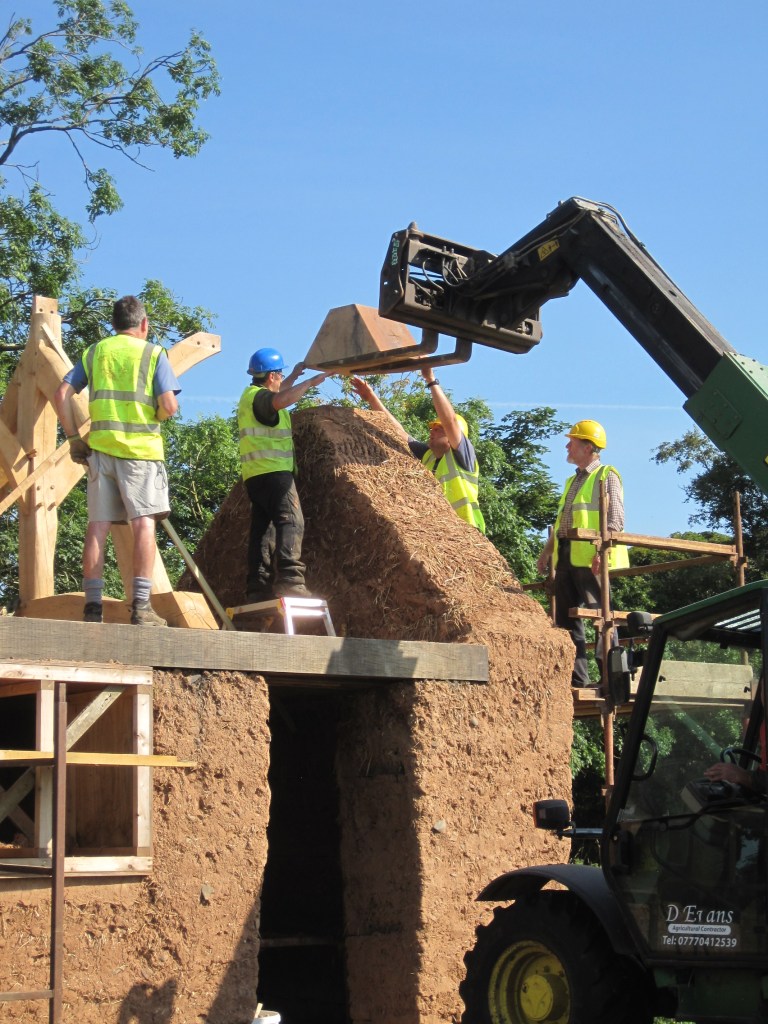
Mixing the clay and sand and straw is heavy work. “We used a tractor to do a batch-mix. It lifted the clay really, really high then dropped it, a big splodge,” Chris laughed. “We built it in four-inch lifts, then put a layer of straw on top. Then you immediately build the next layer on top of the straw, which binds it all together. As we got higher we put up staging, so we could raise the floor level and then just tipped the material onto it. This stuff is incredibly, incredibly heavy – so we used a tractor bucket to lift it.” The sides of each layer are sliced off flat where they slump over the layer below.
Constructing the building with the help of volunteers inevitably took longer, because it depended on availability of volunteers, of Chris and Alex – and, of course, on dry weather. As Alex said, “If I’d been building it with a team of guys that I’d trained, I reckon we could do the clay walls in three weeks – obviously with the help of a tractor, too. It is conceivable that it could be done in a day, using lots of people from the village, say. People with the fitness of the 18th century, rather than someone like me who stops for an egg sandwich!”
By May 2016 the dabbins layers beneath the window were in place; by July the wooden window-frame had been incorporated and the timbers for the roof had been prepared (see photos above).
July 2016Inside: July 2016August 2016
Some of the oak – for the wall plates, the ridge beam, rafters and so on – was sourced locally, from wind-felled trees at Setmurthy.
“We went for truss construction in the end, not cruck,” Chris explained. “Mick Read, the joiner, is a genius with oak!”
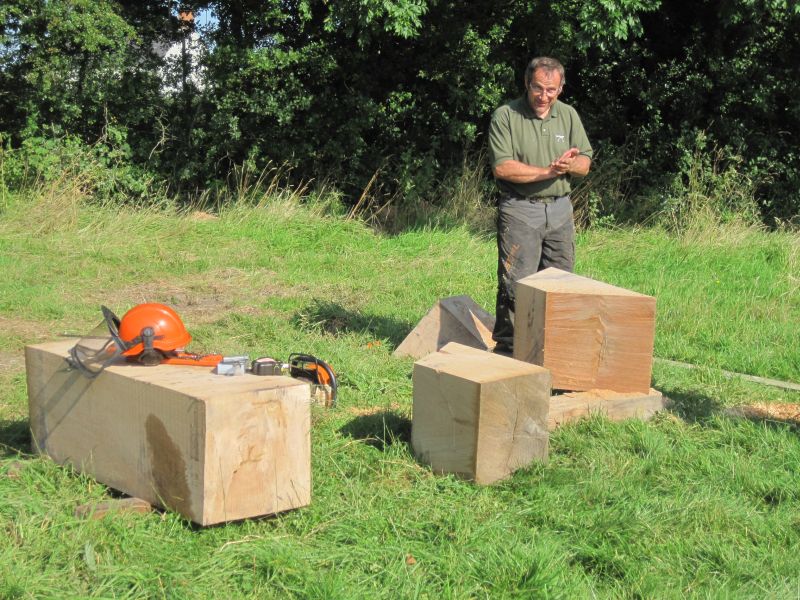
Mick, who lives across the border in Canonbie, told me that he started as an engineering apprentice, then went into carpentry making furniture, and his interest in wood led him to tree surgery, “specialising in portable chain-saw milling. It’s small-scale equipment, quite light to transport – but time-consuming and slow. Basically, I have the option of going into a woodland, selecting a tree, and then milling the wood that has a bend in it.” In other words, producing timber that has two flat sides and two curved sides.
He found the oak for the truss – the tie beam, king post, truss members and wind braces – “at the back of the Canonbie sawmill. There was a ‘firewood pile’ of oak trees. The owner said ‘Take anything you like’. He let me chainsaw it and take it away, and gave it to the dabbin for free! I milled it at my house, framed it, then dismantled and labelled it, and brought it here.”
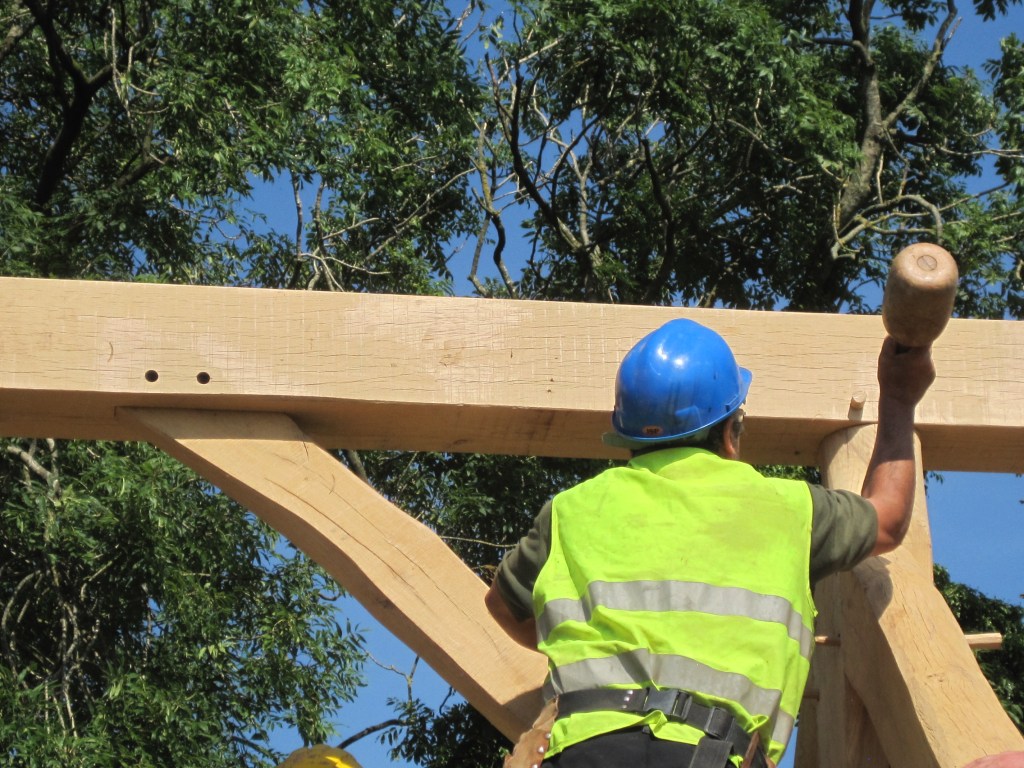
Mick also made the wedge-shaped pegs, and drilled the off-set holes in the beams. ‘You hit the pegs in, and the wood shrinks and tightens up the pegs. It’s quite an old way of construction.’
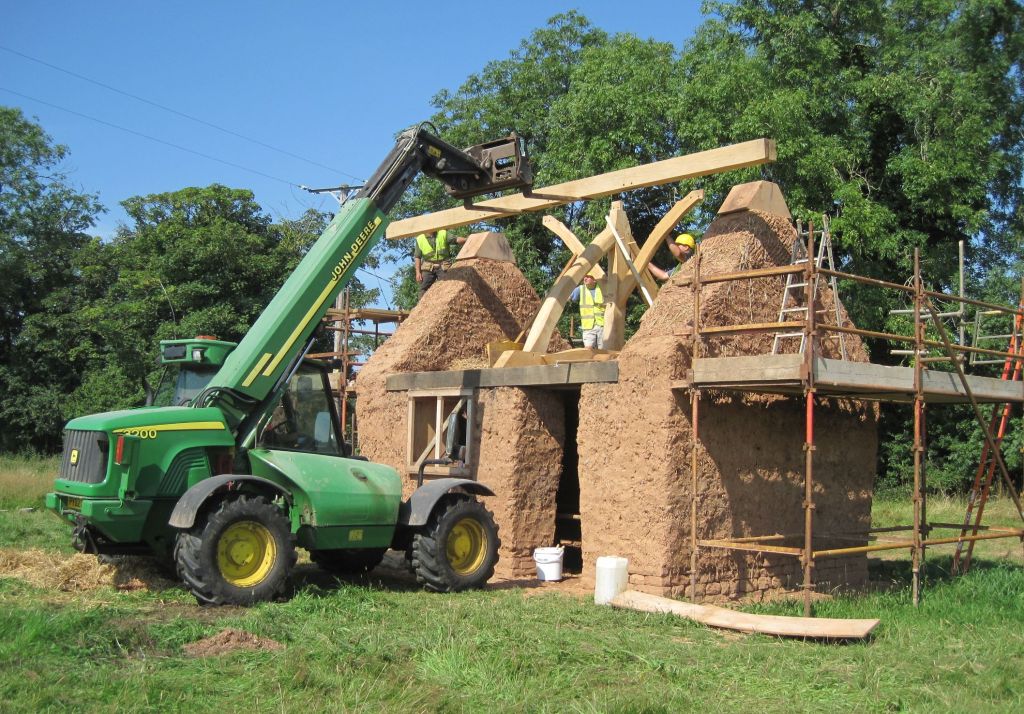
Mick Read enjoying chainsaw workLifting the blocks into placeThe final timbers are lifted…… and lowered into place
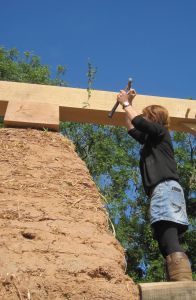
In August, he supervised the lifting and fixing of the truss roof timbers. As project photographer Fiona Smith and I watched, Chris and volunteers had little trouble steering the timbers into place. Chris was full of admiration: the tractor-driver “just dropped it onto the tenon on the kingpost and it fit so well we just had to give it a knock with a hammer.”
We hastily found a sprig of hawthorn and Fiona climbed up to nail it in place for the ‘topping-out’ ceremony.
Fiona ‘topping out’
Wilson Irving got a small bursary from SWLP to take part in the EBUKI 2016 festival, and has worked on the dabbins house throughout. “I came on training days, and to the workshops on making dabbin and heather thatching. I was involved more or less from the beginning. I didn’t do the drystone wall at the bottom,, but I helped with the dabbin, put on the wooden wall plates – they rest on the dabbin and spread the load of the roof. And two of us helped Alex build the gables. I enjoyed it all – but seeing the truss go up was the best bit.”
That was Chris’ favourite moment too. “It was all good! But lifting the roof timbers on was very good, it felt like it was marking a sense of completion, the mud work was over.”
rafters in placeHeather thatch finished
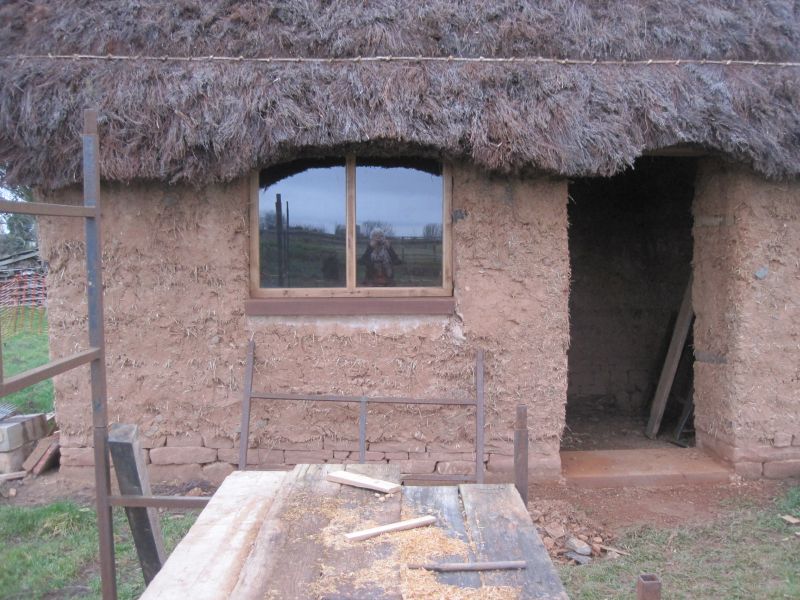
Over the next couple of months, the rafters were nailed in place and the thatcher William Tegetmeir from Scarborough, “a real craftsperson” according to Chris, laid the heather thatch. The door and window were completed and the building was water-tight – but not yet weather-proof.
The rendering of the inside and outside walls
Render tests
was done by Alex early this year. “The outside was done by harling – using a scoop-shaped trowel and throwing it on. I used a limewash of pure lime putty mixed with pure clay putty – the clay is screened down and water added.” In contrast, the inside walls are smooth, with flat plaster that reflects the light.”
Then there was the floor. “The base layer [of the floor] is about four inches thick, it’s rubbish, screed – everything that didn’t go through the screen. The top layer’s screened-down mud mixed with the sand and tamped down.”
Tamping down the floor
John helped with the tamping, and we went to help again on the day the ox-blood was to be added.
As we arrived, two dumpy bags of Dalston sand were being delivered to the dabbins’ door. “You’d think we could go and get some sand from the Solway just up the road,” Alex said, “but it’s all too muddy.This sand’s slightly rough, it holds together well.” He squeezed some to show us, and it kept its shape.
And the ox-blood?
‘What am I supposed to do with this?’‘Thick or thin mixture?
“I heard about blood from various people – it’s one of those folklore things.”
We were using dried and powdered blood. We tried mixing the powder with water to various consistencies, and there was much hilarity and discussion about the best way to apply it to the surface of the floor.
Alex speed-painting the thin mixtureAnd trowelling on the thick …
“I’m calling it experimental archaeology,” Alex said. “It sounds better than saying I don’t know what I’m doing! When I’ve looked at old floors, they’re always really black.”
In the end, Alex painted on the mixture. Apparently it was very smelly and ‘furry’ a week later! But on the day of the official opening, April 28th 2017, it was clean and firm, although it was generally agreed it would probably need a linseed coating to ‘fix’ it.
***
Three pupils from Kirkbride Primary performed the official ribbon-holding and cutting, and the building – now fitted with solar-powered LED lights and very helpful interpretation boards – was open, a year after it had been started.
Chris and Kirkbride students ‘open’ the houseExplanation panels‘Job done!’:Wilson, Alex and Mick celebrate
As Chris Spencer said in his opening speech, “Many hundreds of people have helped – with the drystone walling, the clay-building, the thatching – it’s been quite an amazing year centred around the building.”
The dabbins house “shows how the Solway vernacular buildings were made. It’s also important to show that they are under threat around the Solway Plain. We hope from this to help people understand how to care for them and mend them.”
And then, of course, there was Elizabeth’s cake…
House complete with dogAlex cuts the cakeDemonstration of what happens when clay walls slump
Bowness Moss, looking towards the Solway; Rogersceugh Farm on its drumlin in the foreground (Copyright James Smith, with thanks.)
Bowness Moss or Common is one of the South Solway Mosses National Nature Reserves, NNR. The near-pristine centre of this raised mire is a Site of Special Scientific Interest, SSSI; it’s also a Special Area of Conservation, SAC. Acronyms are alienating but the reality of their being is important: I’ve tried to explain why elsewhere.
I could write a paean of praise to Bowness Common by searching for metaphors and complicated synonyms to exercise your mind, “sympathising in some fuzzy way with the totality of nature and the interconnectedness of things”[1].
Or I could write a check list – tick, tick, tick – of everything I have seen.
Here is the list, summoned from my memory not from a note-book, of some of the plants, mosses and animals I have seen amongst the hummocks, ‘lawns’ and bog-pools of the central mire (there are many more but they are currently nameless because I need some expert tuition in identification).
10 species of Sphagnum moss
Bog rosemary
Bog myrtle
Cranberry
Heather
Cross-leaved heath
Bog asphodel
2 species of cotton grass
2 species of sundew
Butterwort
Assorted sedges and grasses
Rushes
Frogs and spawn
Lizards
Adder
Roe deer
Fox scat & otter spraint
9 species of dragonfly and damselfly
Caterpillars and pupal cases of oak eggar moths
Grasshoppers
Midges
Curlew
Snipe
Reed buntings
Peregrine
Larks
Pipits
According to Fortey [1], “A list of animals and fungi could become tiresome, but it is necessary to grasp the true richness of nature. Think of it as not so much an inventory as a catalogue leading to compelling and interacting stories…”
Now enjoy trying to imagine how those ‘compelling and interacting stories‘ might play. This requires some effort and certainly some patience, but perhaps it will imprint in your mind the importance of the Moss – of any Moss or peatland. Perhaps, by creating the stories in your mind, instead of being handed the words on the page, you will start to understand the characters and the sense of place; perhaps you will enjoy a sense of ownership.
So, imagine those stories in three dimensions: burrow into the ancient peat, bask in the sun on a boardwalk, hide amongst Sphagnum floating in a pool, flit above the heather, rise up into the air.
And then throw in the fourth dimension, of time: imagine what is happening around you on your ‘virtual Moss’, minute by minute (as a damselfly flits), day by day, week by week, through the seasons … the years of growth past and future.
Imagine the smells, of wetness and hot, dry heather.
And then try to imagine the sounds – what might you hear?
But imagine too, and above all, the silence; a silence that is comfortable with itself.
***
The impact of humans on Bowness Common has been a grimace on the face of its geological history and now we’re working to smooth out the wrinkles. Let’s hope that we can continue to feel, in Paul Kingsnorth’s words, “that the natural world, the non-human realm, is not an obstacle in the way of our progress but a part of our community that we should nurture” [2]. Imagining the interacting stories on the Moss might help.
Bog myrtle
Bog rosemary
Whitebeaked sedge, sundew and cross-leaved heath
Cranberry
Cross-leaved heath
Common sundew
Lizard in the sun
[1] Richard Fortey, 2016. The Wood For The Trees. The Long View of Nature from a Small Wood. Collins
Peat-cutter’s barrow, tools & foot-boards. Scale model made by Mr Malcolm Wilson (see below)
“I just went and asked for a job – I fancied gaan cuttin’ peat. The foreman said, ‘I’ll take you up on the moss’ – and what a walk it was! A big wide open space, peat stacks everywhere. And I thought, I’ll have a bit go at it.” And so Thomas Holden and his cousin went to work on Kirkbride Moss.
The Solway Mosses – Wedholme Flow (which includes Kirkbride Moss), Glasson Moss, Drumburgh and Bowness Common – are unusual in that they are raised mires, not blanket bogs, and as such are very special. They are now of course protected by several important conservation designations but previously they were used as turbary – where individuals and families had their own ‘stints’ to cut peat for fuel – and then commercially for compost and other products.
Google Earth image. South Solway Mosses = Wedholme + Kirkbride MossRed line shows Kirkbride Moss on Wedholme(thanks to Frank Mawby)
The Cumberland Moss Litter Company at Kirkbride was started by a Dutchman, Henry Engelen. This might seem surprising, but peat-cutting and drying on a commercial scale requires well-founded knowledge of cutting and draining the landscape, and the Dutch had been designing and overseeing peat-works in England and Scotland since the late 19th century. Indeed, a Lodewyck Engelen (Henry’s father?) is recorded as among ‘the Dutch’ who came across to work with the Midland Moss Litter company on Whixhall Moss in Shropshire in 1926.
“My mother’s side of the family were Dutch, too,” Engelen’s son (also Henry) told me. “Her father came to Airth in Scotland in about 1920, and they had Blackburn Moss at Fauldhouse near Bathgate.”
It was there, as a young woman, that she met and married Henry Engelen; they moved to Horwich, near Bolton in Lancashire, where Engelen set up the Lancashire Moss Litter Company in 1931; next in his sights were the deep peat Mosses to the South of the Solway and so, Henry Jr told me, “He bought up some of Wedholme Flow, and they had two mills near the hangars on Kirkbride airfield. He used to travel there on a motorcycle, and lodged at Whitrigg.” Once the Cumberland Moss Litter Company was established at Kirkbride Moss, the whole Engelen family moved up to Cumberland.
Patrick McGoldrick, now in his seventies and living in Carlisle, was born in Ireland; his father came over to Scotland in 1927, where the family later joined him. I first met Patrick and his twin sister Bridget at Port Carlisle, where they were taking part in the oral history project, ‘Remembering the Solway’[1], and later I visited them at their home to hear more of his stories about working on the Moss. Patrick, with a shock of white hair and a soft Scottish accent, told me about his father: “Dad worked on at least four mosses in Scotland, the last moss was Blackburn [2], in Fauldhouse about three miles from Bathgate. It was owned by the Dutch, they were all owned by the Dutch. Some got worked out, they were not as deep as Kirkbride [Moss]. At Kirkbride you could dip your big ash pole in as far as you could and still couldn’t feel the bottom.” (Frank Mawby, former Reserves Manager for Natural England in the North-West, told me that coring had shown about 10 metres of peat in some places on Wedholme Flow – and that it must have been even deeper before the mire was damaged by cutting.)
Bridget and Patrick McGoldrick (peat-cutter), and Tommy Atkinson (peat-mill worker), at Port Carlisle 2016
“The boss said to my Dad, ‘My son-in-law, he’s a big man down in England, at a place called Kirkbride in Cumberland – and he’s desperate for skilled men to work.’ I was fourteen-and-a-half at the time – it was just at the start of the school holidays – and me and my Dad landed down in Kirkbride. There were four ex-RAF sheds, me and my Dad got one [to live in].” Patrick’s mother stayed in Blackburn with his seven sisters, and moved down later.
“We got there and Henders [the foreman?] said, ‘There’s a lot of stacking to do, some of it’s just stooled, some just walled’– so we went stacking. I helped Dad. As life went on, after eight weeks, the school-board man came looking for us. ‘Why’s that laddie not at school?’ But by then it was tattie-picking time – we had a week off school for that – so I was able to stay on. Dad went on cutting and I got a job at a farm at Kirkbride. Every time I could I went to the moss with my Dad.”
Stooking and sticking and batting
Stooling/stooking, walling, stacking; stickers, bats and spades: the language for cutting and drying the peats varies from country to country and region to region. The shapes of the tools vary, too, as do the patterns of piling peats to dry.
Tools were personal and precious. “My Dad used to look after his tools, he had a big stone and a file to keep them really sharp. We always carried our tools over our shoulders. Then we went back to Ireland for a week’s holiday and he put them in a ditch that had running water in it, to keep the handles tight. When we came back the tools were missing. He said, ‘Patrick, where did I put my tools? I was sure it was in that ditch but they’re no’ there. Somebody’s pinched them.’ There was this big guy, broad, Big Stan the Pole, and he wasn’t a grafter, his tools weren’t good. Big Stan would have fought anybody. And Dad said, ‘Aye, he’s cutting peat, I’m going to see his tools.’ And there was the stripping spade, the tools, all with my Dad’s initials on them – he’d carved them on the handles. Stan was in the ditch working and my Dad says, ‘That’s a good set of tools you’ve got here. They’re mine.’ ‘No. No, Frank, you bugger off.’ And Dad picked up the spade and put it to Stan’s throat – he got his tools back! Anyway, Stan got some more tools. And then I saw them, sitting on the bank, and my Dad was sharpening his tools for him!”
“Your tools – the blades were never rusty,” Thomas Holden told me. “You stuck them in the peat at the end of the day, and they came out really clean and shiny, it must have been the acid in the peat.” Thomas had got in touch with me when he heard that I was interested in talking to Kirkbride peat-cutters, and had invited me to his home in Aspatria; he had started cutting peat when he was in his thirties, and later had driven the workers’ bus. Even though he is now in his seventies, he still had happy memories of that time, although “it was hard work, but I was younger then. You got worked-in!”
Patrick had explained how to use the various tools. “You put down a line then cut a mark along the line with the sticker [Dutch stikker], it’s flat with a handle, and very very sharp, about 15 inches long.Then you stripped off the heather, with like a turfing
Swan-necked spade: scale drawing (2″=1ft) by Malcolm Wilson
spade.” He still has his father’s spade and went to fetch it from the shed. The shaft is curved (‘swan-necked’), the blade pointed; he showed me how he’d cleaned it and repainted the metal part green, then demonstrated in the sitting room how to push it in at an angle and lift the turf.
The layer of heather and grass stripped off the top was thrown down into the ditch “with the heather up so it widnae die back”, to keep the bottom of the cut drier and to protect the underlying peat.
“The bat was used for cutting the peats, its blade was only 4-5 inches wide—” (he drew a little diagram on my note-pad – it looks a bit like a cricket bat, with its long, narrow blade). Standing in the cut, “You cut in at an angle, then lifted out the peat and heaved it up onto the bank.”
In July 2017, at the ‘launch’ of the oral history project Remembering the Solway, some of the peat-cutting tools were on display:
Peat-cutting tools: bat, sticker & spadeGordon Wanning demonstrates how to use the bat
Mr Wilson’s models
Another person who contacted me about the Kirkbride peat-cutting was Malcolm Wilson; he told me he was 88 years old, and his family had lived in North-West Cumbria – Calvo, Holme Cultram and now Silloth – since the late 1700s. He used to go out on the Moss where the lines of peat-stacks “were like a village, nearly”. Malcolm has been a model-builder for most of his life, building yachts, barques and ships like the Bounty from scratch, making and assembling all the parts himself. Some of his exquisitely detailed models have even been sold at Christies. But in the 1980s, the manager at Fisons – the company were still cutting peat commercially at Kirkbride – asked him to make models of the tools and barrows as gifts for members of staff who were retiring.
Malcolm had visited the Kirkbride workings to measure the tools, and in the course of a few years, he had made six or seven scale models. Now, as the warm Spring sunshine flooded into his front porch, he unrolled the scale drawings that he had made in 1989 and showed me photos of the beautifully detailed finished pieces. Suddenly, movingly, the reality of what Patrick and Thomas had been describing became very clear. And before I left, Mr Wilson gave me his precious drawings and photos, insisting that he was glad that they were going to someone who would appreciate them. I shall treasure them.
Scale model of barrow, tools and foot-boards, by Malcolm Wilson
The area for commercial cutting at Kirkbride was mostly brown peat, and not used for fuel, but individual and families had stints around the edge of the Moss. According to Thomas, “Some of the peat was like butter, but it was more fibrous where we were cutting ‘cos it was used for gardens.There was peat being cut for fires too – that was black peat. It was dark and thick, and it curled up like a banana when it was dry. They used a different tool, like a bat but with a blade on the side so it was L-shaped, it could cut the bottom and the side at once.”
This blade with a flange would have been like the Fenland ‘beckett’, Irish ‘slane’ or Scottish ‘flauchter’ [3], or the tairsgeir of the Outer Hebrides. Artist Anne Campbell, with the help of Finlay Macleod and others living on the Isle of Lewis, has produced a glossary of Gaelic words relating to the moorlands, and especially to the cutting and stacking of peat. The words are collected together in a delightful pamphlet Rathad an Isein [4]: all parts of the tairsgeir have their own name, so important is the cutting of the peats on the island. The book’s title means The Bird’s Road – the narrow gap left on top of the bank between the cut edge and the gàrradh, the stook or stool.
The cuts and drains
The peats, then, were dug out along a line or cut. “The cut was 22 metres long – it was all in metres because of the Dutch,” Patrick said. “The stacking area between the cuts was 10 metres wide – that was the bank, there was room for the stacks and walls and the rails.” These lengths, equivalent to 1 chain and a half-chain, were standard distances for constructing ditches to drain the peat on, for example, Thorne Moor [5] in Yorkshire, and Bowness Common for the Solway Junction Railway.
Patrick’s father “was a grafter. He could cut one-and-a-half lengths in a day.” And Thomas was full of praise for the Irish workers: “Those Irish fellas, they could cut a straight line, it was spot-on … The Irish, they were dab-handed, they used to cut the peats a lot bigger than we could. You couldn’t fault their peats. The tidier they were, the easier they were to stack. They had their own patch of the moss, and they looked after that lump of moss…”
“You got [paid] the most for cutting,” Patrick told me, “’Cos that was the hardest work. First you cut one peat length, then two down, then the two bottom ones. And you’d throw them up onto the bank.” Usually, one man would cut, another would do the stooking, but Thomas and his cousin seem to have worked in tandem.
Peat is wet, about 95% water, 5% solid material; if its integrity is damaged, all that water will escape. Peat-cuttings, then, were wet and slippery places, and ditches had to be dug at the ends of the banks to allow the water to flow away.
Scale drawing of a footboard, by Malcolm Wilson
Thomas Holden told me, “Every so often the ditch would lift ‘cos the peat rises, so you had to cut another depth off the ditch. … It was surprisingly how wet it was. You’ve got boards on your feet, you walk like a duck!” He laughed and stood up to show me, walking bent-kneed, bow-legged, across his sitting-room.
“The deeper you cut the wetter it got. We wore footplanks to stop you sinking. You had a piece of wood with the corners cut off. Then the bottom of a boot nailed on, and you put your wellies in and laced it up – we’d get bits of leather to strap the boot in, see?” Patrick explained.
Piling the peats to dry
All peat is wet, and the best peat, low down, was the wettest. Drying the peats seems to have been a complicated process on Kirkbride Moss, perhaps influenced by the Dutch way of doing things (‘stooling’ is a Dutch word for the first set of peat-piles).
Patrick tried to explain the three stages to me, lifting and stacking imaginary peats in his sitting-room.
First, there was stooling or stooking: heavy work, piling the new-cut peats 4-5 high, with one bridging across the top of each stook, in a way that would allow air to circulate. There would be about 5-8 stooks along the side of the cut. Stooking started sometime after Easter, and the amount they could do would vary. “My Dad could do about five a day. He’d tell me, ‘stand in the ditch, Patrick, it’ll save your back,’ because you’d be having to lift the peats and it was easiest with the first rows.”
Thomas called this stage ‘walling’ rather than stooking. “You’d put two down then another two on top crossways so the air blows through the gaps – up to about five peats high.” I had taken along some wooden blocks and he showed me what he meant.
Thomas Holden stooking the ‘peats’‘peat stooks’
The stooks were left for one or two months to dry, depending on the weather. Then, according to Patrick, the peats were taken from the stooks and built up into small towers eight peats high, with a hole in the middle; more peats were stacked, slanting, against the towers. “You might have 6-8 towers along the bank. The air could get through everything and that’s how they dried.” This was walling. “Walling would be finished the middle of July, it would all be dry by then.”
Finally there was the stacking. “When it all got dry, it was time to stack. We had two barrers, they were long with wooden wheels, the legs were short, mebbe six inches high.”
Part of Malcolm Wilson’s drawing of a barrow
Thomas explained further, “There were planks, we’d lay them each side of the walls and across the ditch at the end. We’d pile the peats on the barrer – they were quite light by then so you’d get on as many as you can – and wheel the peats along the planks and over the ditch. There’d be a space six or seven metres wide up the middle, you’d throw the peats roughly in the middle, then start to put them on the ground … building them up. The air gets reet through the stack. On the top you lay two peats so the water drains off. You get knackered throwing them up.” “The stacks would be all in a row right across the moss.”
“In the middle of your workings you might have 60 rows of walling,” Patrick said. “Dad would go way up the bunker [bank]– he’d run his barrer up and he’d build a tower to start about 12 peats high. Then you’d build the stack up against it, you’d empty your barrer and fling it all into the middle. The peats were then put in singly, up to 10 feet high. You put standards, peat standing up on end, then a whole row right the way round again. The stack would be like that—“ Patrick holds his hands up at an angle—“ to let the rain run off.”
It was all piece-work, Thomas said. “The foreman would come along and he’d make a note of how many peats you’d cut, how much you’d stacked.”
“You can imagine if it was bad weather you wouldn’t be earning much. But [Patrick’s Dad would] work to build up the peats so there was always walling and stacking to do. He’d put his wages on the mantelpiece every Friday night, he never opened his wage-packet. And Henders would come along and say ‘You two men have done as much work as these three other jokers’.”
Rails and locomotives
Narrow-gauge rails, Wedholme Flow, 2016: thanks to Mark Graham of Grampus Heritage
The dry peats then had to be taken to the mill – in waggons or bogies, drawn by a small, narrow-gauge locomotive. This meant that temporary rails had to be laid along the banks beside the stacks.
Patrick had started on the Moss when he should have been at school, but “at 15, they could legally employ me – and at that time you went to work filling the bogies. We could put the rails down even when we were young, we were strong. The only time we’d get to drive the locomotives was when we were putting the rails down!”
“The rails were tied to the sleepers by fish-plates and transported on a flat bogie, in pieces 4-5 yards long, piled 5-8 high on the bogies. Two men could lift them and put them in place. They were laid down all this way and that, it was hard to move the cart. I lost a few bogies in my time! There were sets of points too, to send the bogies to the different stack areas.”
Frank Mawby told me, “It was by all accounts an incredibly wet mire and I recall Pete Wanning [a later foreman] telling me that when they began the drainage of the main dome the bog sunk so rapidly that almost every morning they had to re-do the railway line because it buckled and distorted the tracks.”
Thomas, too, remembered the uneven-ness of the tracks. “The lads’d put their laal railways down, narrow gauge it was. It was all up and down, they’d need to chock up this bit, and let down that bit – there were some queer angles, like. The lines would be across the gutters and along beside the stacks – the lads’d stand on the stacks and throw the peats in the bogies. There’d be some fun with them, like, the bogies coming off the tracks …”
He talked about the locomotives being electric “with loads of batteries stacked on them, just sort of humming along. We used to ride on them sometimes ‘cos it was a long way to walk.”
Patrick’s memories were of diesel locos: “They were big diesel engines – originally from the First World War, 22-inch narrow-gauge. And they got a lot of the locomotives from the mines, the pits.” There was a driver – but Patrick had been able to drive too. “They could be hard to start. They had big crank handles, we used to tie a rope onto the handle and shout ‘pull!’ When it was cold, you got a peat and soaked it in the diesel, then you’d light the peat and put it over the air filter.”
According to a letter shown me by Henry Engelen Jr, Fisons (who took over the Cumberland Moss Litter Company) “arranged for a locomotive which [they had] donated to the Lakeland Mining Museum to be rebuilt for display and named Henry Engelen”. I went to look for it, so I could send him a photo, but although several men, young and old, who lovingly repaired and reconstructed old locos, were there, sadly none had any knowledge of that particular engine. I was, however, shown other engines from the Mosses – but none were intact, all were in various stages of decay, patiently awaiting repair.
Remains of the ‘Lincoln’ diesel locomotive at Threlkeld MuseumRemains of an electric (?) locomotive at Threlkeld
The mill
At the mill, “The first grind, that was granular, very fine, and it was all baled between four pieces of wood and wire, and then compressed. Then there was the tailings, that was rough stuff used for horticulture. Even during the war, the army came and used it for packing bombs – you know, they had nothing else for packing, eh?”
Henry Engelen told me, “The peat was milled for horticultural use, and also used to make firelighters. They sliced the peat, and then the pieces, like fingers, were treated with paraffin and then wrapped in cellophane – that came from the factory at Wigton [where the plastic film for banknotes is now made].”
Cutting peat was hard manual labour, but Thomas thought it would be better than working in the mill: “When the mill-workers come out of the mill they were absolutely brown with all the dust. And it was noisy in there, really humming, you knew when they were milling.’
Out on the Moss
It was unremitting hard work, but what comes over strongly is how much Thomas, and Patrick and his father seem to have enjoyed being out on the moss.
“And see, you’d see all the wildlife. Cuckoos – my Dad would never disturb cuckoos. There were dragonflies, and adders there too … The only thing my Dad would grumble about would be the midges – but he’d have his pipe and he’d puff the smoke. Even in the rain it was good.”
Southern Hawker dragonflyFour-spot dragonfy
(My thanks to Judith Rogers for these photos from her blog about Campfield Reserve)
For Thomas, “Mind you, I enjoyed it, there was a lot of freedom, there was nobody chasing you, like. What I liked about it as well, there was always a lot of birds there [he’s been a keen bird-watcher since about 12 years old]. There were cuckoos in summer, nesting in the meadow pipits’ nests – they nested in the stacks, and there were wagtails nesting there too. And I remember another thing, all the snakes – adders. One fella said he’d chopped more snakes in two than he’d hardly cut peat. The adders’d be curled up on the path, and they slithered away when you came.”
“On the moss, we’d get really dry, we used to run out of drink in the hot weather. We’d gaa across the fields and gaa to the farm and get bottles of lemonade – they made it there. We was absolutely gasping. … You could start at any time of day, some of them took their wives – it doesn’t mattter, as long as you get the peats.”
In contrast, “if it was really cold you could make a fire. If it was gey windy, where you’d stacked the peats you could take peats out and make an alcove, like. The peats would burn away faster than … they were that dry and light.”
Or, if you were near the mill, there were old railway carriages and, as Patrick recalled, “an old bus which was a bothy for the workers. We’d eat our pieces in there – we called it our ‘piece’ [that’s the Glaswegian term] and the men from Aspatria and Wigton, they called it their ‘bait-tin’.”
He remembers his father as a hard-working, kind and honest man: the photo in the sitting-room shows a man with a broad, kindly face. “He was only a small wee man – he had hands like leather. He was a grafter. As soon as he finished with his piece he started again. I always remember him, working away with his pipe in his mouth. He’d put it on top of a peat and forget where it was. Then later he’d be saying ‘You know, Pat, I’ve covered that pipe of mine again.’ In stacking the peats in the Springtime he’d find his pipe again and he’d always say ‘that’s the best smoke I’ve had for a month!’.”
But the men and the methods moved on.
In 1958, when he was nineteen, Patrick left the moss to work as a shunter on the railway.
Thomas left in 1963, having shifted from cutting peat to driving the bus for the peat-workers from Wigton. “It was the winter of ‘62/’63 – it was that hard winter, there was snow on the ground for months, everything was frozen. The covering of short moss, all over, it was solid. We went on the dole, and then I went to work on the chicken farm at Heathfield. I didn’t go back to the Moss after that.”
Henry Engelen Sr, meanwhile, went to Germany “to look at the automated cutting there, and he imported German cutting machines – which could cut, chop, lift and lay, so that the hard labour was done away with.” Engelen eventually sold the Cumberland Moss Litter Company to Fisons. After a management buy-out in 1994 Fisons became Levingtons; then Scotts took over the peat-cutting and milling in 1997, until peat-harvesting ended in about 2000.
The Moss was skimmed and ‘harrowed’, the heather all gone, the peat exposed and drying out. Patrick took his father back a couple of times, but they were upset at the changes, the lack of heather and vegetation, the lack of birds.
Wedholme Flow restoration March 2017Wedholme looking South, March 2017
(My thanks to James Smith for these aerial photos)
Since 2003, Kirkbride Moss and Wedholme Flow have been in the care of Natural England, and work is ongoing to repair and re-wet the damaged peatlands. If the many wetland species of Sphagnum moss can re-colonise, they will capture and store rain-water, the virtuous cycle of wetland restoration can re-start, and the mire will gradually rise up again. This could take several decades, but the first steps have been made.
We appreciate, now, (even though this often means re-learning, and reminding others) how unique and important the Mosses are in terms of their vegetation, their animals – birds, vertebrates ranging from lizards to roe deer, and invertebrates such beetles and dragonflies – and their importance as a carbon-store and record of the past.
The peat-workers, too, appreciated the wildlife and special-ness of the place, but in those days climate change and carbon stores were not part of the vocabulary. ‘Natural capital’ means different things at different times: then, peat was there to be harvested and sold, and peat-bogs provided work.
As for Henry Engelen Sr, after he retired “he liked his music, and his ballroom dancing – he’d often go dancing five times a week!” his son told me.“He bought the old British Legion hall at Silloth because it had a good wooden floor, perfect for dancing, and he took the floor away and used it in St Cuthbert’s Hall at Wigton.”
***
I am grateful to Patrick McGoldrick and his sister Bridget, and to Thomas Holden, for their warm hospitality and willingness to tell me about their experiences; to Susan Childs of the Remembering the Solway project for introducing me to Patrick; to Frank Mawby for helpful discussions about awards, stints and the history of Wedholme Flow; to Mark Graham of Grampus Heritage for the photo of the remnants of the narrow-gauge track at Wedholme; to Henry Engelen for a long phone conversation; and to Malcolm Wilson for his great generosity.
[1] Remembering the Solway, a video based on the Oral History Project with Solway Wetlands Landscape Partnership and the NE Civic Trust; see especially the first two interviews (David Hume, Margaret Sharples) about working and playing ‘on the Moss’.