Hobbling through Allonby with an Idle Apprentice

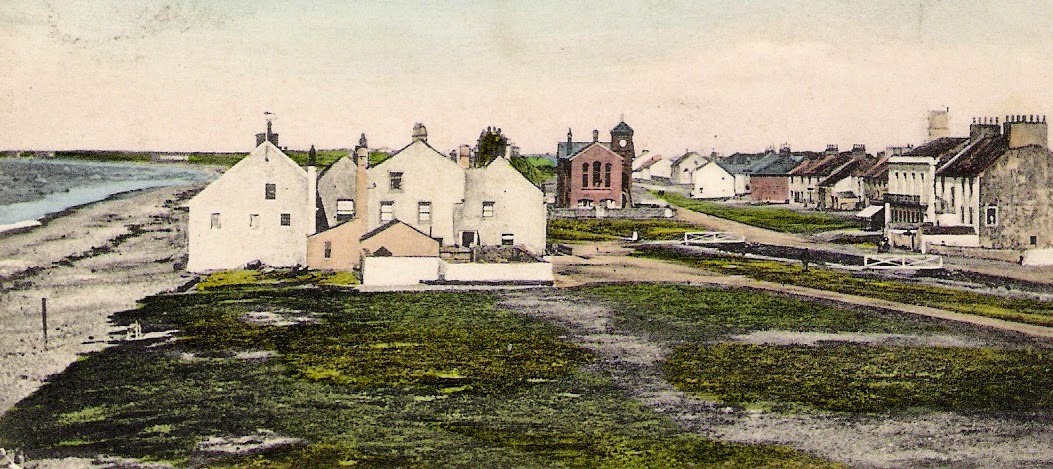
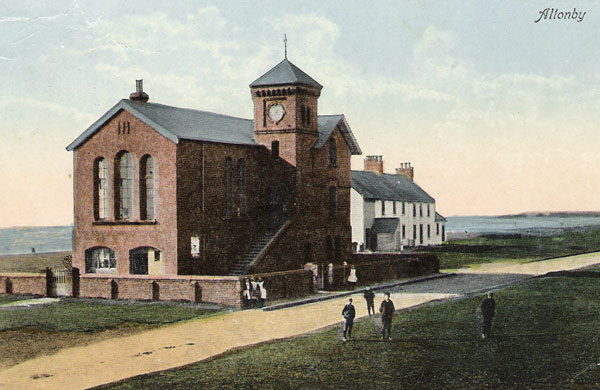
Allonby in the late 1800s (postcard image from 'More Plain People'); Reading Room in the distance

Allonby in the late 1800s (postcard image from ‘More Plain People’); Reading Room in the distance

“Of course there was a reading-room. Where? Where! why, over there. Where was over there? Why, there! Let Mr. Idle carry his eye to that bit of waste ground above high-water mark, where the rank grass and loose stones were most in a litter; and he would see a sort of long, ruinous brick loft, next door to a ruinous brick out-house, which loft had a ladder outside, to get up by. That was the reading-room, and if Mr. Idle didn’t like the idea of a weaver’s shuttle throbbing under a reading-room, that was his look out.” Thus ‘Francis Goodchild’ described Allonby’s reading room to his companion ‘Thomas Idle’.

‘Goodchild’ and ‘Idle’ were Charles Dickens and Wilkie Collins, who had found accommodation at Allonby’s Ship Hotel. In September 1857, they were being guided up Carrock Fell, in the Caldbeck Fells to the north-east of Allonby, when Collins hurt his ankle: he “was within one step of the opposite bank, when his foot slipped on a wet stone, his weak ankle gave a twist outwards, a hot, rending, tearing pain ran through it at the same moment, and down [he] fell.”

We know the story and its sequel because they wrote about themselves, as Goodchild and Idle, and their adventures, in The Lazy Tour of the Two Idle Apprentices.

Allonby, postcard, from Peter Ostle's blog

Allonby, postcard, from Peter Ostle’s blog (for details, see below); note foreshore coming right up to the houses

Collins was taken, via Wigton, to an unnamed village, where he was treated by a doctor. After a day or two of rest, and boredom, ‘Goodchild’ then “converted Thomas Idle to a scheme he formed, of conveying the said Thomas to the sea-coast, and putting his injured leg under a stream of salt-water. … he immediately referred to the county-map, and ardently discovered that the most delicious piece of sea-coast … was Allonby on the coast of Cumberland. … and at Allonby itself there was every idle luxury (no doubt) that a watering-place could offer to the heart of idle man.”

They set out with great expectations.

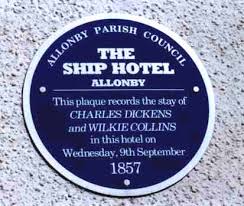
ship hotel plaqueAt Allonby, Collins hauled himself up “a clean little bulk-headed staircase, into a clean little bulk-headed room”, at the Ship Hotel, and lay in enforced idleness for three days while the inflammation in his ankle decreased. Dickens, meanwhile, was required to explore and describe the village to his sessile companion: perhaps he wasn’t a shore-walker, for he doesn’t mention the shore.

He was very rude about Allonby.
“It was… what you might call a primitive place. Large? No, it was not large. Who ever expected it would be large? Shape? What a question to ask! No shape. What sort of a street? Why, no street. Shops? Yes, of course (quite indignant). How many? Who ever went into a place to count the shops? Ever so many. Six? Perhaps.”

“And was there a reading-room?” Idle/Collins asks …

It’s mentioned in a verse of the poem, Allonby, 60 years ago, recited by Allonby’s ‘cobbler poet’ J.J.Heskett, in 1901 (so relating to the 1840s):
Where now we have the Reading Room/ Th’ old weaving factory stood,/There busy men, with fourteen looms,/for many mouths earn’d food.

A reading room had indeed been established above the weaving shed, but this was soon to change. Thomas Richardson, a Quaker, banker, and local philanthropist, commissioned the construction of a new building, with considerable financial backing from his cousin Joseph Pease, who was the country’s first Quaker MP.

Pease appointed an architect, and a local builder and joiner, and the tall and substantial red sandstone building, held in trust for the public by five Trustees, was opened on July 28th 1862 – nearly 5 years after the Idle Apprentices’ visit. The building is described in the delightful book, full of precious memories, ‘More Plain People, and places on the Cumbrian Solway Plain’ *:
“The building was raised on vaults, to protect it from high tides, and, originally, these were open, providing an Italian style piazza in which visitors could shelter during inclement weather. Above this was a 16 foot reading room and at the end of this, separated by folding doors, was the library.”

rdg room from Holme website

A postcard, reproduced in ‘More Plain People’ (for details of the book, see below)

Later, the colonnade was enclosed to provide a games room. According to Darren King, the builder involved with the 21st-century renovation and conversion, and quoted in the Times & Star in 2012, “Right up until the 1940s, silent movies were shown on the ground floor of the Reading Rooms. There was a billiard room, and reading room on the top floor with newspapers and books for local people to read.”
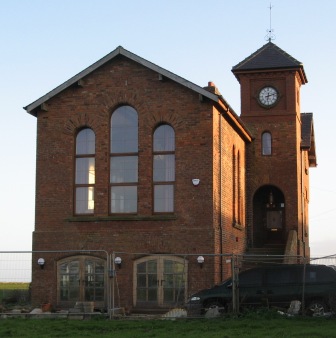
Gradually, though, usage declined. The Trustees sold the building in the 1970s, and for the next 30 years or more, the Reading Room decayed, its disintegration accelerating when the roof collapsed during a storm. It began to resemble Dickens’ “ruinous brick loft”.
Every time I walked or drove through Allonby I was saddened by its decrepitude, its boarded windows and surrounding drifts of wind-blown rubbish.

Then, in 2005, it acquired new owners and eventually, by January 2014, the Times & Star was able to report, in a feature illustrating the interior, that Allonby’s Reading Room had been converted from “a seaside eyesore into a stunning, desirable home”, through a “labour of love” by the owners (and, presumably also, by Darren King).

The Reading Room  a couple of years ago, nearing completion of its conversion

The Reading Room a couple of years ago, nearing completion of its conversion

As for the original architect, appointed by Joseph Pease, he was a Quaker from Manchester –Alfred Waterhouse, who went on to design the rather more magnificent Natural History Museum in South Kensington, London.

Natural History Museum, Cromwell Road entrance

Natural History Museum, Cromwell Road entrance

More Plain People, and places on the Cumbrian Solway Plain, 2007; published by the Holme St Cuthbert History Group. ISBN 978-0-95488-232-7

Peter Ostle’s blog is Solway Past and Present

Posted in Allonby | Tagged , , , , , , | Comments Off on Hobbling through Allonby with an Idle Apprentice

Snippets 2: A chance encounter, as lifeboat ’47-024′ leaves the sea

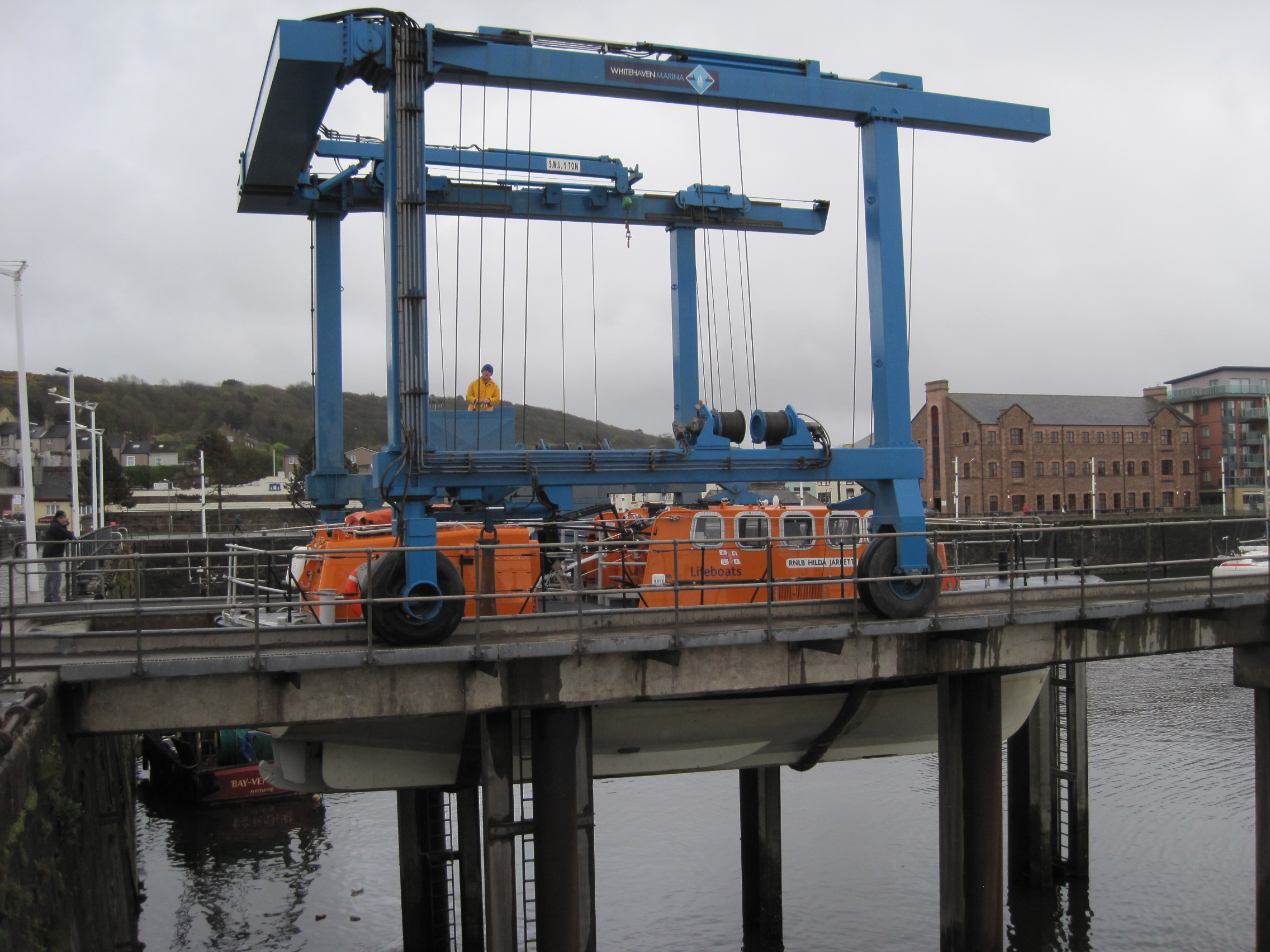
A lifeboat takes to the air

A lifeboat takes to the air

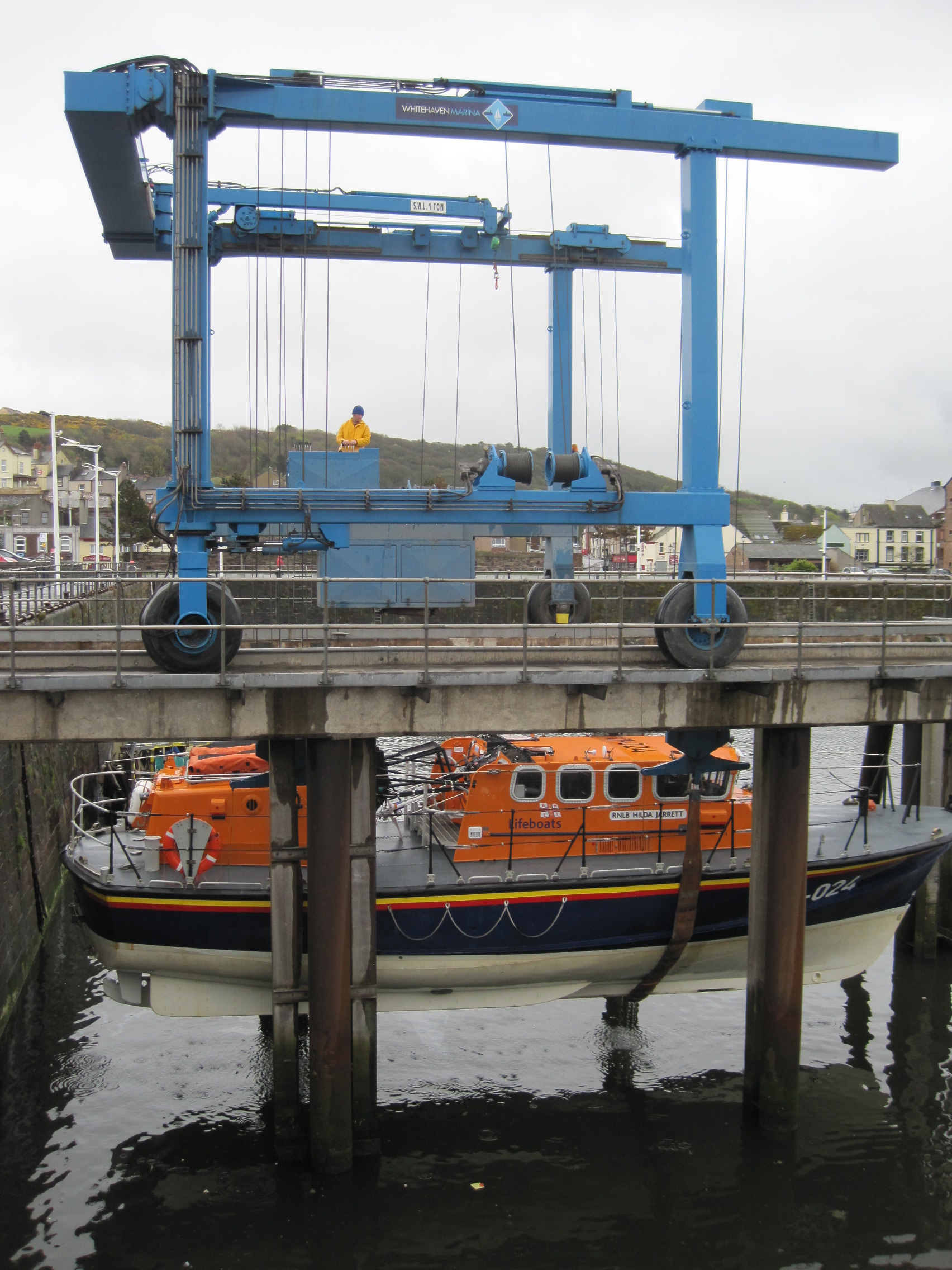
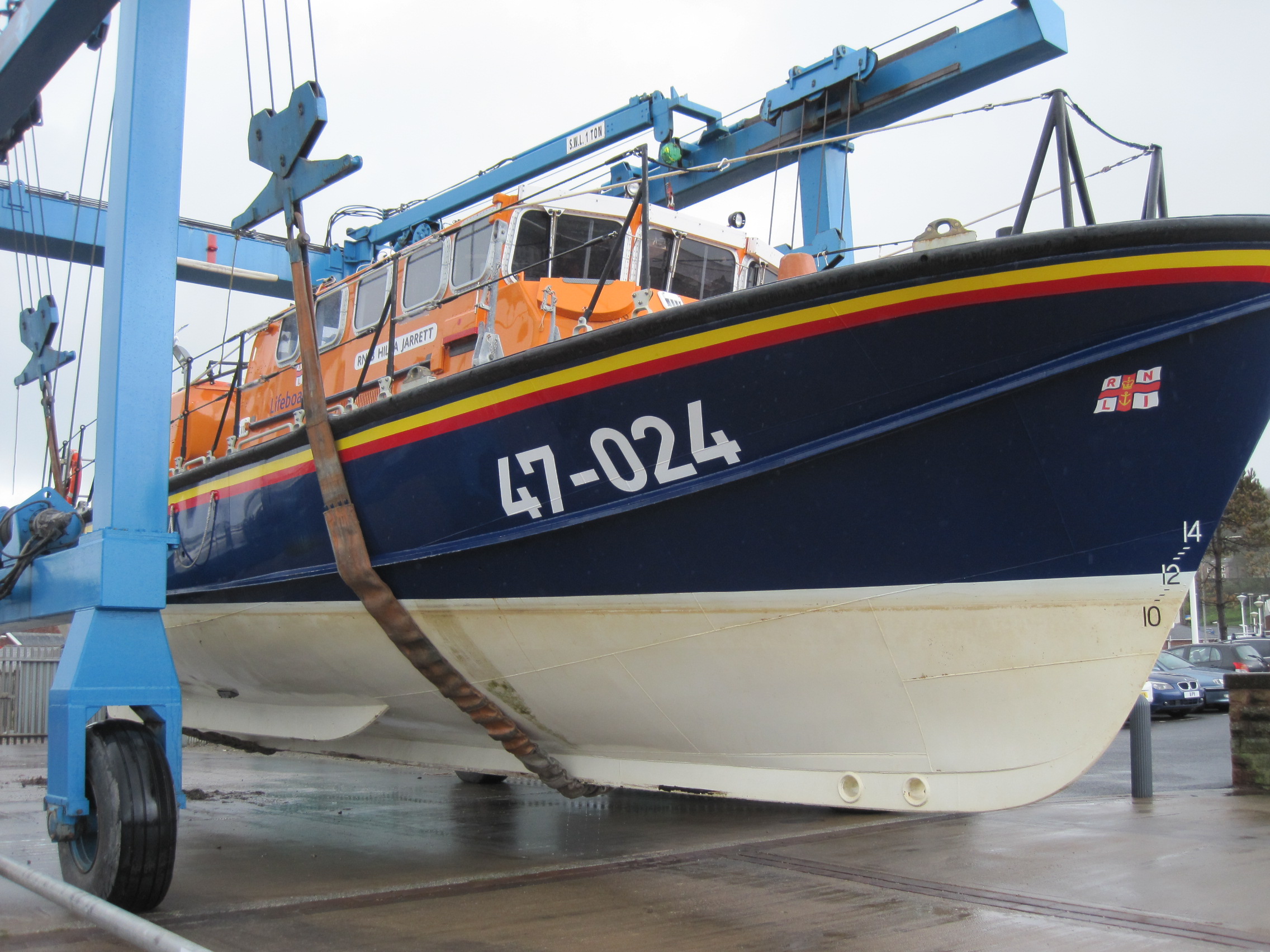
The man with the camera seemed to know a bit about lifeboats. We were standing on the dock at Whitehaven harbour, watching as a lifeboat was hoisted out of the water. I hadn’t known that was due to happen: I’d seen the lifeboat moored down below the harbour wall earlier, and now as I walked back that way it was rising up into view.
I waited behind the barrier. A man in a hi-vis jacket told me it was going to Poole “on the back of a truck, it’ll get there in a day that way!”

IMG_2856The man with the camera came over. “It’s going to Poole” I told him, knowledgeably.
“It’s going to be sold,” he said. And soon Bob McLaughlin, for 11 years the volunteer operations manager at Workington RNLI station, and now Chairman of its Management Committee, was telling me many things about this Tyne class boat. I am very grateful to him for assuming – correctly – that I would want to know.

IMG_2859When the mobile hoist had carried the lifeboat across the dock road to a bay to wait for the lorry, he led me round the boat, showing me the two holes in the keel at bow and stern where ropes could be attached to pull the boat up a slip.
“You see she’s got a white bottom – that shows she’s a general-purpose boat. She can be housed on a cradle, go down a slip, or stay afloat.” Red-bottomed lifeboats are moored afloat all the time.

The Tyne class boats were built to last about 15 years: this one, RNLB Hilda Jarrett, is 24 years old and she will be taken to RNLI’s HQ at Poole to be sold. Previously boats have been sold as far afield as China and Canada. Of the 40 boats in the class, “only six or seven remain, and they’ll all be away in the next 18 months.”
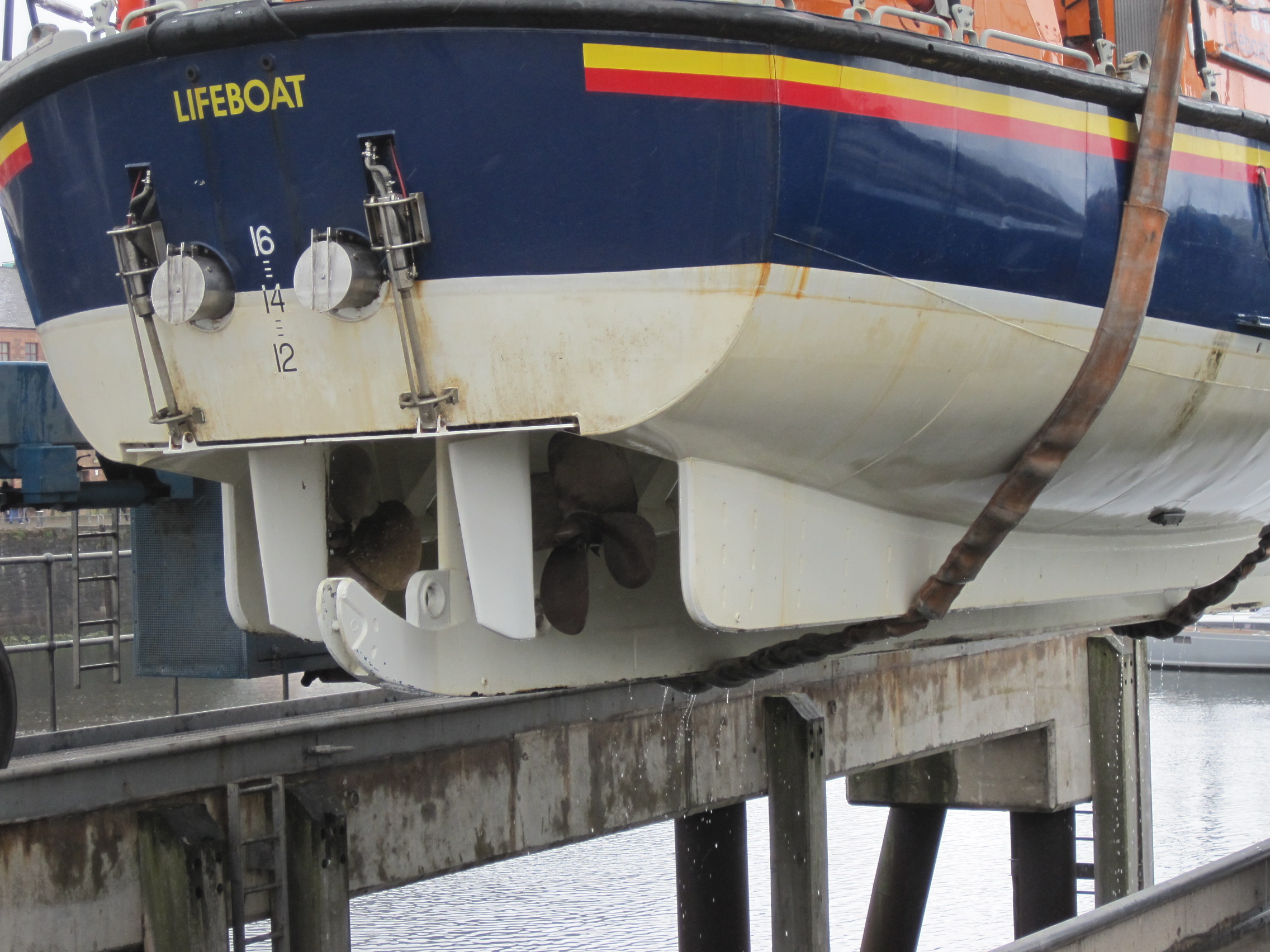
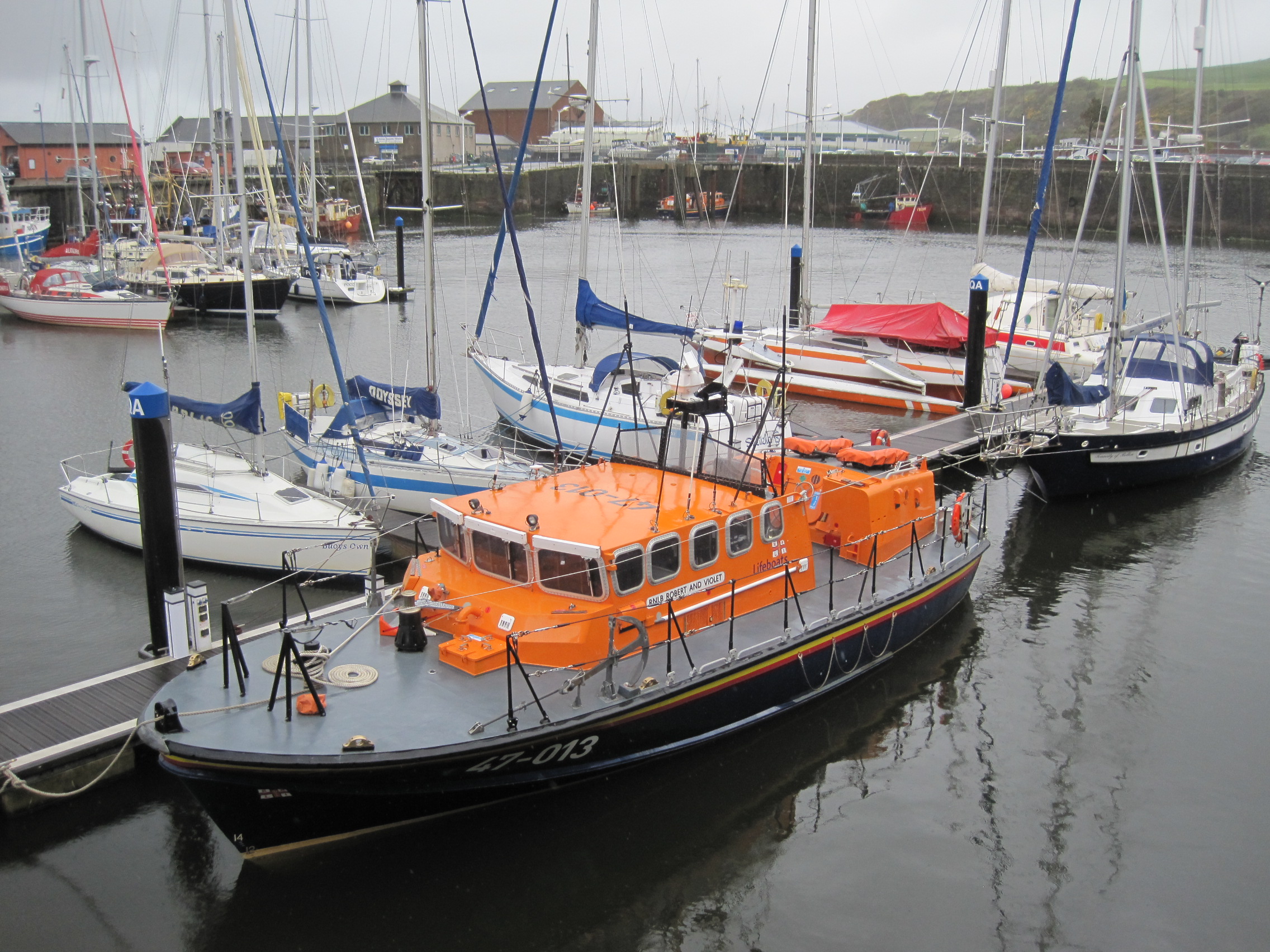
Originally she was kept at Baltimore in Southern Ireland.“Did you see she hasn’t got a name on her stern, it just says ‘Lifeboat’? That’s because she’s been used as a relief boat” – for example as a temporary replacement for a local lifeboat that is being repaired – from  ports as varied as Douglas Isle of Man, Port Patrick, and even the Isle of Barra. A new relief boat,  the RNLB Robert and Violet, had arrived at Whitehaven a couple of days previously.

I commented on the easily-recognised and well-loved livery of dark blue, red and yellow, and Bob laughed. “The RNLI wanted to change the colours but there was an outcry. And you see the number on the bow? 47-024 – that’s the length in feet, and she’s number 24 in her class. They wanted to change the feet to metres …”

IMG_2858

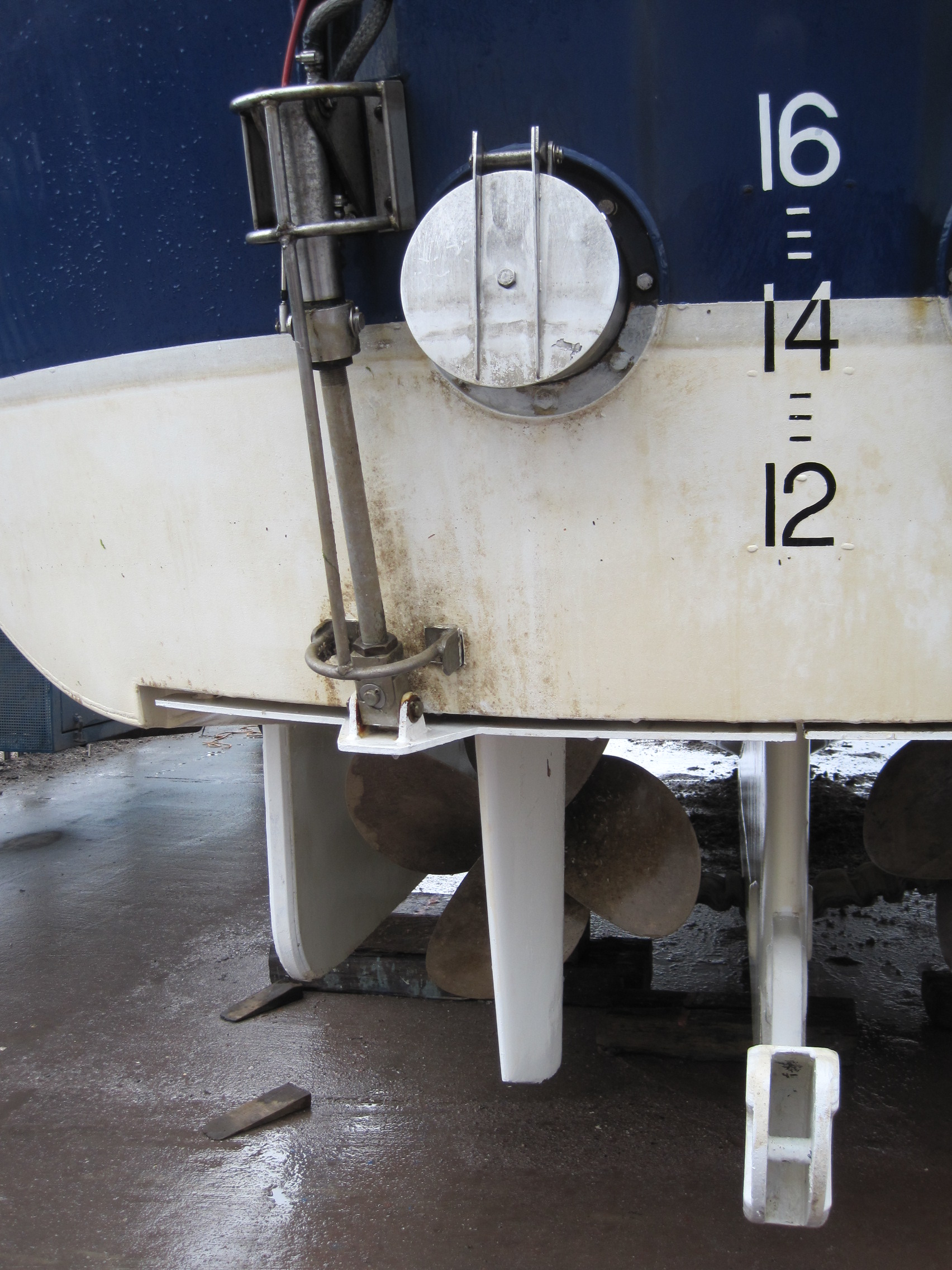
He took me round to the stern and we looked at the propellors (which had a few white limey tubes of the marine worm Serpula on them, but were otherwise clean) and saw how they were protected by the structure of the hull, so as not to get damaged on a slipway. And there were two circular hatches, way underneath, which can be opened to allow for cleaning weed from the propellors. “You can do it from inside, you hang down into the tube – it’s a good way of getting seasick!”
Also at the stern were twin metal flaps covering the exhausts, and two vertical cylindrical structures, which I then saw were attached to flat plates with keels; they would be hydraulically-operated to change the trim of the boat as it gained speed, to prevent its bow lifting too high out of the water.

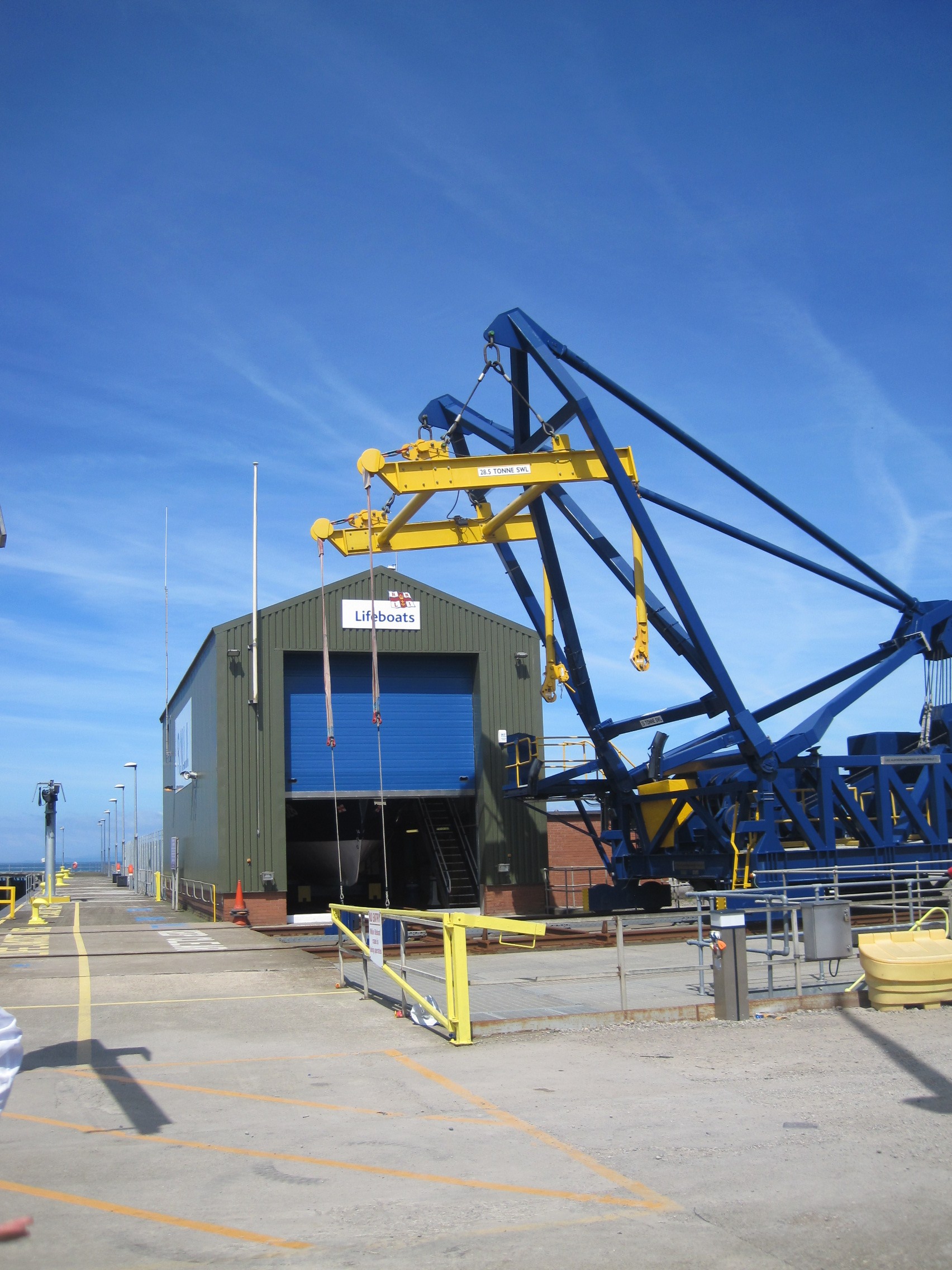
IMG_2860Workington RNLI’s general-purpose lifeboat is another Tyne-class boat, 47-028, the Sir John Fisher; the Facebook page notes that “it is the only davit launched alb [all-weather lifeboat] owned by the RNLI.” I remembered looking into its boat-house when I was at the Port of Workington.

When the Sir John Fisher is de-commissioned, they will receive one of the new, faster Shannon-class boats that have been designed specifically for the RNLI.


The Workington lifeboat crews have always played a very important role, both during the Carlisle and Cockermouth floods and in saving lives at sea. In West Cumbria we are all very aware of the important work they and all the other lifeboat crews do, entirely voluntarily.

The davit for lifting the lifeboat into the sea at the RNLI station, Port of Workington

The davit for lifting the lifeboat into the sea at the RNLI station, Port of Workington

As I write this, lone kayaker Nick Ray is working his way 2015 miles (“2015 in 2015”, and Twitter @LifeAfloat) around the Scottish coast, aiming to visit every Scottish RNLI station in order to raise money for the charity. He started from Kippford, and has enjoyed a couple of Solway sunsets, as well as strong winds and bumpy seas. Let’s hope his only encounters with the RNLI on that long trip are all entirely social affairs!

RNLB 'Robert and Violet', the new relief boat, at Whitehaven

RNLB ‘Robert and Violet’, the new relief boat, at Whitehaven

My thanks again to Robert McLaughin, OBE; and any mistakes in my account of meeting him and number 47-024 are entirely my own. It was a chance encounter, in the rain, for which I had been unprepared – and which made my day!

Posted in ports, RNLI, ships, Snippets | Tagged , , , , | Comments Off on Snippets 2: A chance encounter, as lifeboat ’47-024′ leaves the sea

Hunting for ‘guggies’, and finding ‘canoes’, on the Galloway shore

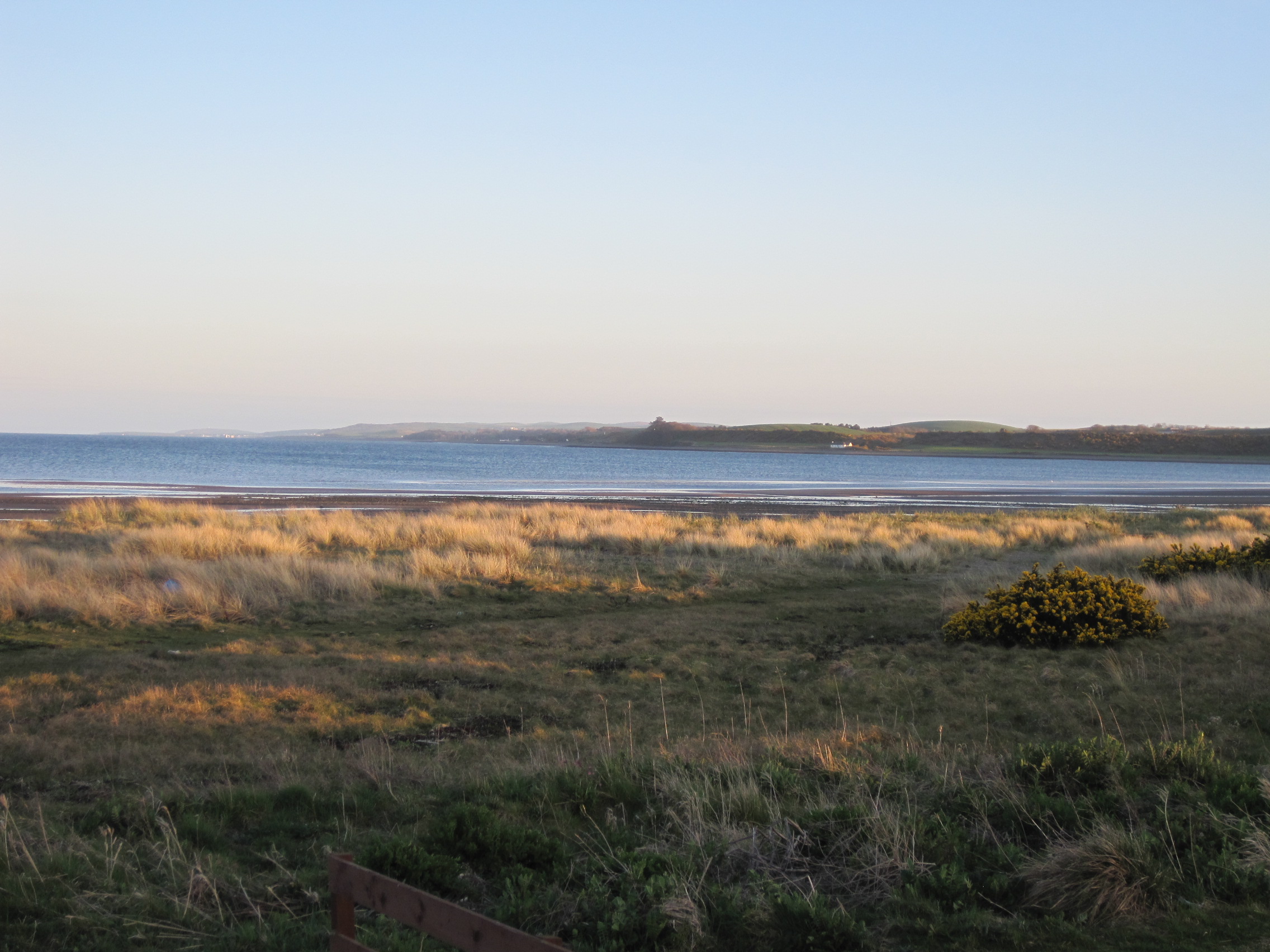
Luce Bay in evening light, looking towards the Mull of Galloway

Luce Bay in evening light, looking towards the Mull of Galloway

We went to the Scottish side of the Solway Firth to hunt for a boring mollusc.
Or, rather more accurately, for the empty shells of a marine snail, Natica monilifera, known variously as the Necklace Shell, the beaded Nerite, or even – according to Victorian naturalist Philip Henry Gosse, as ‘guggy’.

In 1854 Gosse made his second attempt (the first had been foiled by bad weather) to reach Barricane Bay on the Devon coast. In A Naturalist’s Rambles on the Devonshire Coast, he writes that Barricane’s “peculiarity is, that it has a beach entirely composed of shells … From the grassy slope at the top of the cliffs a narrow footpath leads steeply down to an area of what seems to be small pebbles; but which, on examination, prove to be shells, of many kinds. Groups of women from the neighbouring hamlets may always be seen, during the summer months, raking with their fingers among the fragments, for unbroken specimens; collections of which they offer for sale to visitors.”

Many years ago, I too went to Barricane, helping to take a group of Cambridge University students on a marine ecology class, and we too spent much of the afternoon lying and sitting on the shore, ‘raking with our fingers’.

Gosse recounts that “Besides two or three little kinds of whelk, and the common murex and purpura, which are everywhere abundant, and the beautiful little cowry, which cannot be considered rare, there is the elegant wentle-trap (Scalaria communis), the elephant’s tusk or horn-shell (Dentalium entalis), the cylindrical dipper (Bulla cylindracea), called by the local collectors ‘maggot’, and the beaded Nerite (Natica monilifera) a large and beautiful shell, to which the local women had given the euphonious appelation of ‘guggy’.”

We found all of those, and more: I still have most of my collection, of 37 different species, including cowries, Dentalium, Bulla, the beautiful wentletrap Clathrus (Scalaria) and a perfect specimen of the predatory Necklace Shell, Natica.

As I mention elsewhere, Natica bores and dissolves a neat hole through the shell of its bivalve prey – and although we sometimes find bored bivalves such as tellins on our southern shore of the Solway, we have not found Natica. But I knew from Nic Coombey that Natica could be found across the Solway at Luce Bay (sheltered by the Mull of Galloway so, strictly, on the Irish Sea), so we went there for our ‘guggy hunt’.

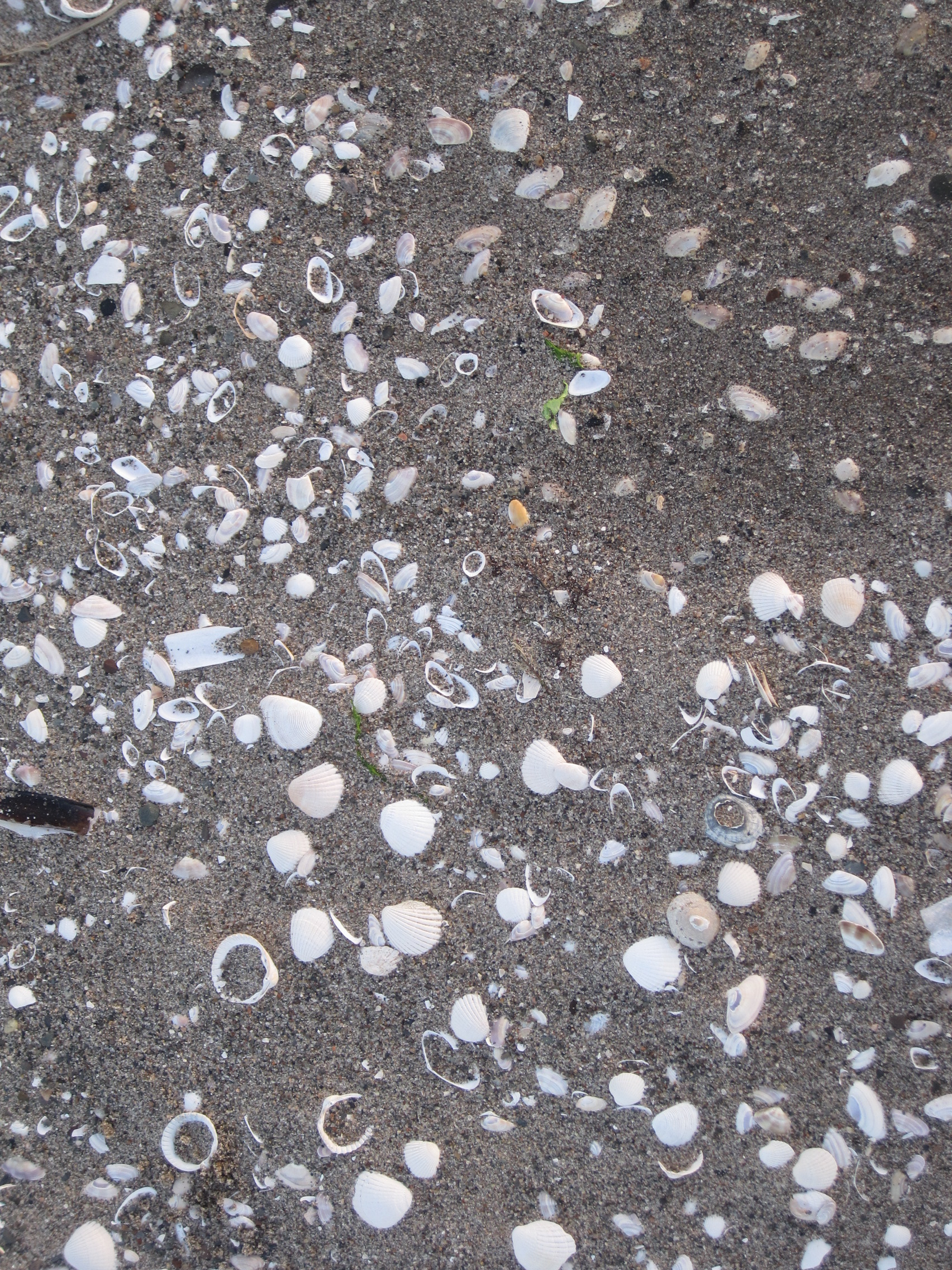
Razor shells, cockles and other bivalves on Luce sands

Razor shells, cockles and other bivalves on Luce sands

The shells on the sandy western stretch of the great bay are well-sorted by shape and size. The first search showed only cockles and razor-shells; then there were cockles and other small bivalves – only a very few of the bivalves showed the bevelled bore-hole characteristic of Natica’s activity. But then I came to an area of a few square metres where Natica shells had been cached by the tide.
They were mostly small and faded – but there they were!

Natica shells, and some of their prey

Natica shells, and some of their prey

Gosse, a consummate shore-walker, collector and teacher, writes with eloquence and enthusiasm about the biology of the species – their mode of predation, the ‘necklace’ or curved gelatinous band of eggs they produce, and their movement – in his Natural History of the Mollusca. (Gosse, too, was the ‘inventor’ of the marine aquarium, which he frequently used to help him observe an animal’s behaviour.) “When put into an aquarium with a sandy bottom, they soon begin to crawl just beneath the surface of the sand, their foot alone being immersed in it … The progress of the creature through the fine, soft sand, is very curious to witness.” Presumably this sub-surface ploughing enables the snail to find its buried bivalve prey and set to work drilling with the radula on its proboscis, “its augur or spiniferous tongue”.

It might seem ridiculous to be happy about finding a few empty shells – but I really was!

‘Canoes’

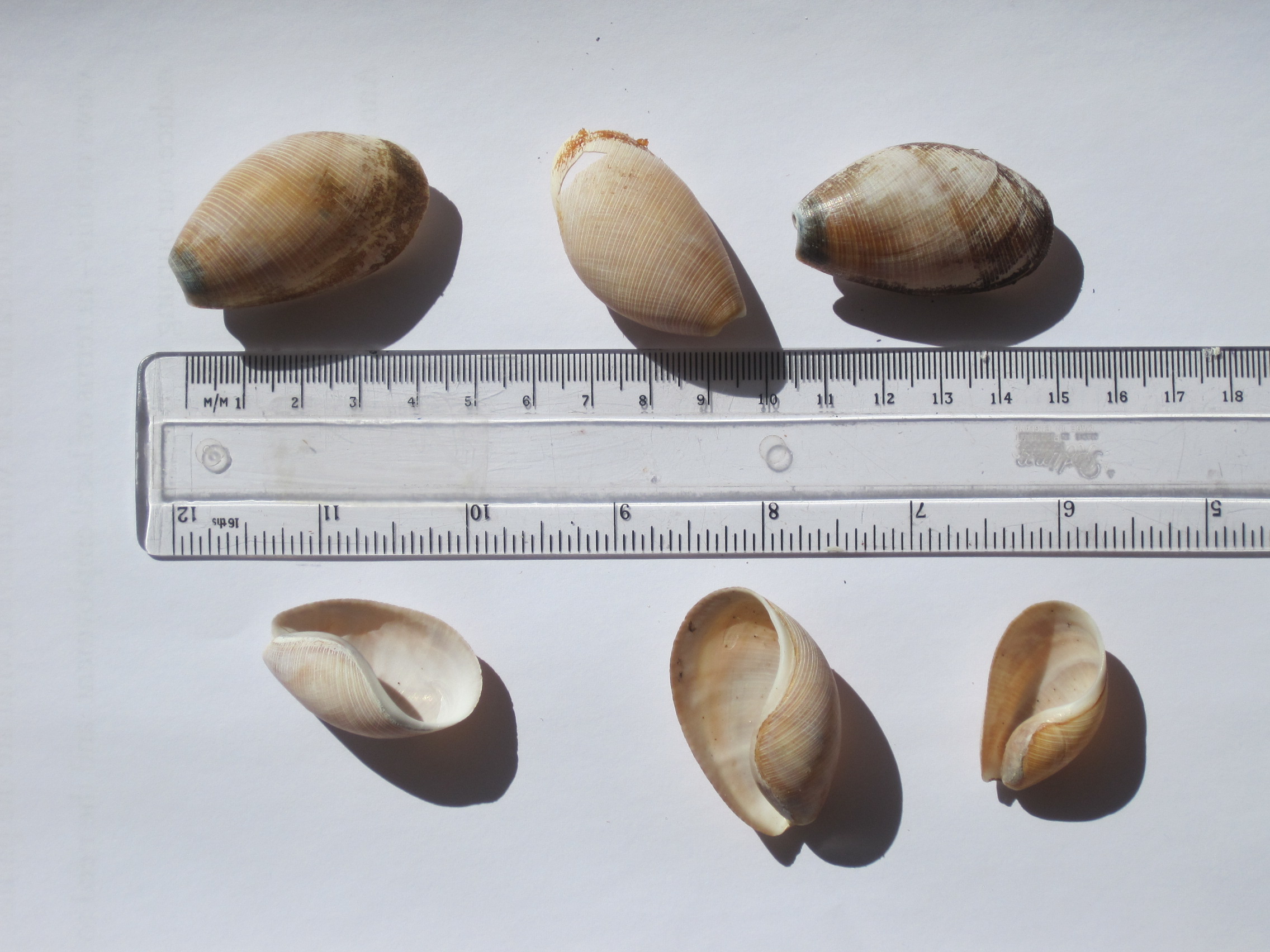
Then, a surprise find made me even happier. At first I thought this large shell must be foreign, discarded from someone’s collection. But then I found more specimens: they looked like very large versions of the Bubble Shell, Bulla, that we had found at Barricane.

Scaphander shells

Scaphander shells

My copy of Nora McMillan’s British Shells (bought in 1975) refers to it as Tricla, but that name is no longer recognised: the animal is Scaphander lignarius, the Canoe Shell.
It isn’t often found, but interestingly a Google search turned up a blog by Valerie Harrison who lives on the Rhinns of Mull in Galloway, and has found Scaphander shells in Luce Bay on two occasions, the last in September 2012.

Scaphander isn’t a borer but it’s highly predatory. Paul Chambers, in his book British Seashells: A Guide for Collectors and Beachcombers, writes that the animal “has astounded scientists with its display of gluttony on the sea-shore” and Gosse, in Natural History of the Mollusca, says “they are very voracious and sometimes swallow bivalves so large as quite to distort their own form”!

I collected a few more shells, in the soft light and long shadows of a late-April evening. The wind was bitterly cold (it would snow the next day) – but it had been a very good evening on the shore.

Posted in shells, tidelines | Tagged , , , , , , | Comments Off on Hunting for ‘guggies’, and finding ‘canoes’, on the Galloway shore

The naming of stones

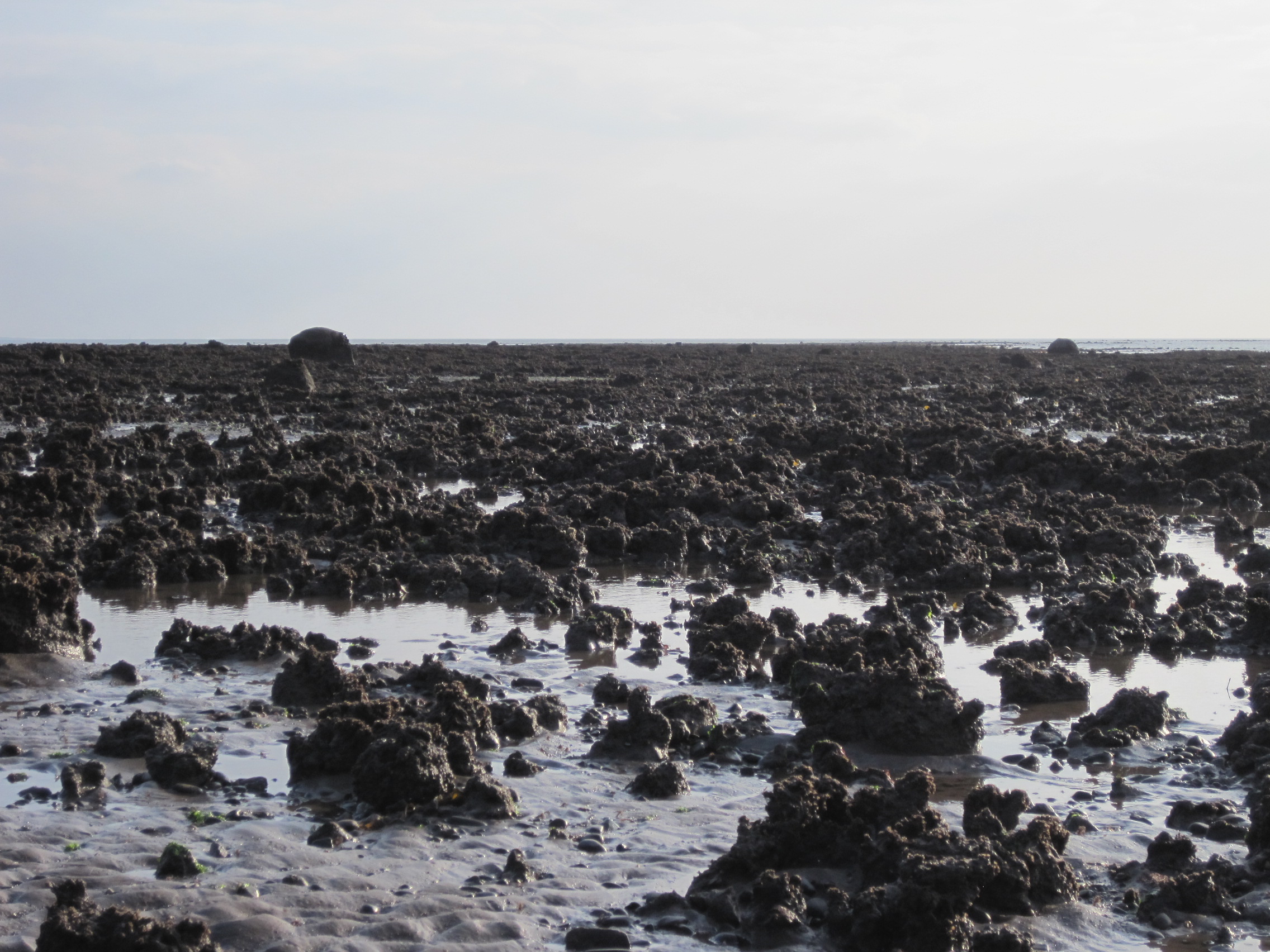
From Mtta Scar, with Sabellaria 'sculptures', Allonby and distant Skiddaw (photo: Ann Lingard)

From Matta Scar, with Sabellaria ‘sculptures’, Allonby and distant Skiddaw (photo: Ann Lingard)

Nellie and Pintle, High Netherma and Maston; Metalstones, Archie and Popple scaurs. “The names go back a terrible long time,” Ronnie Porter tells me. They’re part of the oral tradition of the shore, and neither Ronnie nor his wife know how they should be written.

There’s been a long tradition of fishing for fish and shellfish from the Allonby shore, with fixed nets, fixed and baited lines, fixed lobster-pots, or with hand-held nets or rods or rakes. Ronnie has done most of these, having helped his father and grandfather in the days when the herring shoaled and spawned in the bay, and he is one of the very few people remaining who know the names of the rocky outcrops and big boulders that line the lower shore of Allonby Bay.

Now a spry 78-year-old, he walks on the shore most days and only gave up shrimping with his heavy 6-foot ‘shoe net’ last year.“But it wouldn’t be any good now anyway. I used to go down below Popple, but the sand has gone, it’s all gravel. You can’t use a net there. But it could all change in the next tide, any road.”

From the upstairs windows of his house just above the beach he sees how the profiles of the sands and rocky outcrops continually change, by the day, the week, the season and throughout the years.

“In the ‘50s, the sea came right up to the front wall of this house, there wasn’t a bank,” he told me. “You could see right onto the shore.” (For a picture of the proximity of the sea to the houses, see the ‘Hobbling through Allonby‘ post.) Then in the 1960s, the council built sea-defences of sandstone blocks and banks between the village and the shore. “There were grazing rights on the banks. The council put up a fence – grass grew, marram grew and caught the sand.” Now he has to go upstairs to see the sea.

Despite the defences, in 1966 “the big tide came in the house. Me mam lived two doors along – they put boards at the windows, and they had sandbags at the doors. They were sitting upstairs watching the waves along the window bottom. But the water came in the house, it came round the back!”

These “big tides” and the storms shift the sand, revealing and hiding the scaurs; sometimes the big boulders are exposed to their bases, at other times only their tops may show. Now, below the village, it’s obvious, as Ronnie says, that “the sand has gone off the shore, there are lots of extra scaurs. The gravel bank is moving north-west, and there’s a hollow behind it.” Not long ago he found a line of clay fishing-weights lying amongst newly-exposed gravel.

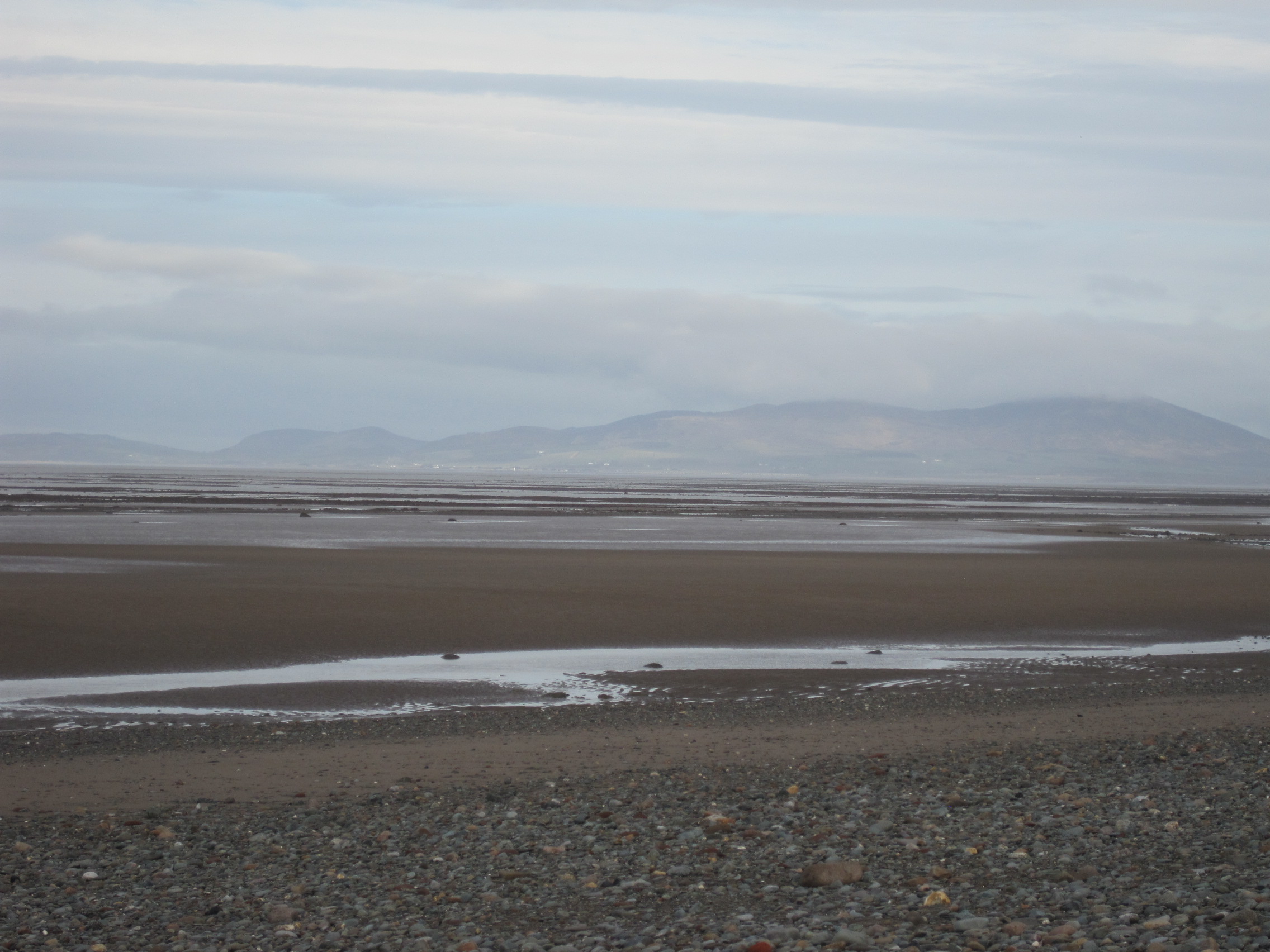
We had planned a month ago to walk along the shore at low tide, but a Low Pressure area and a fierce strong wind had kept the tide high on the shore and only the very top of High Netherma was peeping out. But last week the low-tide conditions were perfect for an evening walk, with calm water and long soft shadows picking out the relief.

A confusion of rocky scars

A confusion of rocky scars

The rocks seem to shape-shift and change in size depending on where you walk or stand: looking from the dunes or the road, you think you understand their topography. From a hollow on the shore, the scaurs merge confusingly, only to reappear as individuals when you climb onto one of the domes of sand that have formed stationary waves along the shore.

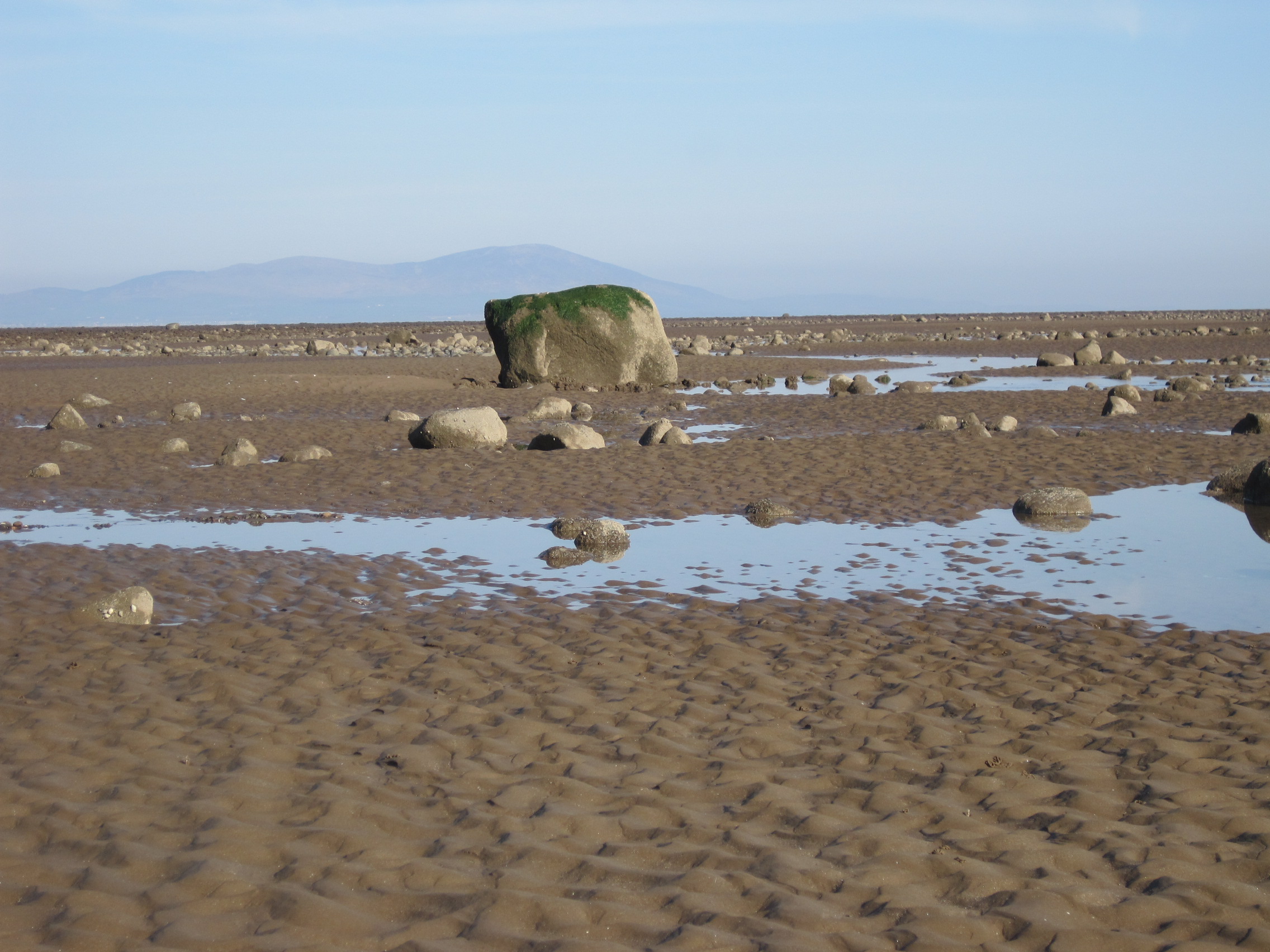
Yet there are obvious markers such as the huge square Maston, down below the end of the Edderstone Road and inshore from the scaur called Archie; and Hanging Stone at the edge of Dubmill Scaur.
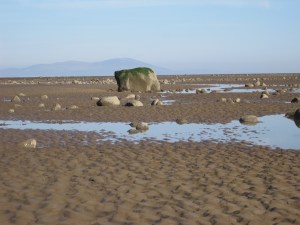
Maston rock

Maston rock (Photo: Ann Lingard)

I stand still and look back towards the village, to the southern end of East Sands, down towards Crosscanonby and the Milefortlet on its little hill, and I repeat the names out loud, trying to fix them in my mind.

Anchor Scaur.

Popple – below the village, and of which more has been exposed this year.

The two boulders, High and Low Netherma (because they’re visible at high and low water).

Then the scaur called Metalstones.

“What’s next? Is that Archie?”

Looking South from Metalstones to Popple and Anchor Scars

Looking South from Metalstones to Popple and Anchor Scars (Photo: Ann Lingard)

“No, that’s Matta.” It’s slightly higher than Metalstones, the reefs forms ridges.

And now we are on Archie, the biggest, and there are two large boulders, Nellie and Pintle. At least, Ronnie thinks they are Nellie and Pintle, but then as he looks North towards Dubmill, he’s not so sure. “I’m not sure any more,” he says. “Maybe that’s Nellie up there.”
We clamber across the “coral”, and reach the far edge of Archie, by the broad swathe of firm and rippled sand. Stretching way out into the Firth are two long lines of rock, Hill (“it’s difficult to get to, and you don’t have much time there”) and Far Hill.

On Archie Scar with Nellie and Pintle (perhaps)

On Archie Scar with Nellie and Pintle (perhaps)

But we can cross the sand to the The Squash at the edge of Dubmill Scar, and on the way I pat the great Hanging Stone, which I myself so often use as a marker for my ‘Dubmill shorewalk’. This year it stands proud and fully-exposed, its top scarfed in green weed.

Ronnie by Hanging Stone with Coving Stone in the far distance

Ronnie by Hanging Stone with Coving Stone in the far distance (Photo: Ann Lingard)

There are many shallow pools in The Squash, in which brown fronds of oarweed are growing. “This’ll be good for prawns,” Ronnie tells me. “They hide under the weed. I’ll have to come back here!”
We stand still for a while to enjoy the peace and soft light of the evening, listening to a curlew and oystercatchers; watching a heron wade into a pool up to its chest then pose, motionless, neck curved.

Further North beyond Dubmill are The Shotts, Number 1 and Number 2; and Crinla Lake and the Coving Stone, with Whitestone Gate (marked by a whitish boulder); and Point of Tail scaur which goes out into the Firth from Crinla.
Some people also call The Shotts ‘The Roads’: “They’re like straight roads going out. The old tale is that they were done by the Romans. The ‘coral’ was cleared, the stones cleared. They’d throw the big stones out to the sides. But you’d hardly see them now, the stones have got pushed about and overgrown.” I wondered if the reason for the ‘roads’ had been to make safe passage for boats to come up the shore, but Ronnie thought they were for catching fish. “ You’d put fishing lines across – the cod would swim up and get caught.”

I asked him about the rows and triangle of stones off Mawbray, but he didn’t know what they were for: “There’s all kinds of funny shapes.” (There’s a more recent blogpost about the fishtraps here.)

The ship's keel

The ship’s keel (Photo: Ann LIngard)

On the way back to the village Ronnie shows me the keel of an ancient shipwreck on Ship’s-Keel Scaur. Encrusted with marine life, it is scarred by the sharp-edged, wide cuts of hack-saws as people have attempted to extract copper nails. What’s the story of the wreck? No-one seems to know, it’s part of the oral history of the shore that has been forgotten. (For a more recent blogpost about the ‘ship’s keel’, see here.)
Posted in Allonby, fishing, stones | Tagged , , , , | Comments Off on The naming of stones

Coal reserves: the ‘profound contradiction’

Today in the Guardian, editor Alan Rusbridger explains why his paper will concentrate on climate change for the next few weeks: he regrets “that we had not done justice to this huge, overshadowing, overwhelming issue of how climate change will probably, within the lifetime of our children, cause untold havoc and stress to our species. So, in the time left to me as editor, I thought I would try to harness the Guardian’s best resources to describe what is happening …”
There are two most important things we need to discuss, he says, one of which is … “how we can prevent the states and corporations which own the planet’s remaining reserves of coal, gas and oil from ever being allowed to dig most of it up. We need to keep them in the ground.”

Keep them in the ground”: whether onshore or under the sea.

In the past month, news has come in that a second company – Cluff Natural Resources – has announced it has acquired licences to extract coking coal from underneath the Solway, north of the former undersea mines such as Haig Pit. The consultants, Wardell Armstrong International (WAI) have indicated that these Workington and Maryport licences, covering part of the Cumberland Coalfield, have an ‘exploration target’ of 384-640,000,000 tonnes. WAI have used a mass of publicly accessible data on geology, coal quality, mine abandonment and so on, but further drilling and other surveys, and their funding, are still needed; for Cluff, it is still early days.

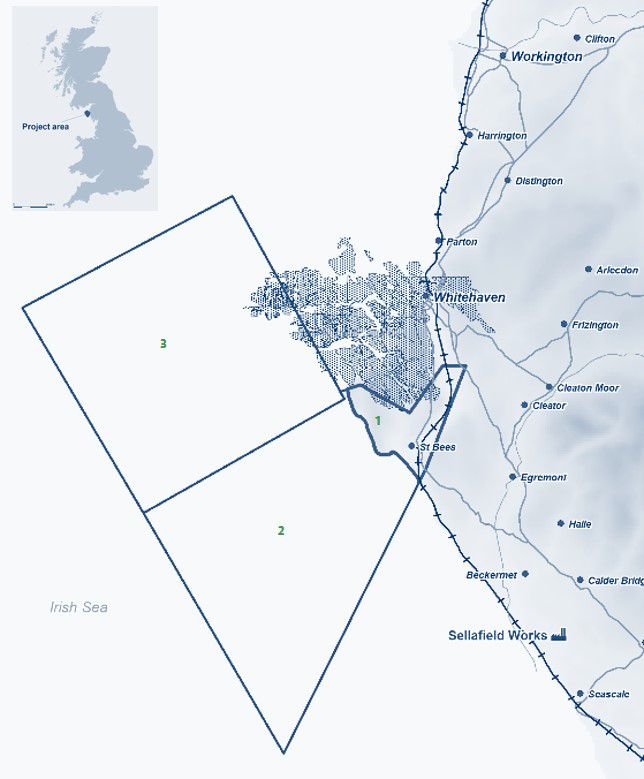
West Cumbria Mining, however, has been busy drilling in the St Bees’ and nearby areas. I’ve written about this previously in this blog, and WCM also provides interesting updates and photos – of drilling rigs and shiny coal-bearing cores – in their community updates and the ‘news’ section of their website. Mark Kirkbride, the CEO, says that “Within the three WCM licence areas it is conservatively estimated that there is around 1 billion tonnes of coking coal. Currently WCM has scoped a mine extracting 2 million tonnes of hard to semi-soft coking coal a year.” The licence areas are just South of the Haig Pit.

West Cumbria Mining, proposed extraction sites

West Cumbria Mining, proposed extraction sites (map from their website)

There are of course advantages to re-opening the Cumbrian Coalfields, Kirkbride says: “The project location has a series of compelling attributes for a new mine, not least of which is the exceptional existing infrastructure nearby. The North West coastal railway line passes through the onshore licence block and connects to the nearby Port of Workington and onwards via the UK rail network to the UK’s three main steelworks. … There is ready power available, an available workforce of both skilled and semi-skilled labour and existing manufacturing and service providers in the local area.”

As for the effect on our landscape: “… West Cumbria is attractive and combines industrial heritage with a unique coastal environment. … Whitehaven and the surrounding area sits outside the Lake District National Park, but nonetheless the environmental impact of the mine is a very significant consideration for WCM, with full environmental impact assessments being undertaken as part of the pre-feasibility study work programme.”

But look at these two quotes:

From Mark Kirkbride, CEO of WCM: “The development of this new mine would appear to fit well in terms of ongoing UK & EU steel consumption, global structural supply issues of hard coking coals and a recovery in coal prices in the medium term.”

And from Algy Cluff, CEO of Cluff International: “The global outlook for metallurgical and coking coal is predicted to remain steady with substantial upside potential on the back of decreasing supply and increased steel demand as the global economy continues to recover.”

“Business as usual”: Sir Nicholas Stern’s “profound contradiction”.

It seems clear that companies like these, even though warned by Mark Carney, Governor of the Bank of England, about a ‘carbon bubble’, are concerned only with profits and not the long-term future of “our species” – humans (either in general or in particular) or of all the other millions of species that inhabit this very special ball of rock in our galaxy.

In West Cumbria, the debates about the various forms of energy along the coast and out on the waters of the Solway Firth, and the effects – on the local environment, on the local economy, on local people – are heated. Certainly Britain’s Energy CoastTM will benefit from the creation of jobs and investment in infrastructure, that can’t be disputed.

So, as Alan Rusbridger says, “Where does this leave you? I hope not feeling impotent and fearful.”

I myself am torn. Leaving aside the effects on the local economy: on the one hand, I love the fact that records and in-depth information about the geology, the topography, the chemistry, the social history, are ‘out there’, and can be used to tell not only the past story of coal-mining in the area but also to help predict the future. It’s fascinating, and I want to know and see more.

But my other hand is more heavily weighted: I, we, the UK, the global economy, must end this dream that we can remove and burn ever more fossil fuel (even if it is for the production of steel – ‘metallurgic coal’ – rather than for power generation). Even if you dispute the indisputable, that this is not causing climate change, we cannot continue ’emptying’ our planet.

So, do we (I) now have the courage to claim the long-term view, forget the personal, and say, “Leave the coal in the ground”?

Posted in coal, sea-bed & undersea, The 'Energy Coast' | Tagged , , , , , , | Comments Off on Coal reserves: the ‘profound contradiction’

Loom-stones or fishing-weights? (And the role of piddocks)

In my post on March 21st 2014 I wrote about an object I had found on the shore near Beckfoot, which one of my shore-walkers told me was a warp-weight or loom-stone; I subsequently saw similar objects used to keep the warp threads taut on a loom in the Dumfries Museum.

Fishing-weights? (photo: Ann LIngard)

Fishing-weights? (photo: Ann LIngard)

But last week, I visited Mr Porter in Allonby who – when he was a lad – had helped his grandfather and father use fixed nets to catch herring from the shore, and has used a hand-net to catch brown shrimp all his life. I’ll write more about the herring and shrimp fisheries later, but during Mr Porter’s wanderings on the shore he has found and collected a large number of red or yellow clay weights that are similar to mine (he gave me the one on the right in the picture; it weighs 65 gms).

He is certain that the ‘stones’ were used to weigh down fishing nets that were – like the herring nets – anchored on the shore; his family’s nets were attached to an anchoring post and the bottom of the net was weighted with a line of lead weights while the top of the net floated free, buoyed up by corks.
Once, after the big tides had uncovered a new scaur on the shore, he found a line of ‘about eight’ of these clay weights amongst the newly exposed rocks and pebbles – and one can easily imagine how they might once have been attached to a rope at the base of something like a gill net.

They could date from Roman times or earlier: the website for the British Museum’s ‘Portable Antiquities Scheme’ has several photos of similar fishing-weights found along the coast from Maryport to Beckfoot, dating from Neolithic through Roman to the Medieval period.

Weights for warp threads or for fishing-nets? If you are going to the trouble of finding and then moulding clay into balls that are perforated by a hole, why use them for just one purpose?

A new use for piddock burrows? (photo: Ann Lingard)

A new use for piddock burrows? (photo: Ann Lingard)

You can find stones like those in the photo on the Allonby shores, too. There are similar stones listed as probable fishing-weights on the BM’s site. Indeed, some could well have been used as fishing-weights, for humans are an adaptable and inventive species. But the holes are not man-made – they have been made by a bivalve mollusc, the Common Piddock, Pholas dactylus. The animal bores its way into a hard substrate, rotating its hard, ridges shells like an auger. As it grows, so it enlarges its burrow – but not its entrance, so it can never leave.

This Piddock species has been found on various stretches of the British coast, where it bores into a wide range of substrata including various soft rocks such as chalk and sandstone, clay, peat and very occasionally in waterlogged wood.’ The  MarLin website also mentions the Solway as part of the Piddock’s range, and I can vouch for that fact as I have found burrows and shell remains in both the peat and some timber of the  submerged forest.

Posted in shells, stones | Tagged , , , , , | Comments Off on Loom-stones or fishing-weights? (And the role of piddocks)

Seeing the sea-bed

‘The ground’s too rough – the shrimp-boats avoid it like the plague, it does too much damage to their nets’, says David Dobson, now retired from the NW-Inshore Fisheries and Conservation Authority at Whitehaven, talking about the sea-bed in Allonby Bay. We’ve been discussing the proposal to make Allonby Bay a Marine Conservation Zone and what effects, if any, it would have on the fisheries. Around Allonby and Beckfoot, on the English side of the water, there are many rocky scaurs stretching out into the Firth – but when we think of the Solway, it’s usually the turbid waters and changing channels and sand-banks that come to mind .

Photo with thanks to E.On (see the Solway Shore Stories' piece about Robin Rigg)

Looking down the column. Photo with thanks to E.On

Before and during the construction of the offshore wind-farm at Robin Rigg, several important surveys looked at the geology of the sea-bed and shore, and the behaviour of the tides. Most of the interesting information that I quote here, about the soft sediments of the sea-bed, is summarised in a 2010 report by COWRIE (ABPmer Ltd et al.(2010) A Further Review of Sediment Monitoring Data  (project reference ScourSed-09). (Can be found at : https://www.researchgate.net/publication/267221965_A_Further_Review_of_Sediment_Monitoring_Data  – apologies but wordpress would not let me embed the link).

For example, “The sandbanks in the Solway Firth have mobile superficial deposits with much denser more compact cores …The seabed material is varied consisting of fine to medium sand and sandy muds”, which overlie sediments formerly scoured out by glaciers and deposited by rivers and tides.
In the region of the wind-farm, the seabed is in fact a series of banks (Dumroof Bank, Robin Rigg, Two Feet Bank and Three Fathoms Bank) orientated in a northeast – southwest direction. Here there are “finer grained granular sediments … ranging from laminated sands, silts and clays to organic silts and clays.” Across the whole of the turbine array area sediments “ generally comprise mobile, shelly fine to medium grained sands”.
There are mega-ripples, too, on Robin Rigg bank – up to to 1m high, with variable orientation and wavelengths between 6m and 20m.”
And so we begin to see a picture of the sandy bed of part of the Firth: the bottom isn’t just plain ‘sand’, it’s a complex mix of sizes and shapes.

Next, when we look at the descriptions of the hydrology, how the water moves around the Firth, we start to see just how easily these sediments could get moved around.

The Solway is an area of high tidal energy and strong currents.

At neap tides, the tidal range (the difference between high and low water) may be as little as 3 metres, but for the largest spring tides, the range can approach 10 metres; the range for mean spring tides is about 8 metres. That’s a lot of water that has to shift in and out of the Firth every 12 hours or so – and the speed for mean spring tides has been “shown to be around 1.9m/s between Dubmill Point and Southerness Point and around 2.4m/s at Annan to Bowness” (COWRIE report).
And “information on near-bed currents at Silloth and Annan indicate … the maximum recorded flood and ebb velocities [are] 2.0m/s and 1.5m/s, respectively (Ove Arup & Partners, 1993), creating greater opportunity for sediment transport during the flood tide and hence sediment transport into the estuary.” (COWRIE report)

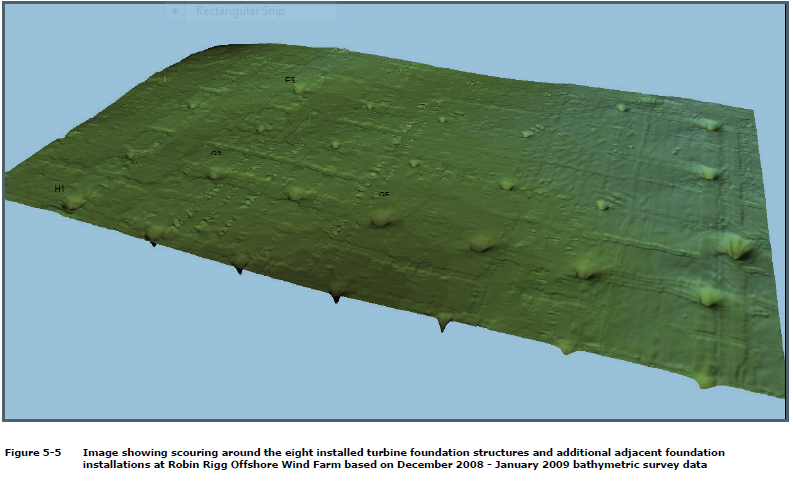
A 3D image of the scour-pits around the bases of the Robin Rigg piles (see COWRIE report for details of the bathymetry)

A 3D image of the scour-pits around the bases of the Robin Rigg piles (see COWRIE report for details of the bathymetry)

Scour-pits (see footnote 1)
You can feel this effect of ‘sediment transport’ on a small scale if you wade out into the sea from a sandy shore – the tide picks up the sand from around your feet (I felt this to alarmingly greater effect when I was haaf-netting, standing up to my chest in the water of the Firth!). If the foot of a wind-turbine is sunk into the sand, the same will happen – ‘scour-pits’ form around the pile.
Engineers and hydrologists carry out a great deal of research and effort into trying to ameliorate this potentially awkward situation, and now we know not only about the composition of the sea-bed around Robin Rigg, but also about the effect of tidal currents on the sand, through a couple of bathymetric surveys that have used sonar to construct profiles, and fascinating 3D images that help us easily visualise the sea-floor.
The tides in and out of the Firth travel mainly east-west, and there seems to be a ‘residual current’ at the sea-bed that travels east. Data show, for example that “At [turbine] position G3, there has been back-filling of the scour hole immediately adjacent to the pile location and general scouring downstream of the pile (relative to the dominant tidal flow direction) … there has been a general lowering of the seabed along the principal flow axis passing through the pile location.”(COWRIE report)

But of especial delight to anyone interested in sea-bed fauna, underwater surveys have shown that many of the scour-pits contain concentrations of starfish.

Reefs on the Solway sea-bed
E.On have commissioned a series of surveys of benthic fauna, sea mammals and sea-birds during and after the construction of Robin Rigg; methods and results are summarised in their Marine Environmental Monitoring Plan for the Scottish Government. Dr Jane Lancaster and colleagues at Natural Power have monitored ‘biofouling’ of cables and piles, and the diversity and distribution of benthic fauna (see page 5 of the MEMP report), and have found no adverse effects on marine invertebrates. Through their use of Drop-Down Video cameras (DDV), they found that the abundance of marine life that had colonised the bases of the turbines and substations after only 4 years was impressive.

Starfish and mussels on a Robin Rigg turbine base (from Natural Power's DDV survey)

Starfish and mussels on a Robin Rigg turbine base (from Natural Power’s DDV survey)

The intertidal sections of the foundations were “colonised with typical rocky shore organisms, with an abundance of barnacles as well as occasional limpets and green seaweed, and a dense carpet of edible mussels around the low water mark.”
Below low-water mark, “the mussels continued, providing a rich feeding ground for starfish, as well as green sea urchins which feed on the anemone-like colonial animals [hydroids]that live on the mussel shells. On foundations in shallower waters this mussel-dominated habitat extended down to the sea bed, but on those foundations located in deeper waters the lower sections were crowded by a forest of brightly coloured plumose anemones as well as pink oaten ear [oaten pipe? Tubularia?] hydroids. Mussels and plumose anemones were even seen thriving on the export cable by the substation before it is buried beneath the sand. Throughout the surveys shore crabs and hermit crabs were seen crawling on the foundations and on the sandy seabed beneath them, and fish such as whiting swimming around the foundations.” (quoted from Natural Power’s press release.)

Mussels densely colonising the base of a turbine (from Natural Power's DDV survey)

Mussels densely colonising the base of a turbine (from Natural Power’s DDV survey)

The foundations are acting as artificial reefs, providing marine animals and algae with solid substrata to which to attach and form new micro-habitats in which other animals can live and feed and shelter.

In summary, the researchers note that the fauna are of species found naturally in the Firth, ‘typical of a rocky reef in the Irish Sea with a moderate or strong current’.

Hidden worlds in four dimensions

I’ve written elsewhere in this blog (with reference to Allonby Bay’s designation as a Marine Conservation Zone) about research on people’s perceptions of the sea-bed: that most people have no idea at all what it might look like — with the follow-on that,  if there’s no great feeling as to whether it might be interesting or important, then why bother to protect it?

Now though, these various surveys of the Solway, plus anecdotal evidence from ships’ pilots and shrimpers, show us a fascinating undersea world of ripples and sandbanks, changing channels and hollows, as well as rocky scaurs and reefs. Sub-surface four-dimensional worlds, of animals in place and time; neither static nor lifeless, constantly changing with the seasons and the weather, as the sea washes in and out, around and overhead.

***

(1) Scour-pits: an update October 2016. This month a side-loading hopper barge, the HAM-602, with assistance from the cargo boat Visnes, has been involved in ‘rock-dumping activities for scour protection’ at the bases of turbines B1, B2, A2, C1 and D1.

(2) COWRIE report on sediments https://www.researchgate.net/publication/267221965_A_Further_Review_of_Sediment_Monitoring_Data

Posted in artificial reefs, Marine Conservation Zone, renewable energy, tide & wind, sand, sea-bed & undersea | Tagged , , , , , , , | Comments Off on Seeing the sea-bed

The balance sheet between blue and green

‘A thin blue line’. Of policemen edging a protest march? The blue halo of Earth’s fragile atmosphere as seen from space? No – in this case, a blue line that Robert Alcock painted along a sea-wall in Bilbao in 2011, one metre above high water mark.

He, like me, has spent part of his life guddling amongst the ecosystems of the sea shore: the rhythm of our lives – like those of the marine fauna and flora – ruled each day, week, month, by the changing levels of the sea. (Somebody once asked me whether my shore-walks – to the lower shore – were always at 9am. Since then, I have always taken a print-out of the daily highs and lows of the tide on the Solway shore.)

The tides at Silloth: daily highs and lows (from the EasyTide website)

The tides at Silloth: daily highs and lows (from the EasyTide website, http://www.ukho.gov.uk/easytide)

Robert, who describes himself as a “faint-hearted activist”, writes about the blue line, his “small act of civil disobedience” in a post on the Dark Mountain website, and I’ll return to the point of his protest shortly.

The form and shape of our coastline is a net result of the balance sheet, the plus and minus, of the relative levels of the sea and the land at any particular time. Those levels were consequences, not causes, the result of the changing interplay between the thick glaciers that weighed down the land-mass, and the effect of the ‘thin blue line’ of the atmosphere on the temperature of the land and sea. When glaciers melted, fresh water caused sea-levels to rise: but the land, freed of the crushing weight of ice, rose too – ‘glacioisostatic rebound’ – and the balance sheet kept shifting between loss and gain.

The effects of these changes in recent geological time are clearly visible on the South shore of the Solway Firth: the so-called ‘25-foot beach’, raised above the shore near Beckfoot, marks one of the periods when the rise in sea level overtook that of the rise of the land. The submerged forest on the mid-shore is a tangible indicator of a time of low sea-level, before the Firth even existed – a mere 8000 or so years ago – when the land was poorly-drained carse, with sparse forests and raised, peaty mires. Now, the peat and the spongey wooden trunks and roots of the forest appear and disappear, revealed or hidden according to the winds and ebb and flow of the tides.

Peast and tree: with grateful thanks to Joan Thirlaway for this photo

Peat and tree. My grateful thanks to Joan Thirlaway for this photo.

As I wrote in my own Dark Mountain guest post, the red sandstone cliffs of St Bees’ and the even older Carboniferous coal-bearing sandstones stretching out beneath the Firth from Whitehaven are evidence of more ancient geological periods, of rivers and richly-vegetated equatorial land raised above the sea. Although the mines have closed, coal still remains in rich seams, and the possibility has been recently raised that the mines may be worked again to provide “coking coal for industrial use” [my italics – ‘coking coal’ for the production of steel is not the same as ‘thermal coal’ for the production of power].

This brings us back to Robert Alcock’s thin blue line, the one-metre increase in sea-level in Bilbao. Last week the Fifth Assessment report of the International Panel on Climate Change was even clearer than previously about the impact of increased carbon dioxide levels on our climate; an assessment of work by 800 scientists, it clearly states the likelihood, based on statistical probabilities, relating to each topic they have considered. It reiterates that global sea levels are on the rise, due to melting of the polar ice-caps and to expansion of water as its temperature increases.

So what will the rise in sea-level mean for those of us living along the Solway or Bilbao shores? According to the IPCC,“Rates of sea-level rise over broad regions can be several times larger or smaller than the global mean sea-level rise for periods of several decades, due to fluctuations in ocean circulation. Since 1993, the regional rates for the Western Pacific are up to three times larger than the global mean, while those for much of the Eastern Pacific are near zero or negative.” An excellent discussion about the global distribution of sea-level changes, with accompanying maps, can be found on the RealClimate website (‘climate science from climate scientists’).

Storm surge at Allonby January 2014 (photo: Ann Lingard)

Storm surge at Allonby January 2014 (photo: Ann Lingard)

The land mass of South-West Scotland – and the Solway area – is still rising, at an estimated 1mm a year (1). But the highs and lows of the diurnal tides, now and at any time, are affected by the wind and barometric pressure, and last winter’s storm surge on the Solway made dramatic inroads along the coast; such extremes of weather are predicted to become more frequent.

I can tell you’re yawning. “Yes, yes, we’ve heard it all before … We’ve switched to energy-saving light-bulbs, we try not to use the car … But our efforts are a drop in the ocean, it’s governments who need to sort it out.”

So what shall we do to attract attention to the fact that time is running out? Paint a blue line along the wall of the Palace of Westminster’s terrace above the Thames, where MPs entertain their guests?
Protest outside the doors of the UK’s power-generating companies? Sorry, the owners aren’t here. You’ll have to cross the sea to find them – to Bilbao for Iberdrola, to France for EDF, and Germany for RWE and E.On (2) … Just as CO2 emissions are global, so too is the generation of power.

(1) Land of Mountain and Flood, the geology and landforms of Scotland. A McKirdy, J.Gordon & R. Crofts. Birlinn 2009. Page 208
(2). Private Island; why Britain now belongs to someone else. James Meek. Verso 2014

Posted in coal, The 'Energy Coast', tidelines | Tagged , , , | Comments Off on The balance sheet between blue and green

Snippets 1: A different perspective – the film-maker’s view

A gyrocopter view of Rockcliffe Marsh (my thanks to Simon Ledingham for this image from his Geograph site.)

A gyrocopter view of Rockcliffe Marsh (my thanks to Simon Ledingham for this image from his Geograph site.)

My Solway Shore Stories deal mainly – but not excusively – with the southern side of the Solway Firth, and several of them are illustrated with aerial photos taken by Simon Ledingham from his gyrocopter.

It’s a pleasure, then, to see the recent films commissioned by the Solway Firth Partnership  through their Making the Most of the Coast project, “to promote the variety and beauty of the Dumfries and Galloway Coast”. The SFP, which is based in Dumfries on the northern, Scottish, side of the Firth deals with cross-border matters to do with the sea and its coast – for example, fisheries and conservation – and runs the excellent (and free to everyone) annual conference about matters relating to the Firth. The next conference is in Carlisle on November 14th, and information about the conference and programme can be found here.

The film maker was Colin Tennant, and he explains that the project “project used state-of-the-art ‘quad copter’ technology to capture stunning aerial video footage of the beaches and coastline of Dumfries & Galloway, providing a unique view of the region”.

All the films are on the SFP’s YouTube channel, and The Solway from the Sky film is especially good in giving you an idea of some of the coastline on the North side of the Firth.

A rather different perspective – from rail-track level – of the flat and industrial part of the coast from Workington to Maryport can be seen from the cab of a train (you might want to skip to about 4’30” into the video, unless you’re a train-spotter): the last train to run the special ‘Floodex’ service from the North side of Workington in the aftermath of the 2009 flood which washed away the bridge over the River Derwent. It’s all very different from the images of the Upper Solway!

Posted in Snippets | Tagged , , , , | Comments Off on Snippets 1: A different perspective – the film-maker’s view

‘Trains and boats and … cranes’: the Port of Workington

Once upon a time you could – it was said – walk from one side of the Prince of Wales dock to the other across the decks of ships, and the Port of Workington employed 150 people. Now, there are about 250 cargo ships a year and about 20 full-time workers.

View from the dock gates

View from the dock gates

Once upon a time, not so very long ago, West Cumbria was a hubbub of industrial activity – coal-mines, iron foundries, and chemicals – but all this has gone, and so have the ships carrying the related products.

So it is important that the Port is being reinvented as a ‘multi-modal logistics hub‘: there is the railway, the road, and of course, the sea, and goods can be transported via the Port using any combination of the three.

Road and rail

Road and rail

Now, instead of the two Nelcon cranes lifting the 36-metre railway lines from Corus onto waiting ships, they find new uses in ‘hooking and grabbing’ heavy goods. Now, the grey, rust-stained tanks that once stored phosphoric acid for Albright & Wilson, are used by Cumbrian Storage for recycling of domestic oils: road tankers collect domestic waste oil, which is piped into the storage tanks, then offloaded into ships to be taken to Denmark or Germany.

There is a to-ing and fro-ing, materials entering, and waiting, and leaving.

ledingham geograph kirkby thore gypsum

Kirkby Thore gypsum plant, photographed from the air by Simon Ledingham (from his Geograph collection, http://s0.geograph.org.uk/photos/07/33/073344_2c703e0f.jpg

The grey mountain of gypsum that glitters on the dockside came in by sea, and will be scooped onto road vehicles and delivered to British Gypsum at Kirkby Thore to be used in plaster-board manufacture.

In Thomas Armstrong’s shed, a single man controls the distribution of cement from ship to road-wagon: cement is blown from ship to shed, and shed to wagon, through a pipe.

Waiting tree-trunks

Waiting tree-trunks

Behind the shed, a pile of tree-trunks shipped in from the Western Isles waits to be reduced to chippings by a growling machine near the Port’s gate, then carried by road to Iggesund at Flimby.

Iggesund also imports wood pulp for its board-making process. Eucalyptus pulp comes directly from Spain, and from Chile via Flushing in the Netherlands. Iggesund’s share is brought into Workington about once a month, in a small, 3000-tonne, coaster.

A Nelcon crane, with the Liebherr crane and the gypsum pile across the dock

From left to right: SRF bales, a Nelcon crane, and the Liebherr crane and the gypsum pile across the dock

A long, high ‘bund’ of cylindrical objects, identically wrapped in pale green plastic – as familiar in appearance as silage bales – almost hides the Harbour-Master’s office from the dock: SRF, Solid Recovered Fuel, the dried and treated product of household waste after recyclates have been removed. There’s an over-supply, so the SRF is brought in by rail from the Mechanical Biological Treatment centre and shipped to Latvia as an alternative fuel.

But the sea is not involved with Iggesund’s calcium carbonate; the Port acts only as a marshalling yard, the calcium carbonate coming in by rail and being transferred to slurry tanks on the dock, then loaded onto road-wagons.

Complex manufactured and engineered objects are dealt with too. The huge new Liebherr crane near the dock-gates can do one-off heavy lifts of ‘project cargo’, such as equipment for E.On’s Robin Rigg windfarm or the nuclear industry. Parts for Sellafield’s Evaporator D were brought in modular form and sent down the coast by sea.

The Liebherr is also waiting for the Port’s transformation into a container traffic hub, when it will come into its own as a ‘lo-lo’ (load on, load off) crane, loading and discharging containers between ships and dockside, and wagons for both road and rail. That will make Workington the only container port between Liverpool and the Clyde, and it will once again have an important place in the scheme of sea-borne goods.

NOTE: (added October 2020). The 2 iconic Nelcon cranes were sold earler in 2020 and removed on barges.

A hydrographic survey was carried out by drone of the harbour and the R Derwent: the video is on YouTube.

Posted in ports, The 'Energy Coast' | Tagged , , , , , | Comments Off on ‘Trains and boats and … cranes’: the Port of Workington